How a Military Housing Watchdog Games the System
As military families struggle to find affordable and safe housing, a real estate behemoth lines its pockets.

(Illustration: Luna Velez / POGO)
America Lunsford was desperate to get out of military housing. By early 2024, Lunsford and her family had been displaced three times because of mold contamination in their home on Joint Base Lewis-McChord just south of Tacoma, Washington. Their health took a toll. Lunsford developed a lung nodule that her medical record links to mold exposure. She suffered from migraines, insomnia, allergies, anxiety, and severe gastrointestinal issues while in military housing. Her daughter had asthma, sleep apnea, eczema, and digestive disorders. America’s teenage son had an inflamed esophagus. Both kids eventually needed EpiPens due to allergies. Altogether, they visited the emergency room 12 times while living in military housing.
“We were not able to have our home remediated in a way that actually eliminated the mold,” Lunsford, a mother of two and then-wife of an Army staff sergeant, recalled. “I felt like if we did not get out of there, I was either going to have a mental breakdown or a physical one.”
But moving off base wasn’t a simple operation. Rent prices in neighboring communities were too expensive to cover with their housing allowance provided by the military. It’s a problem that military families across the country are dealing with, and one that’s fueled by the interconnected network of profit-seeking real estate conglomerates in both on- and off-base housing markets.
Get the latest
Weekly newsletter and occasional updates
One such company, Jones Lang LaSalle (JLL), has held the keys to the privatized military housing system since its inception. A supposedly neutral third party and Fortune 500 real estate empire with over $26 billion in annual revenue, JLL has maintained influential roles as a military housing watchdog and the Pentagon’s “real estate advisor,” ever since it helped design the military’s housing privatization program decades ago. (Today, 99% of military family housing is owned and operated by private companies.)
Accounts and archival documentation from officials, business executives, experts, and government reports reveal the financial labyrinth through which JLL has been able to profit from multiple sides of a system it continues to oversee: It assists investors aiming to capitalize off of military rents; maintains significant and extensive business ties to the military housing companies it “independently” monitors; and — through its subsidiary — allegedly took part in an AI-enhanced rent-fleecing scheme in areas where military families like the Lunsfords struggle to afford shelter, pushing both on- and off-base rents perpetually higher.
Service members receive a Basic Allowance for Housing (BAH), which aligns with local rental housing and utility costs. Amid the nation’s affordability crisis, BAH rates have spiked to keep apace with rising rents, but it isn’t always enough for military families. Military families typically can choose whether to live on base in privatized military housing or off base in the neighboring community. Because both on-base and off-base housing are paid through BAH, the two markets are interconnected — and both types of landlords tend to benefit when allowances increase.
Jones Lang LaSalle is heavily involved in both the on- and off-base housing markets. In the private sector, JLL has employees in over 80 countries and works in real estate development, property management, investment management, leasing, and capital management across its portfolio of hundreds of subsidiaries. Meanwhile, the Pentagon has awarded the company at least $700 million in contracts for consulting, oversight of privatized military housing, and facilities management roles since 1999. JLL has also occupied an advisory role in the commercial real estate market as a federal contractor to the General Services Administration.
The company has also become a leader in what is known as “proptech.” Short for property technology, proptech is a growing subfield of the real estate industry focused on implementing new technologies like artificial intelligence (AI), algorithmic data analysis, and other digital tools to streamline how real estate is managed and priced.
“There are now technological solutions for almost every aspect of real estate functions,” according to a 2024 research report published on Jones Lang LaSalle’s website, discussing AI as a “Real Estate Revolution.”
The Lunsford family’s struggle to find affordable off-base rental housing may have been, at least in part, fueled by those technological solutions.
In Washington state, where the Lunsfords live, JLL subsidiary LaSalle Investment Management was charged with taking part in a price-fixing conspiracy affecting hundreds of thousands of renters. The April 2025 lawsuit alleges that property management software company RealPage, LaSalle Investment Management, and eight other landlords colluded to inflate rents across the state between 2017 and 2024, violating a range of consumer protection and antitrust laws. (The Washington lawsuit followed the settlement of a 2024 Department of Justice (DOJ) lawsuit against RealPage that did not list JLL as a co-defendant.)
Representatives from Jones Lang LaSalle and its subsidiary LaSalle Investment Management, Inc. have not responded to multiple requests for interviews or written comments in regard to the allegations described in this investigation. RealPage and LaSalle Investment Management responded to the Washington lawsuit in February 2026, and it is set for trial in fall 2027.
The Washington suit isn’t the first such lawsuit the company has faced: Jones Lang LaSalle was also named as a co-defendant with the property management software company Yardi in a 2023 lawsuit over similar allegations of algorithmic price-fixing and antitrust violations. JLL was voluntarily dismissed from the case without prejudice that same year. In June, JLL was named a co-conspirator in a separate antitrust lawsuit alleging rental price-fixing in the commercial real estate market.
RealPage, the company at the center of the Washington lawsuit, sells a property management software designed to help landlords set rental prices using data analytics derived from competing landlords. A 2024 White House Council of Economic Advisers report estimated that rental pricing algorithms like the ones used by RealPage cost renters more than $3.8 billion in 2023 alone. This is largely accomplished through the way it decreases competition in pricing among landlords, according to lawsuits filed against the company.
Two of the largest military housing providers in the country have been investigated by the Department of Justice for fraudulent practices. Neither lost their military housing contracts with the government.
In Washington, JLL’s subsidiary LaSalle Investment Management allegedly used RealPage rental price data to “coordinate” with their peers and fix prices. According to antitrust experts, this is not an anomaly.
“You’ve got the potential for some kind of inter-market coordination through the third party,” said Peter Carstensen of JLL’s role in the housing market in an interview. Carstensen is a former attorney at the antitrust division of the DOJ and is now a professor of law emeritus at the University of Wisconsin-Madison. “That’s the sort of thing that’s going to lead inevitably… to maximizing prices.”
In the late 1990s, Jones Lang LaSalle leveraged its government connections to help land the leading consultant role in the privatization of $15 billion in public military housing assets. According to a 2006 United States Military Academy study, military personnel viewed Jones Lang LaSalle as an indispensable “watchdog looking out for soldiers’ best interests” to represent the military in crafting complex public-private partnerships with other real estate firms.
Twenty years later, that characterization is in question.
A True Third Party?
In the Lunsfords’ home state, rent prices keep rising because of anti-competitive behavior by companies like the JLL subsidiary, according to the Washington lawsuit. “In the Seattle-Tacoma-Bellevue area, 49% of renters spend more than a third of their income on rent,” the lawsuit reads.
For the Lunsfords, anything within 45 minutes of Joint Base Lewis-McChord (where America Lunsford’s then-husband was stationed) was too expensive. They ended up buying a house an hour away, despite the profound inconvenience and lengthy commute it entailed.
“It was not a move of desire or convenience,” Lunsford said, explaining how difficult it was to travel for medical appointments in Seattle with only one family vehicle.
For years, military families like the Lunsfords have been raising alarms about serious problems in on-base housing that range from toxic mold to severe pest infestations, and they have alerted lawmakers and military leaders of the significant health and safety implications of these poor conditions. Two of the largest military housing providers in the country have also been investigated by the Department of Justice for fraudulent practices related to housing maintenance; one company pled guilty while another paid a $500,000 settlement for similar allegations of maintenance fraud with no admission of guilt. Neither company lost their military housing contracts with the government.
Congress attempted to address the crisis in the 2020 National Defense Authorization Act, mandating independent inspections and establishing a Tenant Bill of Rights for military families. But watchdog reports from the Government Accountability Office and the Department of Defense inspector general’s office later found the reforms had been hollowed out by inconsistent standards and inadequate oversight. As part of those reforms, Congress mandated service-wide inspections of military family housing by a third-party independent inspector — specifying that this meant the inspector may not be in a fiduciary relationship with the entity that owns or manages military housing.
JLL got the job. Along with partner RER Solutions, JLL was awarded contracts worth nearly $80 million. In multiple announcements for the oversight effort, the Army claimed JLL had no affiliation with the private military housing companies it was inspecting. That claim is difficult to reconcile with the company’s record.
JLL’s Tangled Web of Influence
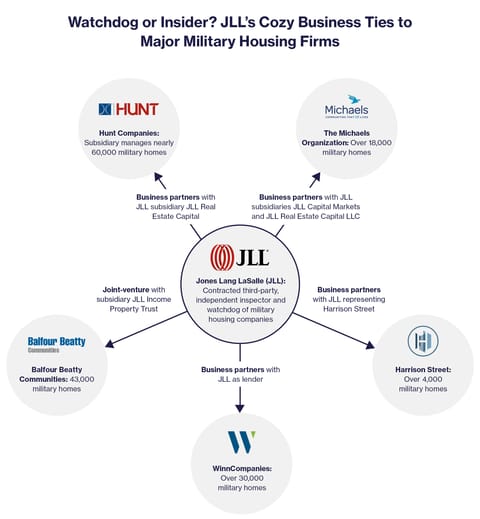
Jones Lang LaSalle has extensive business ties with the firms it is supposed to independently monitor, including some of the largest military housing providers in the nation. JLL has a joint venture with Balfour Beatty, the company that pled guilty to defrauding the government over military housing maintenance, which manages over 43,000 military homes at 55 military installations across the country.
JLL also has co-development projects with The Michaels Organization and has had business partnerships with Hunt Companies (parent company of Hunt Military Communities), WinnResidential, and Harrison Street. Additionally, JLL holds longstanding business ties to Lincoln Property Company, which until 2021 was the parent company of Lincoln Military Housing. Among the largest military housing companies, Lincoln changed its name to Liberty Military Housing and separated from its parent company following lawsuits over housing conditions and a congressional crackdown on military housing companies.
JLL’s predecessor, LaSalle Partners, formed a strategic alliance with Lendlease in 1998 — an Australian company that recently got out of the military housing business but was a major provider until early 2025. The partnership with Lendlease helped make JLL one of the largest real estate services companies in the country. Just one year later in 1999, JLL was negotiating the Army’s housing privatization contracts on the government’s behalf. Among the firms that won those early deals was Lendlease.
When military scholars interviewed officials for a 2006 Army-sponsored study about military housing privatization oversight, they were assured that, “The partner and JLL do not have any ties whatsoever.”
There’s a revolving door of employees between JLL and the housing companies it’s supposed to oversee.
Lendlease completed the sale of its military housing portfolio to Omaha Beach Investment Holdings, LLC for $320 million earlier last year amid a wave of lawsuits in which tenants alleged the firm misallocated federal housing revenues to turn military housing into a “profit center.” A $10.3 million damage award for one military family after arbitrators found Lendlease showed a “lack of care or concern for families living in military housing.”
The Army’s housing watchdog, JLL, was its business partner the entire time.
There’s also a revolving door of employees between JLL and the housing companies it’s supposed to oversee. Balfour Beatty announced Jennifer Hill as president of its military housing business in January: “She spent 28 years at Jones Lang LaSalle (JLL), most recently serving as Managing Director and Global Head of Strategy and M&A Execution,” the announcement read. “Earlier in her career, Hill was a founding member of JLL’s Public Institutions business, where she served as Principal Advisor to the U.S. Army on Military Housing Privatization Initiative (MHPI) programs and the Office of Energy Initiatives (OEI).” Balfour Beatty executives Michael Price and Kelly Spinola also previously worked at JLL.
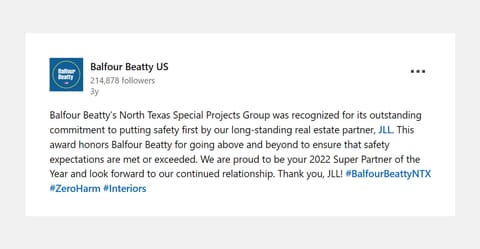
Balfour Beatty describes itself as JLL’s “Super Partner of the Year” in a LinkedIn post.
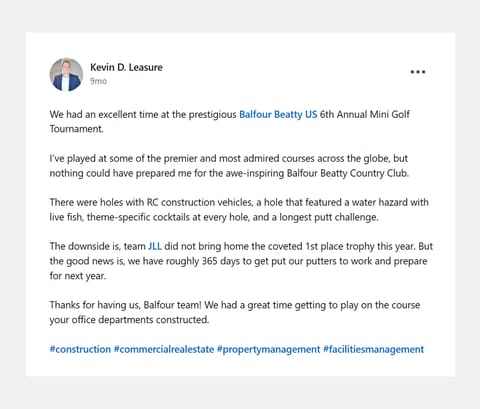
Jones Lang LaSalle team lead Kevin Leasure reflects on Balfour Beatty’s annual mini golf tournament in a LinkedIn post.
Additionally, JLL’s managing director, Ronda Clark, was once a project manager at Lincoln Property Company. Tony Beatty, another managing director at JLL, was previously named Lincoln Property Company’s Broker of the Year three years in a row. Andy Douglas, a longtime Lendlease employee who was the company’s SVP, general manager of business development, went to work for JLL as a senior project manager in 2013 before going back to work for Lendlease from 2015 to 2024 — all before Lendlease had exited the military housing business.
“Strategic Alliances” or Conflicts of Interest?
While Jones Lang LaSalle was collecting taxpayer dollars to protect military families from bad landlords, the company was simultaneously helping its landlord clients identify military tenants as premium targets. JLL has listed off-base rentals on a service member housing referral network and frequently references military real estate as an asset in marketing materials. For example, a representative of JLL’s Capital Markets debt advisory team described a Hampton, Virginia, luxury apartment complex as a “unique multifamily investment opportunity” due to its military tenant base and proximity to Langley Air Force Base and Naval Station Norfolk, enabling “significant rent premiums.”
In recent real estate advertising materials, JLL boasted the benefits of military proximity: “#1 Metro Area with Largest Concentration of Active-Duty Military Personnel.” The document pitched the military presence as a boon for investors, identifying potential rent increase opportunities of $559 per month.
JLL has acknowledged that conflicts of interest are a risk that could affect their bottom line, according to an annual SEC filing.
JLL also arranged financing for an apartment community purchase by Madison International Realty and The Accend Companies. The latter firm has an explicit strategy to “dominate” the off-base multifamily military housing market through planned acquisitions near four dozen installations. Accend’s military-adjacent properties have been managed by Allied Orion Group and Greystar, companies that have both been defendants in lawsuits against RealPage.
JLL has acknowledged that conflicts of interest are a risk that could affect their bottom line, according to an annual SEC filing; the firm has drawn scrutiny for risks of inappropriately profiting from government consulting and withdrew from a privatization job last summer due to conflicts of interest.
But the company argued in a 2010 SEC filing that their position in the industry is a critical asset. “In many cases, we establish strategic alliances with clients whose ongoing service needs mesh with our ability to deliver fully integrated real estate services across multiple business units and office locations,” the filing reads.
JLL’s conflicts of interest aren’t a new phenomenon, nor are they limited to the private sector.
In a 2023 podcast interview, JLL Vice Chairman Herman Bulls explained that as an Army Reserve colonel in the 1990s, he was walking the halls of the Pentagon while simultaneously working for JLL, using his access to land the leading role in military housing privatization. When the interviewer observed with a laugh, “You were like a lobbyist there yourself,” Bulls replied, “I never thought of it that way. You’re probably right.” Bulls described military housing as an achievement that established him as an irreplaceable “rainmaker” for JLL. According to Bulls’ LinkedIn, in addition to his leadership position at JLL, he also was a board member from 2021 to 2025 on the Defense Department’s Defense Policy Board, which is charged with providing “independent, informed advice and opinions concerning matters of defense policy.”
Former Vice President Al Gore, who intervened to override the Office of Management and Budget’s opposition to the military housing privatization plan, spent a decade as a top JLL investor through his investment management firm before selling his shares late last year.
Gore and Bulls have not responded to multiple requests for interviews or comment for this investigation.
Protecting RealPage and Protecting Profits
The dangers of inserting profit-seeking entities into government-funded military housing were not entirely a surprise.
For decades, government reports and lawmakers have flagged the risk of guaranteeing military housing allowances as a revenue stream for private industry. A 2002 GAO report found that developers of seven military housing projects would receive roughly $369 million in unanticipated profits and fees because contracts failed to account for annual increases in housing stipends.
More recently, elected officials have raised concerns that AI could be used to “price gouge military families.”
Senator Elizabeth Warren (D-MA) said in an email to POGO Investigates that this investigation’s findings about Jones Lang LaSalle are reflective of the Pentagon’s ongoing accountability failures in privatized military housing amid “corporate landlords’ outrageous price-fixing practices.”
“Military families deserve to have a safe, affordable place to call home, but for too long, abusive corporate landlords have left servicemembers, their families, and the federal government paying too much for poor living conditions,” she said.
According to a 2022 Department of Defense inspector general report, all the military housing companies use third-party property management software, though not all use RealPage. Some use proptech products from Yardi — which faces its own algorithmic price-fixing litigation that previously named JLL as a co-defendant. There’s also Entrata, a property management software company partially owned by Blackstone, the subsidiary of which is a co-defendant in the DOJ’s RealPage suit.
“If landlords are able to match the maximum that the federal government will spend on [privatized military housing], then they will.”
In January, the Senate Banking Committee pressed the Pentagon for information about property management software company RealPage’s role in surging military housing costs. The senators identified a correlation between areas where the DOJ alleges RealPage fueled rent increases and regions where military housing allowances went up to offset rising rents. These include areas in Washington near Fairchild Air Force Base, such as Spokane, which received an immediate 20% increase in military housing allowance in 2021, as well as areas near Joint Base Lewis-McChord.
“Anything within 45 minutes to [Joint Base Lewis-McChord], renting was actually more difficult than purchasing,” Lunsford said of her house-hunting experience in 2024, noting the high move-in costs.
In the lawsuit, the state of Washington accused JLL’s investment management arm, LaSalle Investment Management, of colluding with RealPage to inflate rents in these same areas. The suit charges LaSalle with “direct conspiracy” alongside other corporate landlords to align their rental prices in RealPage “User” groups, instead of functioning competitively. Antitrust laws, like the ones the lawsuit accuses JLL of violating, are intended to prevent anti-competitive behavior from companies that could lead to unfair and predatory consumer practices.
According to corporate documents, the JLL subsidiary LaSalle relies on its parent company for proprietary insight and research, and its operations are “seamlessly integrated” within JLL’s corporate umbrella.
JLL and LaSalle’s company leadership has touted RealPage’s algorithmic pricing tools for years: “We wanted to change the outdated methodologies that were used in setting rents at our communities,” LaSalle Senior Vice President Stephen Adams explained in 2010. “By outsourcing to YieldStar [RealPage’s algorithmic pricing tool], we’ve got a team of multifamily experts … who essentially act like an extension of our team.”
The Pentagon responded to the senators’ RealPage and military housing inquiry last March, revealing it had conducted no assessment of RealPage’s use among landlords in military communities, despite acknowledging that service members routinely complain about rent increases that coincide with BAH bumps. The department said it does not track this pattern of rent increases and claimed there is no policy in place that would allow military housing companies to exchange renter or service member data with third parties.
Now with RealPage or some comparable program, it becomes possible for these guys to coordinate much more effectively.
RealPage denies that BAH is ever factored into its rent pricing recommendations. The firm argued high housing costs have instead been caused by the “failed policies of the Biden Administration” and the nation’s undersupply of housing.
The company did not respond to repeated inquiries about how it maintains policies to prevent military client information from flowing through its integrated software ecosystem — data that could inform pricing for off-base rental units or help predict demand fluctuations tied to service members’ frequent relocations.
Real estate expert Samuel Stein said this rent inflation dynamic is to be expected. “If landlords are able to match the maximum that the federal government will spend on [privatized military housing], then they will,” Stein said.
Carstensen agrees. “The higher the off-base price, the stronger the argument for the on-base subsidy,” Carstensen said. “Now with RealPage or some comparable program, it becomes possible for these guys to coordinate much more effectively.”
Carstensen said experts also believe separate AI pricing systems — such as RealPage and Yardi — could be capable of learning to coordinate with each other’s pricing recommendations, indirectly building on each other’s recommendations, a phenomenon known as secondary tacit collusion.
Robert Zeithammer, an expert on pricing and a professor at the University of California Los Angeles, said in an interview that algorithms are “sort of better at colluding than humans,” and that military housing allowance data would make colluding even easier.
"A well-publicized increase in the housing allowance for a group of people who are stuck in a specific spot is like an invitation to the local landlords to raise prices,” Zeithammer said.
“Why are consultants managing the Army’s housing portfolio rather than Army personnel? ... And who in the hell is monitoring the consultants?”
Concerns about RealPage have spurred multiple states, including New York and California, and municipalities like Spokane and Seattle, to enact local bans on algorithmic price-fixing. This state and local push toward more regulation contrasts with efforts to weaken enforcement at the federal level. The Department of Justice’s Antitrust Division issued a sweetheart settlement with RealPage in 2025, which did not subject the company to any financial penalties or require them to admit guilt. Likewise, the Trump administration has backed efforts to nullify state and local regulation through an AI regulation moratorium. Some Republican lawmakers attempted a last-minute effort to attach the moratorium to the fiscal year 2026 annual defense spending bill, before reportedly dropping it amid bipartisan pushback.
One of the forces fighting regulation of AI companies like RealPage is the National Multifamily Housing Council — a powerful lobby group that counts both Jones Lang LaSalle and RealPage in its top sponsor category. In its third-quarter 2025 federal lobbying disclosure, the industry group reported spending $1.8 million to back a moratorium on state and municipal AI regulation as well as to lobby on issues like military housing privatization, the fiscal year 2026 National Defense Authorization Act, and Basic Allowance for Housing (BAH).
JLL’s sponsorship dollars were, in effect, financially aiding the industry group actively lobbying to protect RealPage’s algorithmic pricing software from government regulation.
“The Biggest Takers”
The scope of Jones Lang LaSalle’s role in the privatized military housing system is difficult to overstate.
Its broad-ranging responsibilities have included negotiating the terms of partnerships between the military and private housing companies, health and safety inspections of housing, performance monitoring of the housing companies, budget compliance, portfolio and asset management, and even planning and hosting an Air Force forum for real estate companies seeking to get involved in military housing.
At a 2002 hearing, former Representative David Hobson (R-OH), then-chair of a subcommittee overseeing military construction, told Pentagon officials he had not anticipated the scale of what had been handed over to private consultants. In his view, the consultants weren’t protecting the Army from bad deals. They were the bad deal.
“Why are consultants managing the Army’s housing portfolio rather than Army personnel?” Hobson asked. “What are the performance measures the consultant must achieve for each service provided? And who in the hell is monitoring the consultants?” Hobson concluded that “the biggest takers” in military housing privatization efforts were private consultant firms like Jones Lang LaSalle.
Lee Cokorinos, former research director of the Institute for Democracy Studies, published a critical analysis of the government consulting industry in 2009, arguing it had enabled the corporate capture of government decision-making.
“Back in the 1940s there was a capacity to evaluate this stuff within the government,” Cokorinos said in an interview, explaining how those capacities had been outsourced to private industry. “The only way to actually get ahead of this — besides national rent control — is actually to begin developing some capacity within DoD or GAO to actually look at the contract management.”
In the early days of military housing privatization, advocates promised better quality of life and lower costs, but the Congressional Budget Office maintains it has ultimately been more costly for taxpayers. The report said the Department of Defense had paid $28 billion into the military housing privatization program as of fiscal year 2023. Meanwhile, military housing companies — many of which have business entanglements with JLL — profit handsomely from guaranteed military rents via 50-year land leases, receive questionable performance bonuses despite substandard service, and remain largely shielded from liability.
The Pentagon has not responded to multiple requests for comment for this investigation.
Despite the lawsuits and potential conflicts of interest, the Pentagon’s reliance on JLL for military housing oversight hasn’t faltered. In 2025, JLL was awarded a $165 million contract for “cradle to grave” management of the Air Force’s portfolio of privatized housing across 63 installations.