ICE Inspections Plummeted as Detentions Soared in 2025
The number of ICE detention facility inspections dropped by 36.25% in 2025, even as detention rates — and deaths in ICE custody — surged across the nation.
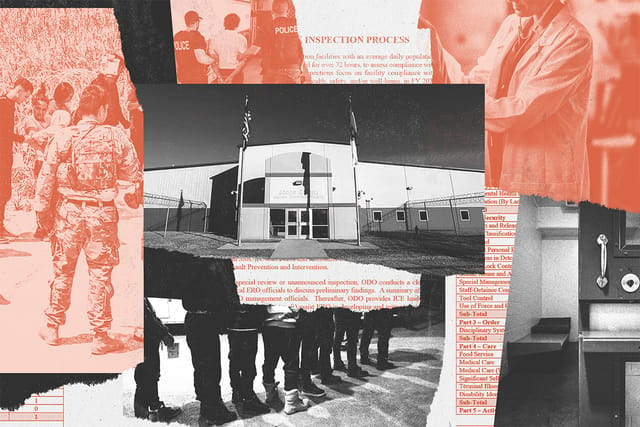
(Photos: Getty Images; Illustration: Ren Velez / POGO)
Amid a massive expansion in immigration detention in 2025, Immigration and Customs Enforcement (ICE) dramatically reduced the number of facility inspection reports by the agency’s Office of Detention Oversight (ODO), one of its key tools for tracking detention conditions.
There was a 36.25% decline in ICE detention facility inspection reports published in 2025 compared to the previous year, according to an analysis of data pulled from the agency’s facility inspections website by the Project On Government Oversight and American University’s Investigative Reporting Workshop.
These inspections assess whether facilities meet a range of detention standards, including those that shape fundamental health and safety conditions for the people being imprisoned there, including whether detention facilities are providing adequate health care, monitoring and effectively preventing suicide, providing quality food, and maintaining habitable shelter. The agency is supposed to conduct these inspections twice per year for facilities with an average daily population of 10 or more that detain “noncitizens” for longer than 72 hours. Detention centers that fail two inspections in a row are required to lose federal funding. And yet, reports on ICE’s website do not indicate that more than one inspection was conducted at any of the agency’s detention facilities in 2025.
ICE did not respond to an interview request for this investigation.
Get the latest
Weekly newsletter and occasional updates
As facility oversight lagged, it was a record-setting year for immigration detention. As of mid-December 2025, there were 68,440 people being held in detention by ICE, a 78% increase from the number detained in mid-December 2024. The escalation follows campaign promises by President Donald Trump to overhaul immigration in America, often marked by rhetoric vilifying immigrants and asylum-seekers.
Last year also set records for deaths in ICE custody: 32 people died in the agency’s custody in 2025, nearly three times the number of deaths in 2024 and the most since 2004, according to a report by The Guardian.
The drop in oversight inspections is an “invitation” to increased lethality in detention, according to Andrew Free, a lawyer and researcher who founded the #DetentionKills project, which advocates for increased transparency and accountability in ICE detention.
Without the revival of key oversight tools, Free predicts the increase in the number of deaths in ICE custody will continue in 2026. “All signs point to increasing amounts of suffering, increases in preventable harm and ultimately death that will occur to the ICE detained population,” he said. “The tragedy of it is that there are oversight systems and accountability mechanisms that were developed over the course of years to reduce the rates of death and mortality in ICE detention.”
Tricia McLaughlin, spokesperson for the Department of Homeland Security, characterized detention conditions differently in a September 2025 statement. “All detainees are provided with proper meals, medical treatment, and have opportunities to communicate with lawyers and their family members,” she said. “Ensuring the safety, security, and well-being of individuals in our custody is a top priority at ICE.”
In 2019, Congress mandated that ODO conduct inspections twice per year at ICE facilities that detain 10 or more people daily for over 72 hours, appropriating $6.9 million for the added cost, according to a DHS Fiscal Year 2021 report to Congress. Resultantly, ODO published more inspection reports in the years following the congressional mandate before declining precipitously in 2025 despite no change in congressional requirements.
ODO inspection reports record “deficiencies” — violations that do not comply with detention standards, policies, or operational standards. These violations can range from facilities not providing recreation time for people in detention to ignoring medical concerns raised by people being detained. Once the report is finalized, the oversight office sends it to ICE leadership so they can create a plan to prevent a detention facility from violating standards in the future.
Inspection reports published in 2025 revealed significant failures at a number of detention facilities around the country. These include ICE staff not properly monitoring detained people at risk of suicide, medical staff not responding to medical care requests or lacking sufficient medical training and credentials, failure to report patients with suspected active tuberculosis, and detention facilities not providing detained people with enough toilets.
Free said the detention facility inspections matter for myriad reasons, not least of which is that ICE relies on the inspection process for legitimacy. “Whenever there are allegations of mistreatment or poor conditions or preventable deaths, one of the first things we hear from contractors and the agency is that these facilities are subject to an overlapping set of rigorous inspections,” he said.
Although inspections are a valuable oversight tool, Free also highlighted pending lawsuits against ICE over “sham inspection” processes at two different detention facilities as examples of ways the existing inspection requirements can fall short of true accountability, noting the rarity that detention facilities actually receive a failing grade. Even still, “they’re basically the only thing left … where you have official agency acknowledgment that standards are being violated,” he said.
The drop in oversight inspections is an “invitation” to increased lethality in detention.
ICE has dramatically expanded its network of detention facilities to compensate for the growing number of people being imprisoned in them. In 2025, ICE detained people in 59 new facilities and reopened 77 facilities that were previously shuttered. The Trump administration also dramatically increased the use of local and county jails for immigration detention through the agency’s 287(g) Program, which empowers local law enforcement to carry out immigration enforcement. Last year, the program expanded to over 1,000 agreements with law enforcement entities in 40 states.
But inspection report data indicates that safeguards for people in detention have not kept pace with the rapid expansion. In Florida, a state that mandated the 287(g) Program for all counties, conditions within ICE detention have become “inhuman” at two facilities, according to a recent report from Amnesty International.
One of those facilities, Krome North Service Processing Center, has “trended downward” when it comes to meeting ICE’s facility standards, leaving people without reliable medical care or proper mental health support, according to the 2025 inspection report of the facility. The agency documented five violations in medical care and 14 overall violations of detention standards, including overcrowding, with people sleeping on floors without bedding or pillows, and staff failures to ensure people had been offered food when held for more than six hours. While Krome received the required two inspections per year in both 2023 and 2024, in 2025 it received only one.
The contractor that oversees Krome, Akima Global Services, did not respond to a request for comment.
The other facility Amnesty International reviewed, Everglades Detention Facility, commonly known as “Alligator Alcatraz,” did not have any inspection reports published during 2025 at all. The state-run facility opened in July 2025. Following the Amnesty International report and criticism surrounding the conditions faced by detainees, Florida Governor Ron DeSantis said, “they are going to accuse you of [mistreatment] no matter what. You put them up in the Ritz-Carlton, they are going to accuse you of doing that.”
Other oversight protocols meant to hold ICE detention facilities accountable were also abandoned under the new administration. The Trump administration gutted two key oversight offices within the Department of Homeland Security in early 2025. Hundreds of employees were laid off, including those who conducted critical investigations into conditions in immigration detention.
The drop in detention facility inspections was also exacerbated by the government shutdown in the fall of 2025, when employees within ODO were furloughed from work even as other immigration enforcement offices stayed open, despite outcry from lawmakers.
“This office is not peripheral; it is the department’s primary safeguard against abuse and neglect in immigration detention centers,” wrote Representative Raja Krishnamoorthi (D-IL) in a letter to Secretary of Homeland Security Kristi Noem in October. “Oversight and transparency are not optional; they are essential for maintaining public trust in the U.S. government.”
Aarushi Sahejpal contributed data analysis to this report.