No SEC Probe of Trump Crypto Deal Despite Alleged "Illegality"
In matters involving the president and cryptocurrency, some experts say the Securities and Exchange Commission has abandoned its mission of protecting investors.
(Illustration: Luna Velez / POGO)
Editor's note: The company Alt5 Sigma changed its name to AI Financial Corporation in April. Since most events in this story predate the name change, it is referred to as Alt5. This story is a collaboration with Political Wallet.
Last August, World Liberty Financial, a Trump family cryptocurrency venture, struck a deal with a publicly traded company called Alt5 Sigma. That deal would come under fire in a previously unreported shareholder lawsuit against Alt5 that alleged “illegality,” “unjust enrichment,” and “avarice.” The arrangement between the two businesses netted President Donald Trump and his family an estimated $500 million, a major chunk of Trump’s $1.4 billion in crypto-related income last year. In the months following the deal, Alt5’s stock price tanked by more than 90%.
The lawsuit, filed earlier this year and obtained from a Nevada state court by POGO Investigates, adds to concerns surrounding World Liberty Financial and Alt5 Sigma.
Some of those concerns, namely that Alt5 failed to disclose key information, have led to calls for the federal agency tasked with protecting investors — the Securities and Exchange Commission (SEC) — to probe the company. In response to a Freedom of Information Act request, the SEC told POGO Investigates this month that it could not find any investigation records involving Alt5 over the last year. Alt5's spokesperson said the SEC is not investigating.
Get the latest
Weekly newsletter and occasional updates
The SEC’s apparent lack of investigation of Alt5 comes as experts, lawmakers, and former government officials say the agency is failing to do its job when cryptocurrency — the biggest source of Trump’s income in his second term — is involved.
“The SEC abetting Trump’s corruption is a problem in its own right,” said Corey Frayer, director of investor protection for the Consumer Federation of America and a former Biden-era SEC advisor on crypto markets, in an email. But Frayer also said the SEC’s hands-off approach is fueling distrust in U.S. markets, even as they reach new highs and attract trillions of dollars, including from U.S. workers’ retirement savings.
A cornerstone of the agency’s mission has been enforcing laws that require publicly traded companies to regularly and honestly disclose critical information to investors.
There are signs that criticism has not just come from outside the agency.
In March, the SEC’s head of enforcement, Margaret Ryan, abruptly quit after reportedly clashing with SEC Chair Paul Atkins and other appointees because she “wanted to be more aggressive in pursuing charges for fraud and other misconduct including in cases that touched the president’s circle,” according to Reuters. Ryan had been on Trump’s first-term list of potential Supreme Court nominees.
She did not respond to a request for comment, and the SEC did not respond to multiple queries.
Enriching “the Company’s new stakeholders”
The February lawsuit was brought against Las Vegas-based Alt5, current and former Alt5 executives, and board members by a major Canadian investor named Bruce Bent.
His suit against the cryptocurrency payment services company claimed a “breakdown in the Company’s management” after World Liberty Financial leaders joined Alt5’s board of directors as part of the deal. The two World Liberty Financial executives who became Alt5 board members are its CEO Zach Witkoff and Chief Operating Officer Zak Folkman, who were defendants in the lawsuit.
(Zach Witkoff, Alt5’s board chairman, is the son of businessman Steve Witkoff, a “co-founder emeritus” of World Liberty Financial and a friend of the president’s who is serving in a wide-ranging diplomatic role. Steve Witkoff, Trump, and his family are not named as defendants.)
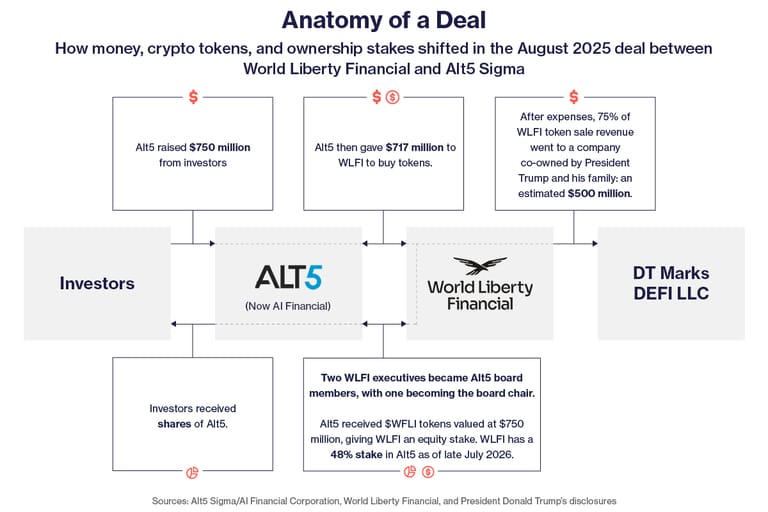
Bent’s lawsuit claimed that the deal with World Liberty Financial was “a large dilutive transaction that could only serve to enrich the Company’s new stakeholders, including new management and directors, by unlawful means.” The deal involved Alt5 issuing a large number of shares to buy $717 million worth of World Liberty cryptocurrency. It also involved World Liberty Financial getting a large stake in Alt5 by transferring $750 million worth of tokens, receiving 100 million shares in return.
After deducting expenses, 75% of World Liberty cryptocurrency sales benefit a company owned by Trump and his family, which is why the Trumps made an estimated $500 million from the Alt5 deal. In contrast, Bent’s lawsuit noted a sharp drop in Alt5 stock share prices after the deal was announced, and decreases for months after.
Bent’s lawsuit also claimed that specific decisions after the World Liberty Financial deal breached the company’s fiduciary duty to operate in shareholders’ best interests.
In a filing, Alt5 wrote that it “disputes the allegations concerning the Company and the named individual defendants and will vigorously defend itself and the other parties against the claims.”
Bent withdrew the lawsuit in late June “with prejudice,” meaning it cannot be refiled. That can happen when a settlement is reached, when a plaintiff believes they can’t win or don’t want to pay for the cost of litigation, or for other reasons. Bent and his attorneys did not respond to queries.
A spokesperson for Alt5 Sigma, rebranded as AI Financial Corporation (AiFi) this spring, declined to say whether Bent’s lawsuit was dismissed due to a settlement. They said in an email to POGO Investigates that “AI Financial rejects any attempt to present third-party allegations as facts.”
In a late July press release, its CEO and board member Tony Isaac defended the company’s relationship with World Liberty Financial and the August 2025 deal, decrying what he described as “misleading reporting” on the finances involved. Isaac was another defendant in Bent’s lawsuit.
“World Liberty Financial's interests are aligned with those of all our shareholders,” Isaac said. “World Liberty Financial does not control the AiFi Board.”
“Comparing the gains from cryptocurrency activity by stakeholders of another company (World Liberty Financial) in 2025 with investor paper losses,” Isaac said, “is not an apples-to-apples comparison.”
A spokesperson for World Liberty Financial declined to comment.
Bent’s lawsuit isn’t the only time concerns have been raised in connection with the Alt5 and World Liberty Financial transaction. In a complaint filed by several attorneys, the SEC has been asked explicitly to investigate whether Alt5 kept information secret from investors while raising money from them to fund the deal.
“The paradigmatic securities fraud case”
Months before the World Liberty Financial deal was announced to investors, a Rwandan court ruled that one of Alt5’s subsidiaries was “criminally liable for offenses including illicit enrichment and money laundering.” Alt5 did not reveal that Rwandan court ruling to investors until weeks after the World Liberty Financial deal was announced on August 12, 2025.
When it finally disclosed the ruling, Alt5 said it would internally review “potential misstatements or disclosures in the financial statements of the Company.” Alt5 stated its board of directors did not know about the court judgment at the time of the World Liberty Financial deal. Alt5 has appealed the court ruling, which is still pending, and the subsidiary in question — Alt5 Sigma Canada — was sold to another company earlier this month.
Alt5’s stock price collapsed in the wake of these unflattering revelations, falling by over half in the few days after the Rwandan court ruling was disclosed to shareholders on August 29, 2025.
Disclosure problems continued. In subsequent months, Alt5 failed to notify investors in a timely way about the departure of its then-CEO and accountants, which Bent’s lawsuit decried as having “a devastating effect on the Company and its shareholders.”
In an April letter, ethics lawyers at the nonprofit Democracy Defenders Fund and a former state attorney general called on the SEC to investigate. They argued that Alt5 may have withheld information about the Rwandan court ruling from investors as it was raising money from them for the World Liberty Financial deal. The letter also said the other disclosures “point to a pattern of persistent accounting deficiencies and faulty internal controls,” which its authors say is another legal basis for the SEC to review Alt5.
“When a company raises billions from investors while failing to disclose serious compliance issues, and at the same time routes massive sums into politically connected entities, that should set off alarm bells,” said Matthew J. Platkin, a former New Jersey attorney general, in a statement.
This situation would typically lead to an SEC investigation, according to a former top agency attorney.
“The meat and potatoes of SEC investigative work are cases involving misrepresentations or omissions to investors in public companies,” said Howard A. Fischer, a former senior SEC trial counsel and current partner at the law firm Moses Singer. He said in an email to POGO Investigates that the situation involving Alt5 “is the paradigmatic securities fraud case.”
Representative Ro Khanna (D-CA), who has repeatedly raised concerns regarding cryptocurrency-related corruption involving the presidency, also called on the SEC to act, partly because of the overlapping board membership of Alt5 and World Liberty Financial.
“They need to investigate,” said Khanna.
But to date, there is no indication that the SEC has been investigating.
“There may be political reasons this one is hands off,” said Reed Kathrein, a veteran securities law litigator at the law firm Hagens Berman Sobol Shapiro LLP, which is examining Alt5.
There are severe doubts among experts that the SEC currently has the degree of independence it needs to assess matters that come too close to the president’s wealth.
Trump’s Crypto Wealth Rapidly Grew In Second Term

Eric Trump (left), the newly appointed ALT5 Board Director of World Liberty Financial, is joined by his brother and ALT5 Board Observer Donald Trump Jr. outside of NASDAQ in Times Square as they mark the $1.5B partnership between World Liberty Financial (WLFI) and ALT5 Sigma with the ringing of the NASDAQ opening bell, on August 13, 2025 in New York City. (Photo: Spencer Platt / Getty Images)
After recapturing the White House, crypto became Trump’s largest source of income. A key part of that has been revenue from World Liberty Financial, launched a few months before the 2024 election. In a “gold paper” document featuring Trump’s face on the cover, the company described itself as “inspired by the vision of Donald J. Trump,” and called him “Chief Crypto Advocate.” He and his three sons are listed as co-founders, along with Zach Witkoff and Zak Folkman, who are now on Alt5’s board of directors. (Eric Trump was originally intended to join Alt5’s board, but that did not happen.)
A Reuters investigation found that “since the 2024 election, the Trumps have, as a family, generated more profit from crypto than any U.S.-listed company, according to company statements and industry data.” And World Liberty Financial’s deal with Alt5 ranks as one of the largest transactions affecting Trump’s wealth in his second term thus far.
“There's nothing illegal. There's nothing wrong with it,” Trump said in July when asked about the money he made from his family’s crypto ventures while he has been president. White House spokesperson Anna Kelly has said, “President Trump’s assets are in a trust managed by his children. There are no conflicts of interest.” The president and vice president are exempt from a conflict-of-interest law that applies to the rest of the executive branch.
“President Trump only acts in the best interests of the American public,” Kelly said in an email to POGO Investigates, “which is why they overwhelmingly re-elected him to this office, despite years of lies and false accusations against him and his businesses from the fake news media.”
World Liberty Financial also states on its website that it, related businesses, and “$WLFI tokens are not political or associated with any political campaign.”
"I fully expect President Trump and his family to do everything possible to extract as much profit as they can from these ventures before he leaves office"
But some see the president’s moneymaking from crypto ventures as directly connected to his political power and favor. The people owning the largest number of Trump-connected cryptocurrency have been invited to events that the president himself attends.
“President Trump has effectively created an entirely new asset class: political assets. These assets have little or no fundamental value beyond their ability to curry favor with, and potentially buy access to, the President of the United States,” said Lee Reiners, a lecturing fellow at Duke University who formerly worked at the Federal Reserve Bank of New York.
“I fully expect President Trump and his family to do everything possible to extract as much profit as they can from these ventures before he leaves office and their value collapses,” he said, via email, predicting “a never-ending stream of scandals, many of which will unfold in plain view of financial regulators.”
One of those financial regulators is the SEC — and it is supposed to be somewhat insulated from direct presidential control.
When Trump launched World Liberty Financial in September 2024, a prominent cryptocurrency investor and Trump supporter named Nic Carter warned that it would be “an obvious target for the SEC.”
But major changes in Trump’s second term have reduced the SEC’s insulation from presidential control and radically slashed its cryptocurrency enforcement.
The Collapse of the SEC’s Cryptocurrency Enforcement
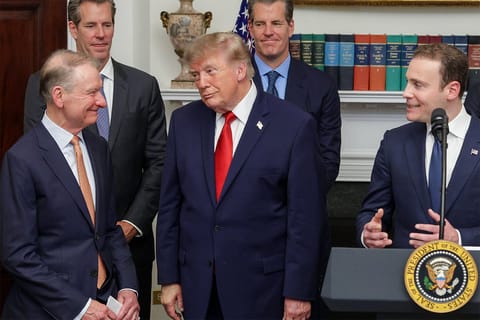
Chairman of the U.S. Securities and Exchange Commission (SEC) Paul Atkins, U.S. President Donald Trump and Commodity Futures Trading Commission (CFTC) Chairman Michael Selig during a summit of crypto and technology leaders in the Roosevelt Room of the White House on August 19, 2026 in Washington, DC. (Photo: Alex Wong / Getty Images)
In the 1930s, Congress created the SEC with five commissioners leading it, intending no more than three from the same political party. Currently, the SEC has three Republican commissioners, and no Democrats. Trump has only appointed one commissioner so far in his second term: Atkins, the SEC’s chairman.
Reilly S. Steel, a Columbia University law professor who published a 2024 study of partisan bias at the SEC, said the SEC is more under the thumb of the president now than during prior periods he examined.
His assessment is partially due to the current makeup of commissioners and the gutting of removal protections by the Supreme Court this summer, which overturned a 91-year-old precedent shielding top officials at agencies like the SEC.
“This means that the President can effectively remove the SEC commissioners at any time if he deems them disloyal,” Steel said in an email to POGO. “If that means that certain wrongdoers escape accountability merely because they are well connected, that would obviously leave an investor protection gap.”
Since Trump’s inauguration, the SEC has sharply curtailed its enforcement efforts regarding cryptocurrency companies writ large. But when matters have intersected with the president, the pullback has been even more dramatic. A New York Times review found that the SEC “backtracked against every firm that either has relationships with the Trump family’s crypto businesses or has donated to his political causes. The agency’s only remaining crypto cases are against little-known defendants without clear ties to Mr. Trump.”
For instance, in May 2025, the Commission said it was exercising its discretion to dismiss a case against Binance, a cryptocurrency exchange, after World Liberty Financial announced it was facilitating a deal between Binance and a United Arab Emirates-based fund. (That same month, Binance founder Changpeng “CZ” Zhao said he was seeking a pardon from Trump for a guilty plea to money laundering charges. Trump pardoned Zhao in October.)
The SEC’s current leaders say the drop in cases is due to a more hands-off approach to overseeing crypto compared to the Biden era. Still, Atkins said in February, in response to a lawmaker’s questions about the SEC and cases that intersect with the president’s crypto ventures, that the SEC has a “very robust enforcement division” and that “we put investors first every day.”
The Trump administration has embraced the industry and sought to make the U.S. “the crypto capital of the world,” which SEC Chairman Atkins has cited as a basis for making changes.
Last year, Atkins said the SEC would no longer engage in “a shoot-first-and-ask-questions-later approach of regulation through enforcement” that he described as “ad hoc” and unclear to companies. Instead, Atkins said he would return the SEC to focusing on policing “fraud and manipulation.”
But the extent of SEC’s enforcement pullback is enabling fraud, according to the most recent Democratic SEC commissioner, Caroline Crenshaw.
“Without deterrence, there is no accountability,” said Crenshaw in a December speech.
As with the Alt5 deal with World Liberty Financial, Trump benefitted while many investors lost out.
The trendline has alarmed some congressional Democrats, who have cited the Binance case, among others.
“The SEC’s declination of its responsibility to enforce the securities laws against crypto companies and their leaders comes at a time when crypto companies are pouring money into the accounts of President Trump, his family, and his associates,” three Democrats on the House Financial Services Committee wrote in January. “Frankly, it puts both investors and the U.S. economy at risk.”
Earlier this month, Senators Elizabeth Warren (D-MA) and Richard Blumenthal (D-CT) called on the SEC to investigate whether any securities laws were violated in connection with the $TRUMP meme coin, issued three days before the inauguration.
As with the Alt5 deal with World Liberty Financial, Trump benefitted while many investors lost out.
“Nearly a million investors lost over $3.81 billion on the coin from its debut through the end of June, while Trump himself made $636 million,” the senators wrote.
“If anyone other than the President were involved, regulators would almost certainly take action,” said Reiners, the former Federal Reserve Bank of New York staffer. “But like so many people around Trump, they have chosen loyalty to the President over fidelity to the rule of law.”
Related Content