$1.5 Trillion Pentagon Budget Benefits Top Contractors
Despite rhetoric about embracing innovation and new companies, the Pentagon’s $1.5T budget request boosts troubled programs and contracting giants.

(Illustration: Luna Velez / POGO)
If the Pentagon gets the budget it wants, the Navy’s controversial Trump-class battleship would see a more than 1,200% increase in its annual budget in the next fiscal year. A hypersonic missile program that has seen years of testing challenges could get a 215% increase. These are among the 24 major weapons programs where the Pentagon is seeking to at least double annual spending, according to a review of a key budget document by the Project On Government Oversight (POGO).
Longstanding contracting heavyweights Lockheed Martin, Huntington Ingalls Industries, RTX (formerly Raytheon), General Dynamics, Boeing, and Northrop Grumman are poised to be the main beneficiaries. That would be an outcome at odds with years of Pentagon rhetoric emphasizing the need to do more contracting with smaller, nontraditional companies. Lockheed and Huntington dominate the programs slated to see the steepest proposed budget increases.
Get the latest
Weekly newsletter and occasional updates
Some observers say the influence game may play a larger role than usual this legislative cycle, in part due to the vast size of the $1.5 trillion Pentagon’s budget request, unveiled on April 21. Executives from Lockheed, RTX, Boeing, and Northrop have even met with President Donald Trump at the White House to discuss weapons production issues.
These and other companies have also been working the other end of Pennsylvania Avenue. In the first quarter of 2026, available data shows an uptick of 10% more entities lobbying on defense issues compared to the same time period last year, according to OpenSecrets. A POGO review of lobbying disclosures shows all six of the contractors particularly poised to benefit from weapons spending have been lobbying Congress on defense legislation and other issues, and have spent a combined total of about $21.2 million on lobbyists in the first quarter of 2026. Boeing, Lockheed, and Northrop are among the all-time top spenders on lobbying, having shelled out a combined total of over $1 billion since 1998.
Those companies’ lobbyists, some of whom formerly worked for key congressional committees, are advocating for many of the major weapons programs favored by the Pentagon’s budget.
The companies’ political action committees have also donated to the campaigns of lawmakers who sit on key committees overseeing military spending. This follows a well-worn trend that has raised ethics concerns in the past, but the scale of political giving by the companies this year won’t become fully apparent until 2027 due to a lag in reporting to the Federal Election Commission.
The Pentagon’s record-breaking proposed $1.5 trillion budget for fiscal year (FY) 2027 is 42% larger than the current year’s spending level. The result is a budget proposal in which, out of a listing of 87 major weapons programs that are currently funded, 62 are slated for a year-over-year funding increase, while only 25 are facing cuts. Collectively, the 87 programs will see a proposed funding boost of 63%, substantially steeper than the Pentagon’s overall budget increase.
POGO’s review of the Pentagon’s budget request overview reveals that while some of the programs slated for increases are directly related to present military contingencies — for example, replenishing munition stockpiles depleted by the Iran war — others have less to do with current hostilities. For some, there are lingering questions about their cost, feasibility, reliability, or effectiveness.
“Taken together, these requests raise the potential for billions in taxpayer dollars spent on contracts without demonstrated defense value, an environment ripe for waste and abuse,” the Center for American Progress, a liberal leaning think tank, commented in a June 2026 article on the Pentagon’s FY 2027 budget. One of the reviewers of that report has a particularly blunt assessment of the Pentagon’s request.
“I don’t think $1.5T is realistic or needed and it certainly isn’t sustainable,” said Frank Kendall, who served as secretary of the Air Force during the Biden administration, in an email to POGO.
The Pentagon did not respond to POGO’s queries. (Disclosure: POGO’s Center for Defense Information has opposed increasing the defense budget without more oversight.)
Ultimately, Congress has the final word on how much money will be appropriated for the military to spend, although Pentagon budget proposals are influential and set the initial terms of the budget debate. Congress often significantly boosts funding levels beyond the Pentagon’s requested levels, although the scale of this proposed increase is facing political and procedural headwinds in Congress. That’s largely because the Pentagon’s budget request relies on Congress passing $350 billion through the often-time consuming reconciliation process, which top lawmakers say is unlikely, meaning the ultimate amount may end up closer to $1.15 trillion.
Some defense budget analysts say the result will likely and overwhelmingly benefit traditional, large Pentagon contractors and shortchange smaller and newer companies that could bring innovation — and lower costs — to the military.
“The funding is not aligning to stated priorities.”
“Submitting a request that will likely be subject to such significant cuts will play to the advantage of traditional defense suppliers,” wrote Matt Vallone, director of market intelligence at the aerospace and defense consulting firm Renaissance Strategic Advisors, back in March. “In what will almost certainly be epic lobbying battles across the FY2027 National Defense Authorization Act and the defense appropriations bill, programs that have hot production lines, employees who are actual constituents, and established Congressional relationships will be much better positioned.” Vallone was a legislative director for then-Representative Carol Shea-Porter (D-NH), who served on the House Armed Services Committee.
And this outcome would worsen what some experts say is a discrepancy between Pentagon rhetoric about embracing new companies with innovative technology and how it actually spends its money.
“With over 99% of Pentagon contract dollars still flowing to a small number of large, incumbent contractors, the funding is not aligning to stated priorities,” wrote Rachel Hoff, the Ronald Reagan Institute’s policy director and a former aide to the late Senator John McCain (R-AZ), who chaired the Senate Armed Services Committee. (Hoff’s calculation is based on Pentagon contract dollars going to 15 defense technology firms in fiscal years 2023 to 2025.)
Huntington Ingalls and the Widely Panned Trump-Class Battleship
One of the biggest military contractors is Huntington Ingalls Industries, and it plays a key role in the program with the biggest increase in the Pentagon’s major weapon systems budget listing: the BBG(X) Trump-class battleship.
The Pentagon is proposing a 1,276% annual funding boost for the program — about $1.7 billion over present spending.

U.S. President Donald Trump, joined by Secretary of Defense Pete Hegseth and Secretary of State Marco Rubio, arrives to announce the creation of the “Trump-class” battleship during a statement to the media at Trump’s Mar-a-Lago estate on December 22, 2025 in Palm Beach, Florida. (Photo: Tasos Katopodis / Getty Images)
According to the military’s budget request, the battleship will be “the centerpiece of the Golden Fleet; the most lethal surface combatant ever built in the United States.” It describes the ship as leveraging “state-of-the-art combat systems,” such as a long-range missile system and “directed energy weapons.”
The programs with the sixth- and seventh-largest increases in the Pentagon budget also belong to Huntington Ingalls. The Huntington Ingalls-built America-class amphibious assault ship would see a 451% boost under the Pentagon’s proposal, and the FF(X) frigate, based on an existing Coast Guard design, would see a 408% annual budget increase. In all, the Pentagon has requested spending increases for eight major defense programs on which Huntington Ingalls Industries is, or will likely be, a prime contractor.
Trump announced the battleship program on December 22, 2025, alongside then-Navy Secretary John Phelan. The battleship and the frigate represent the core of the administration’s so-called “Golden Fleet Initiative,” an effort to boost the U.S. Navy’s fleet and to overcome a troubling track record of cost overruns in Navy ship programs over the last decade. Phelan was ousted this April, reportedly because development of the battleship program could not hew to the president’s aggressive timeline.
While the Pentagon’s budget breakdown lists the battleship’s prime contractor as “TBD,” the Navy is already planning on Huntington Ingalls building it, and the company recently disclosed to investors that it sees “additional upside” in the announcement of the battleship and FF(X) frigate programs. A Huntington Ingalls fact sheet states that it “is collaborating with the Navy on the design, engineering and analysis of the BBG(X) guided missile battleship.” A company spokesperson told POGO in an email that, “We stand ready to support the Navy’s requirements” and referred questions about the battleship to the Navy. The Navy did not respond to POGO’s queries.
“The Trump battleship is a waste of money.”
Critics of the program say it will fail for several reasons, such as its reliance on advanced systems that are still in development or may prove difficult to integrate and maintain. Experts also say it will be extremely vulnerable to drones and other guided weaponry. One widely cited defense analyst predicted the billions of dollars spent developing the battleship over several years will all be wasted. “A future administration will cancel the program before the first ship hits the water,” wrote Mark Cancian, a senior adviser at the Center for Strategic and International Studies. Similarly, Kendall, who also served as the Pentagon’s top official overseeing weapons buying, told POGO that “The Trump battleship is a waste of money.”
Citing such criticisms, some lawmakers on the House Armed Services Committee sought to strip battleship spending in the National Defense Authorization Act, but the amendment failed mostly along party lines. While that proposal was sunk, the committee’s lawmakers approved language that blocks the Navy from inking a contract to build “the lead ship of the battleship program” until it can certify “that the weapon systems planned for inclusion in such lead ship are at a sufficiently mature technology readiness level.”
The shipbuilder remains undaunted. Huntington Ingalls spent nearly $2 million in the first quarter of this year on lobbying — a slight increase compared to the first quarter last year. The company’s lobbying efforts have included the battleship, the America-class amphibious assault ship, and the FF(X) frigate, according to its most recent federal lobbying disclosure.
Huntington Ingalls’ lobbyists include former staffers of the congressional committees that oversee and approve military spending. For example, two former staff members for Senator Susan Collins (R-ME), who sits on the Senate Defense Appropriations Subcommittee and chairs the full Appropriations Committee, are lobbyists for Huntington Ingalls at KED Strategies. A former deputy chief of staff for Senator Roger Wicker (R-MS), chair of the Senate Armed Services Committee, is a lobbyist for the company at BGR Government Affairs. Stewart Holmes, Huntington Ingalls’ executive vice president for government and customer relations, served as the staff director and minority clerk for the Senate Appropriations Subcommittee on Defense and as a staff member for the full Appropriations Committee, according to his bio.
A spokesperson for Huntington Ingalls Industries (HII) said the company values executives with government expertise. “Extensive knowledge and experience in government relations and defense issues, as well an understanding of HII’s business processes with the DOD customer and on Capitol Hill is critical in continuing HII’s proven track record of providing solutions to our customers’ biggest challenges,” the spokesperson said in an email.
Last year and in the first quarter of 2026, Huntington Ingalls’ political action committee (PAC) gave lawmakers on the House and Senate defense appropriations subcommittees and armed services committees $305,000, according to POGO’s analysis of the company’s disclosures and Federal Election Commission data. These congressional committees did not respond to requests for comment.
-
The congressional armed services committees are “authorizing” committees that are responsible for the annual National Defense Authorization Act. Generally, appropriations from Congress are limited to purposes authorized by a previously passed law, but “Congress may choose nevertheless to appropriate funds” even if there is no separate authorizing law, according to the Congressional Research Service. And programs may get authorized but fail to receive appropriations.
According to Huntington Ingalls, its PAC “makes political contributions in a bipartisan manner based on alignment with established criteria and our company values.” When making donations, the company’s PAC considers several factors, including whether candidates have “Membership on relevant committees of jurisdiction.”
Lockheed Martin and the Missile Buying Spree
After the battleship, the three programs receiving the biggest proposed budget increases all feature Lockheed Martin as the prime contractor.
The Pentagon is requesting 953%, 842%, and 748% funding increases — a total of $26 billion over current spending — for the Typhon Strategic Mid-Range Fires System, Terminal High Altitude Area Defense (THAAD), and Patriot Advanced Capability-3 (PAC-3) defensive missile systems, respectively.
It also seeks large increases for the Lockheed-manufactured Conventional Prompt Strike (CPS), Aegis missile defense system, and Precision Strike Missile. In all, 22 major defense programs on which Lockheed Martin is a prime contractor are slated for funding increases in the next fiscal year. That includes the massive F-35 Joint Strike Fighter program, which would receive an annual boost of about 61.6%, from $13.2 billion to $21.4 billion. The F-35 is the most expensive weapons program in U.S. history and is also years behind schedule.
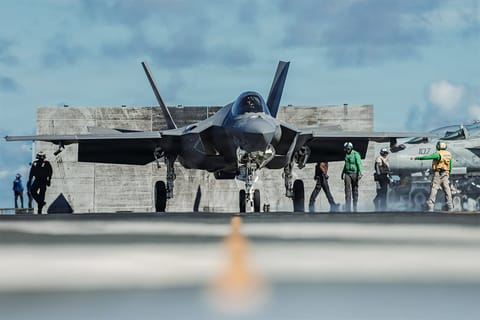
A Lockheed Martin F-35 Lightning II readies for takeoff, June 27, 2026.
There are also concerns surrounding some of the munition programs. For example, in its fiscal year 2025 annual report, the Office of the Director, Operational Test & Evaluation (DOT&E), the Pentagon’s independent testing office, noted that the Missile Defense Agency and the Army “continue to address THAAD training and component reliability shortfalls.” While the THAAD, deployed with other interceptor systems, has reportedly had a high success rate at stopping Iranian missiles and drones — which are estimated to cost between $20,000 and $50,000 — THAAD interceptors take years to procure and each of them costs between $12 million and $15.5 million.
The program with the tenth-largest planned funding boost — 215%, or $1.77 billion over current Pentagon spending — is the Conventional Prompt Strike. The hypersonic missile program, which also involves Leidos and Northrop Grumman, is meant to provide the U.S. Navy with “highly survivable, prompt, long range precision strike capability against high-value, time-critical targets deep within contested environments.”
About half of the planned increase in the CPS is due to a spike in procurement spending from zero to $750 million despite a lack of independent validation that the weapon is ready (spending in the current year has been limited to research, development, testing, and evaluation). The most recent DOT&E annual report said the testing office has “insufficient data” to fully analyze the operational effectiveness, suitability, survivability, and lethality of the CPS, and that data from an August 2025 test had not been provided to the testing office. Tests from fiscal years 2022 through 2024 also “did not include operationally representative targets and consequently did not provide direct validation of the weapon’s lethal effects,” according to DOT&E.
Uncertainty around the battleship program is in part due to weapons expected to be deployed on it, such as the CPS. Admiral James Kilby, vice chief of naval operations, told Congress in March that the CPS will be used on the Trump-class battleship, along with a railgun — which has been beset by technical hurdles — and “nuclear capable cruise missiles.” Trump’s announcement of the battleship also said it will be armed with high-powered, laser-based weaponry. The House Armed Services Committee may have blocked a contract to build the first battleship due to concerns with the CPS, the railgun, lasers, and other cutting-edge tech, according to The War Zone.
Further underscoring how large naval ships are intertwined with other weapon programs, Huntington Ingalls’ most recent lobbying disclosure from May reveals that it also lobbied Congress and the Navy on the CPS program and “High Energy Lasers.”
Lockheed Martin’s lobbyists have bent lawmakers’ ears on issues such as “hypersonic weapons programs” like CPS and “integrated air and missile defense systems” like the THAAD and PAC-3, according to its most recent disclosure form. It has spent over $4.7 million on federal lobbying so far this year, a slight uptick from the first quarter last year.
Some of the company’s lobbyists are also former Hill staffers who worked for the key defense spending committees, a revolving door that has attracted controversy in recent years. Two are current Lockheed Martin lobbyists at Strategic Marketing Innovations. One of those is a former professional staffer on the House Appropriations Subcommittee on Defense. The other is a former defense policy advisor for Senator Jeanne Shaheen (D-NH), who is on the Senate Armed Services Committee. Another lobbyist who works at the firm Public Strategies Washington is a former chief of staff for Representative Joe Morelle (D-NY), who sits on the House Appropriations Subcommittee on Defense. Lockheed Senior Vice President for Government Affairs Robert Head, according to his bio, was formerly a chief of staff for now-retired Representative Kay Granger (R-TX), who served as chairwoman of the defense appropriations subcommittee and of the full committee after Head departed Congress.
Last year and in the first quarter of 2026, Lockheed’s political action committee gave lawmakers on the House and Senate defense appropriations subcommittees and armed services committees $542,000, according to POGO’s analysis of the company’s disclosures and Federal Election Commission data. The company says on its website that its PAC donates to “federal and state political candidates who support national defense and other business issues of interest to the corporation,” and its expenditures “are made solely based upon the best interests of the Corporation and its stockholders.”
“Our engagement with the federal government is guided by rigorous ethics and compliance standards and conducted in full accordance with all applicable laws and regulations, and our employee PAC program continues to observe long-standing principles of non-partisan political engagement in support of our business interests,” a Lockheed spokesperson explained in an email to POGO.
The $1.2 Trillion Golden Elephant in the Room
One significant program that is only briefly mentioned in the Pentagon’s FY 2027 major weapons systems document is the Golden Dome for America missile defense system. Lockheed, Palantir Technologies, SpaceX, and other contractors are poised to profit from the massive funding sought for Golden Dome. The administration is seeking $17.9 billion for Golden Dome next fiscal year, and the Congressional Budget Office recently estimated it “would cost about $1.2 trillion to develop, deploy, and operate for 20 years.”
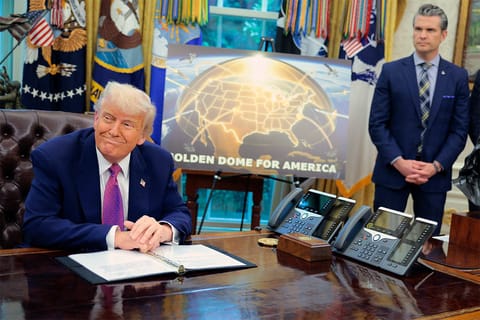
U.S. President Donald Trump speaks alongside Secretary of Defense Pete Hegseth in the Oval Office at the White House on May 20, 2025 in Washington, DC. President Trump announced his plans for the "Golden Dome," a national ballistic and cruise missile defense system. (Photo: Chip Somodevilla / Getty Images)
But the program is regarded as an extraordinary technical challenge that some experts say could actually lead potential adversaries to develop systems that would undermine it.
“Some elements of Golden Dome are needed in any event (missile warning and tracking for example),” said Kendall, the former Air Force secretary, in an email, “but the pursuit of a large-scale defense against a massive attack is a fool’s errand that we have tried before. It’s unaffordable, unlikely to work, and dangerously destabilizing.”
“These giant corporations aren’t funding the Trump ballroom fiasco out of the goodness of their hearts.”
Palantir is seen as particularly close to top Trump officials, and both it and Lockheed have donated an unknown amount to fund the controversial White House ballroom, fueling suspicion of a “pay-to-play” attempt to win favorable treatment from the administration.
“These giant corporations aren’t funding the Trump ballroom fiasco out of the goodness of their hearts,” said Jon Golinger, who works for the consumer advocacy group Public Citizen.
Palantir did not respond to POGO’s queries.
White House spokesperson Anna Kelly dismissed suggestions of influence peddling and criticisms of some of the administration’s high-profile projects as coming from political opponents “who clearly suffer from Trump Derangement Syndrome.”
“By investing in the historic Golden Dome in America and Golden Fleet to strengthen our national defense and building a long-awaited, secure White House ballroom, the President is protecting our homeland unlike any of his predecessors,” Kelly said in an emailed statement to POGO. “All of his decisions are guided by what is best for the American people.”
Nonetheless, the criticisms from Golinger and others highlight the appearance of a disconnect between the Pentagon leadership’s calls to prioritize “nontraditional contractors” and the defense contracting titans that spend millions of dollars on lobbyists continuing to win the lion’s share of taxpayer dollars.
One of those titans, Lockheed Martin — not only the Pentagon’s biggest vendor but also the largest federal contractor overall — isn’t shy about acknowledging the effect the president’s defense budget will have on its bottom line. In a recent interview with Federal News Network, Tim Cahill, the president of Lockheed’s missile production unit, said, “We are off to the races, all hands on deck.”
“The Department of War has been a great partner here,” Cahill added.
Related Content