White House Official Doubling as Ethics Czar Sparks Concern
Lawmakers and a former head of OGE say an OMB official’s concurrent role leading the Office of Government Ethics will compromise its work.

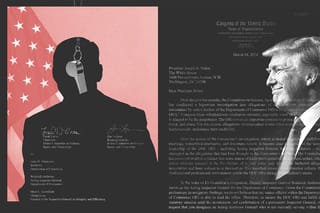
(Illustration: Ren Velez / POGO)
Last month, Eric Ueland, a political appointee from the Trump White House who serves as deputy director for management at the Office of Management and Budget (OMB), was installed as the temporary head of the Office of Government Ethics (OGE). Lawmakers and an ethics expert have raised concerns that this staffing move risks compromising OGE’s work.
Ueland’s confirmation to OMB in May was already split along party lines. Senator Gary Peters (D-MI) was particularly blunt in expressing his opposition. Peters declared on the Senate floor, “Eric Ueland has made it clear that he will ignore conflicts of interest in the government’s policy and contracting decisions, letting those in charge of government use it as a tool to enrich themselves.” Now, he has taken the helm of an agency specifically designed to prevent conflicts of interest and uphold ethics guidelines.
Get the latest
Weekly newsletter and occasional updates
OGE is an independent agency that helps to ensure executive branch employees’ financial interests do not prevent them from fulfilling their duty to the public. It does this by establishing ethics standards for the executive branch, reviewing and publicly posting the financial disclosures and recusal agreements of presidential nominees, and preventing and resolving ethical conflicts of interest among executive branch employees. In short, OGE’s purpose is to help maintain the public’s trust in government — particularly as it pertains to private financial influence. Ethical lapses can mire offices, agencies, or even entire presidential administrations in scandals and, more consequently, impede government programs and operations.
OGE was established in 1978 as part of a wave of post-Watergate reforms — including the creation of offices of inspectors general and the Office of Special Counsel (OSC) — intended to bolster oversight of the executive branch.
A 1983 Senate report explained why the office — and particularly the director — must remain independent and free from White House influence: “Unless the Director is insulated from political pressure from the White House or the OPM,” the report read, “he or she could be forced to compromise on what action the official must take.” Such pressure can intensify during OGE’s process to vet presidential nominees’ financial disclosures for potential conflicts of interest to help the Senate determine whether an individual is fit to serve. The Senate relies on OGE’s review, which can create friction with the White House, which expects the Senate to confirm presidential nominees as quickly as possible.
Ueland is the second official from the Executive Office of the President (which includes OMB and the Office of the United States Trade Representative) to be appointed acting director of OGE, following his predecessor, United States Trade Representative Jamieson Greer, who had held the post since April. Lawmakers and a former acting OGE director have raised concerns that installing political appointees from the Executive Office of the President threatens OGE’s longstanding insulation from White House control and influence. Ueland did not respond to a request for comment emailed to OGE.
Shortly after Greer was named the temporary head of both OGE and the OSC while also serving as U.S. trade representative, four House Democrats sent Greer a letter expressing concern over whether he would be able to “remain focused on fulfilling the duties for which you were confirmed by the United States Senate,” and demanding that he immediately resign from both leadership posts.
“The millions of people who rely on these agencies deserve leaders that are committed and focused on their respective missions, not a figurehead who is juggling multiple positions in the Administration,” the lawmakers wrote. “Further, there is a conflict of interest of your multiple roles since OSC’s and OGE’s jurisdictions include oversight of the Office of the United States Trade Representative, where cases of ethics disclosures, whistleblower reprisals, and mishandling of sensitive information may arise.”
This is no way to run anything and certainly not a way to run our government.
The Trump administration has become notorious for tasking top officials with running multiple agencies and departments simultaneously. As of September 4, at least 12 administration officials were serving in more than one senior position. For example, Ueland’s boss at OMB, Russell Vought, is currently juggling three high-level jobs: director of OMB, acting director of the Consumer Financial Protection Bureau, and acting administrator of USAID.
“This is no way to run anything and certainly not a way to run our government,” Max Stier, the president and CEO of the nonpartisan, nonprofit Partnership for Public Service, told NPR. He compared it to using “a single player to … play center and your point guard on your basketball team at the same time.”
When Don Fox, a former acting director of OGE under President Obama, spoke to POGO, he echoed concerns that a political appointee would not uphold the same standards or independence as an OGE career employee. Fox explained that a political appointee might succumb to White House pressure to certify a presidential nominee’s financial disclosure, while a career OGE official may either deny certification or abstain from certifying due to a conflict of interest.
The elevation of Ueland to the top ethics post is unusual. Until this year, all acting directors at OGE had come from within OGE and therefore had experience in government ethics.
In February, President Trump fired OGE’s previous director, David Huitema, a Biden nominee. Since then, the role of ethics czar has been filled by officials from outside OGE or from the White House: Veterans Affairs Secretary Doug Collins, then Greer, and then Ueland.
This move has reinforced the administration’s reputation for abruptly firing the heads of various watchdog agencies. Just days after taking office in January, Trump fired 18 inspectors general. The following month, Trump dismissed Huitema and also fired the head of the Office of Special Counsel, a decision Fox believes was part of a larger plan “designed and intended to weaken the major watchdogs over misconduct within the executive branch.”
Shortly after his firing, Huitema told ABC News, “I know that there are committed public servants still at the Office of Government Ethics and ethics officials throughout the executive branch who are committed to their work and committed to upholding those values of integrity.”
“But,” he added, “certainly those guardrails have been weakened.”
This investigation has been updated to note that Ueland did not respond to a request for comment emailed to OGE.