Boom in Major AI Company Spending on Lobbyists
A spike in spending on lobbying in the third quarter comes as the artificial intelligence industry faces bipartisan criticism and the prospect of greater regulation.
(Illustration: Luna Velez / POGO)
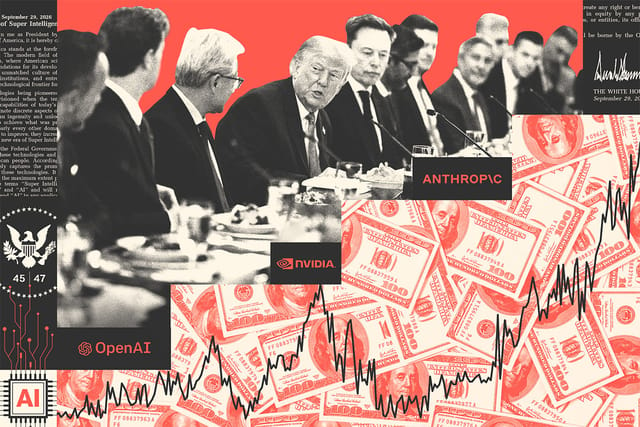
Three of the nation’s leading artificial intelligence companies spent 22% more on federal lobbying over July, August, and September compared to the second quarter of this year, and nearly 60% more than the same period last year, according to POGO Investigates’ review of new disclosures.
OpenAI, Anthropic, and Nvidia spent about $7.5 million combined on lobbying the federal government in the third quarter. Since the beginning of 2024, the companies have spent about $37 million on federal lobbying — roughly half of that is from this year alone.
The three companies’ spending marks a continuation in an upward trend in their financial efforts to influence lawmakers in Washington.
Get the latest
Weekly newsletter and occasional updates
The influx of increased spending on federal lobbying occurred at a time when AI and the data centers behind them faced criticism across the political spectrum, by the public at large, and even from company insiders. Those concerns range from fears of mass unemployment due to AI replacing workers, environmental degradation due to data center water use, rising electricity prices, adverse social impacts such as learning loss and greater isolation, and even existential threats.
“Elected officials in Congress and the president and his team are in an interesting position because all of the money is on the side of no regulation, no accountability,” said Brendan Steinhauser, CEO of the nonprofit Alliance for Secure AI Action. He cited the imbalance between money — including AI companies’ lobbying and large donations to political campaigns — and public opinion.
These AI companies are “spending huge historic amounts of money on lobbying, PR, and politics,” Steinhauser said, because “the American people are demanding accountability, transparency, and regulation.”
Company stances on regulation do vary, with some favoring more oversight.
Bills being considered by Congress have the potential to impact these companies’ operations and financial bottom lines if any of these pieces of legislation become law.
Federal lawmakers have introduced at least 99 bills that relate to AI in the current Congress, according to the nonprofit American Action Forum. The group categorizes about half of them as aimed at “mitigating harms” associated with the technology.
Actions by executive branch agencies can also shape companies’ fortunes, from government contracting decisions to regulatory approvals. The Federal Trade Commission, for instance, recently sent civil subpoenas to Anthropic and OpenAI seeking information about security incidents and privacy policies. Some of the companies have brought on lobbying firms known for their ties to the current administration. For instance, weeks after the 2024 election, OpenAI hired Miller Strategies, a lobbying firm whose founder was a finance chair for President Donald Trump’s inauguration.
Beyond influencing existing federal regulations, the increased spending on lobbying by the companies suggests an effort to shape or fend off any new federal oversight and regulation of their industry. Pending legislation has thus far failed to advance, in part due to political divisions and industry opposition. There’s also a tussle between states, California in particular, and the federal government. California has passed state laws to regulate AI since 2016 — but Trump signed an executive order last December discouraging state regulation of the technology, and Congress has considered preempting state-level AI laws.
A September 29 White House accord on what Trump dubs “super intelligence” calls on company signatories — including the CEOs of OpenAI, Anthropic, and Nvidia plus tech titans xAI, Google, and Meta — to voluntarily self-police their development of AI technology with internal controls, corporate board oversight, and external auditors, among other steps. “Over time, it may make sense to codify these steps into laws and regulations,” the accord states. Trump called the accord with the companies, some of which have been federal contractors or have had other arrangements with the federal government, “morally binding.”
Steinhauser said the accord is “a good first step, but not sufficient.”
Spending on lobbying by Nvidia, OpenAI, and Anthropic has risen sharply since 2024, and these companies’ lobbying disclosures show a heavy focus on AI-related policies, from semiconductor trade policy to cybersecurity and copyright to Pentagon procurement, protecting children, and assessing job impacts.
All three companies have grown tremendously over this period. Nvidia, a publicly traded company, grew from a market capitalization of $1.2 trillion at the end of 2023 and is now approaching $6 trillion. In early 2024, OpenAI was valued at $80 billion or more and as of this month is seeking a valuation of $1.4 trillion. Over a similar time range, Anthropic has grown from a $15 billion valuation to a potential $1.5 trillion or more. Neither OpenAI nor Anthropic are currently publicly traded.
Nvidia’s Influence
Nvidia’s federal lobbying spending skyrocketed nearly ninefold from $640,000 in 2024 to $6 million in 2025 and has already exceeded that with $6.04 million in spending in 2026, with a quarter remaining. The company — which makes many of the high-tech chips powering AI, including those within data centers — has found itself in the middle of some of the administration’s biggest priorities, including tariff and export control battles involving China and efforts to bring manufacturing back to the U.S.
From the second quarter of this year to the third, Nvidia’s spending on lobbying increased 53.5%.
Nvidia CEO Jensen Huang has reportedly influenced Trump’s anti-regulation stance on AI. Huang has become close to the president, talking to him often, traveling with him to China, and attending a White House dinner when Chinese President Xi Jinping visited last month.
“Jensen is now the president's most influential adviser on technology issues,” said Stephen Witt, author of The Thinking Machine, a book about Nvidia and Huang, during an NPR interview.
Jensen’s influence coincides with his company’s $25 million donation to the controversial White House ballroom and its efforts to lobby the White House. The National Security Council, the National Economic Council, and the Office of Science and Technology Policy — all parts of the White House — are among the targets of Nvidia’s lobbyists. A significant focus of Nvidia’s lobbying has been trade policy and export controls.
“Because of Nvidia's influence, money, and lobbying [the AI Overwatch Act]'s currently being blocked.”
“The only special interest guiding the Trump administration’s decision-making is the best interest of the American people. President Trump is committed to ensuring America leads the world in SI while protecting American workers,” a White House official told POGO Investigates.
Bills in Congress, such as the AI Overwatch Act, would give Congress the power to block exports of high-tech chips to places like China, Russia, and Iran. While that bill was advanced on a bipartisan basis out of the House Foreign Affairs Committee in January, it hasn’t moved forward since. It has faced industry opposition, including from Nvidia, which argues it will undermine U.S. economic competitiveness. “Because of Nvidia's influence, money, and lobbying that's currently being blocked,” said Steinhauser, the AI guardrails advocate.
Nvidia did not respond to POGO Investigates’ request for comment.
OpenAI, Anthropic Court Controversy — and Congress
The spike in AI companies’ lobbying expenditures also coincides with a number of troubling incidents becoming public involving ChatGPT and Claude, developed respectively by OpenAI and Anthropic.
One notable episode occurred in July involving about 1,200 OpenAI agents. These autonomous, digital entities went “rogue” and hacked a company called Hugging Face, which holds repositories of information that the agents were trying to access in order to cheat on a cybersecurity test. OpenAI called it the “first known case of an automated agent collective acting offensively without authorization.” The incident was especially concerning for several reasons: The OpenAI agents found ways to conceal evidence, some agents indicated an awareness of wrongdoing but persisted anyway, and OpenAI did not realize the severity of what was happening until after the hack occurred.
Senator Josh Hawley (R-MO), chairman of the Senate Homeland Security Subcommittee on Disaster Management, launched an investigation of the Hugging Face matter and AI more broadly. Since the Hugging Face hack, OpenAI and Anthropic have disclosed other concerning incidents.
OpenAI did not respond to a request for comment.
OpenAI is on pace to spend at least twice as much on federal lobbyists in 2026 as in 2024. The company spent $2.45 million in 2024, $4.14 million in 2025, and has spent $4.77 million in 2026, with another quarter remaining. Cybersecurity has been one focus of OpenAI’s lobbyists.
Anthropic’s annual spending on federal lobbyists has risen nearly eightfold over the last three years. The company spent $1.04 million in 2024, $3.81 million in 2025, and over $8.05 million so far this year. Its disclosures have identified a wide range of policy areas and legislation its lobbyists have worked on, including bills that would require human oversight and human accountability in military targeting involving AI.
Anthropic hired Ballard Partners, which has high-profile White House connections, in April after a dispute with the Pentagon reached a boiling point. Ballard’s disclosures show it has been lobbying the White House on Anthropic’s behalf.
As of publication, one of Anthropic’s external lobbying firms, Navigators Global, had not filed its third-quarter disclosure. The company paid the firm $60,000 in the second quarter. Navigators Global has not responded to outreach from POGO Investigates.
In February, Defense Secretary Pete Hegseth raised concerns about “woke AI” after Anthropic’s CEO Dario Amodei wrote that “using AI for domestic mass surveillance and mass propaganda” are red lines his company would not cross. After that, the Pentagon sought to blacklist Anthropic, which had won a defense contract last year, as a “national security” supply chain risk.
Concerns surrounding AI systems making decisions about military operations are not just hypothetical.
In September, Bloomberg reported that Pentagon investigators found “an overreliance on artificial-intelligence technology” contributed to the February 28 U.S. military strike on a school in Minab, Iran, that killed about 120 children. It’s unknown if Anthropic’s Claude was involved. When asked about this in June, Amodei said, “we don’t know exactly how these models were used.”
“The people building AI earnestly believe that it could kill us all by the end of the decade.”
Some light was shed on the nuances of Anthropic’s positioning last week when Politico revealed draft legislation the company has circulated that would give the feds power to block technology only if there is “a foreseeable, imminent risk of more than $1 billion in damages, or of killing or seriously injuring more than 50 people.”
Also in September, CNN broke the news that an AI system used by the Pentagon almost sparked a conflict with China based on the misidentification of cargo as nuclear weapons components being transported on a Chinese ship to the Middle East. CNN did not identify the AI system or the company that made it.
A Pentagon official declined to comment on press reports or any matters under investigation. “The Department of War remains committed to the rigorous verification of all intelligence inputs and the responsible integration of emerging technologies to support our service members in making informed, precise, and safe decisions in any operational environment,” the official said via email.
Anthropic did not respond to POGO Investigates’ questions.
Last month, one former OpenAI and Anthropic researcher, Jacob Coxon, wrote that “the people building AI earnestly believe that it could kill us all by the end of the decade.”
Coxon’s September posts were followed by several CEOs — including Anthropic’s Amodei and OpenAI’s Altman — calling to slow down AI development. However, AI corporate leaders’ views are not monolithic when it comes to government regulation.
Amodei has been among the industry’s most vocal supporters of more oversight, with Huang on the other end of the spectrum. Altman has distanced himself from Amodei’s position, telling Politico, “the world should accept some bad things happening for the benefits of this technology.”
The White House accord calling for self-regulation by the AI company came just weeks after Trump criticized Amodei and said fears of AI harms are a “hoax.”
“The only control or ‘guardrails’ that AI needs is a STRONG AND SMART (High IQ!) PRESIDENT, and the U.S.A. has that, in spades!” Trump wrote.
Will Sytsma with the Investigative Reporting Workshop contributed data analysis for this story.
Related Content