Explained: Medical Care in ICE Custody
When people in ICE custody have medical needs, who provides that care? What care is required? And who is responsible if those requirements aren’t met?

(Illustration: Luna Velez / POGO)
In any given year, hundreds of thousands of people are held in ICE detention centers nationwide, most without any criminal charges or convictions. Courts have held that the federal government must provide necessary medical care to people in custody regardless of their citizenship status. “In custody” does not always mean a person is physically at a detention center. Anyone arrested by ICE is considered “in custody,” including in the time prior to being placed in a center and even when transferred temporarily out of detention facilities. Medical care for people in the custody of ICE has been a source of concern for years, in part due to scrutiny surrounding deficiencies that may have played a role in deaths.
Get the latest
Weekly newsletter and occasional updates
Over the years, the number of deaths in ICE custody has varied, with ICE reporting 33 deaths in 2025, marking the deadliest year in over two decades. The scrutiny surrounding medical care for those in ICE custody raises key questions about a system that remains largely unclear to the general public: Who provides care, who oversees that care, and how can people seek recourse if they encounter inadequate care?
Who provides medical care to people in ICE custody?
ICE employs a mixed model of health care providers to deliver care to people in ICE detention. The ICE Health Service Corps (IHSC), ICE’s only medical unit, provides care at a subset of facilities. Facilities not staffed by ICE’s medical unit are staffed by medical professionals working for private companies or local governments. Those private companies may be under contract with the government directly. They may be under contract with a larger contractor that operates the facility. Or they could be under contract with a “non-dedicated” local facility — such as a county jail — that holds both ICE and non-ICE populations. A small number of facilities utilize health care practitioners from the IHSC.
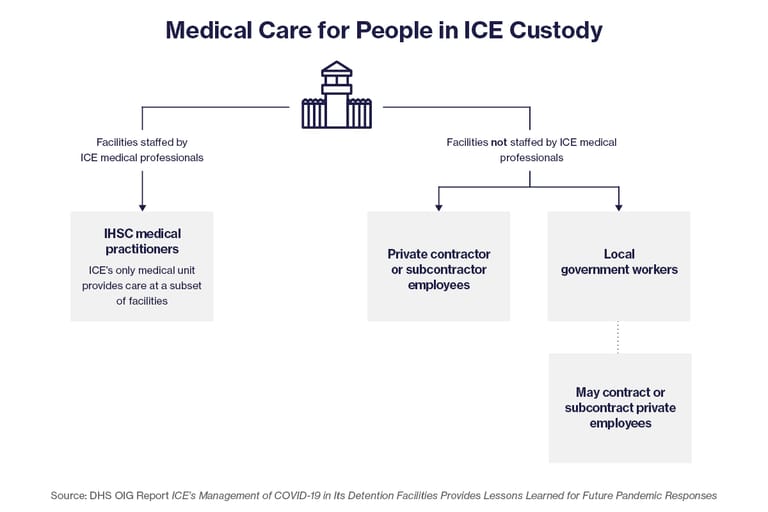
ICE requires providers to conduct a basic health screening within 12 hours after someone enters custody, and to deliver “necessary and appropriate” medical, pharmaceutical, and mental health care to people during their time in custody. That does not merely include basic screenings and exams. ICE standards explicitly require emergency and specialty care.
What are the main concerns with medical care in ICE detention?
Medical care in ICE detention facilities has been criticized for a number of different reasons over the years, but longstanding challenges and concerns include inadequate staffing of qualified medical professionals, inadequate medical screening, and inadequate systems for accessing and sharing the medical records of detained persons.
When do people in ICE custody need off-site care, and what happens when they do?
ICE facilities are not equipped to handle all medical needs. Sometimes, people in ICE detention experience medically complex conditions — such as cancer, a complicated pregnancy, or a chronic health condition — which require a specialist that’s unavailable on-site. When someone needs specialized care, they may be taken to an off-site medical facility, such as a hospital. The IHSC is responsible for all off-site medical referral processing, including approving requests, finding providers, booking appointments, and reimbursing providers for the cost of care. Not all requests by facility staff for specialized care are ultimately approved by IHSC. Both medical and nonmedical staffers working in ICE detention facilities are mandated to train people working in ICE detention facilities to seek emergency services in the event of a medical crisis requiring immediate attention. Even during off-site visits to medical facilities, detained people remain in ICE custody.
Who oversees medical care in ICE detention?
When it comes to medical care, a handful of agencies have oversight responsibilities. The Office of Detention Oversight (ODO) is required to conduct biannual inspections to ensure compliance with standards. Less frequently, the IHSC and the Department of Homeland Security’s Office of Inspector General (OIG) conduct their own, ad hoc, inspections. Historically, the Office of Civil Rights and Civil Liberties (CRCL) also conducts oversight by investigating complaints and reviewing Department of Homeland Security policy.
What happens when there are allegations of substandard care?
When someone detained by ICE experiences substandard medical care, a few oversight offices are seemingly set up to receive and address complaints: DHS OIG, DHS CRCL, and the Office of the Immigration Detention Ombudsman (OIDO). Additionally, people in ICE detention can file a medical grievance with the facility or use ICE’s reporting line (1-888-351-4024). However, there are hurdles to holding ICE accountable for poor medical care, and it can take time to receive medical care.