How DOD Insiders Opened Doors for a Firm Selling ‘Predictive’ AI
Retired generals and defense officials helped sell Rhombus’s AI tools to the U.S. military. The pitch didn’t always match reality, records show.

(Illustration: Luna Velez / POGO)
The sales pitch may have sounded like science fiction, were it not for a dozen high-profile national security names on the company’s marquee.
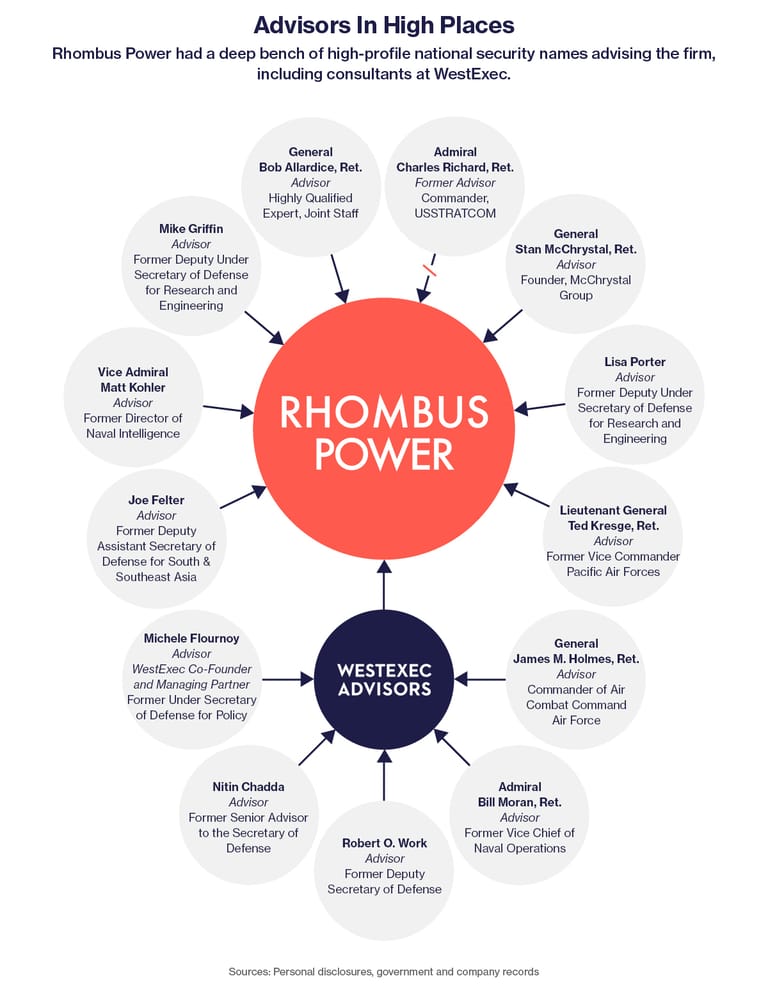
Rhombus Power Inc. said its state-of-the-art AI platform had predicted North Korean missile launches, Iranian attacks, and dustups on the China-India border, often weeks ahead of time. One of its high-profile advisors, Michèle Flournoy, said in 2023 that Rhombus was even helping warn U.S. authorities about the movements of nuclear weapons “that often evaded detection in the past.”
But the showstopper was Russia’s invasion of Ukraine.
Get the latest
Weekly newsletter and occasional updates
CEO Anshu Roy said his platform’s “Unblinking Eye” forecasted the attack “months in advance almost to the day.” In other tellings, it was even more precise: “accurate within 12 hours,” Roy wrote in a letter to Ukraine’s defense minister.
The pitch was delivered on the sidelines of a security summit in Singapore, at a glitzy White House event, in the pages of prestigious magazines, on CNN, and during visits to Rhombus’s Palo Alto headquarters. It was also paired with the work of an influential Washington consultancy called WestExec Advisors, according to emails reviewed by POGO Investigates.
Former generals and plugged-in politicos made introductions for Roy, spoke glowingly of his products, and in the case of Rhombus advisor and WestExec managing partner Flournoy, were called to help when a lucrative deal was in jeopardy, emails show.
“I need your help getting fully funded at SOCOM … I think it would be best if you talked to the Commander.”
The charm offensive appears to have helped Rhombus shine in a crowded field seeking contracts in the Pentagon’s dash to inject AI across the force, including money earmarked for “tactical” AI at combatant commands that Rhombus sought. During the AI boom, Rhombus has worked on classified programs, including for unnamed government clients, inked a contract worth up to $200 million, and won a multiyear foreign military sale financed by American taxpayers.
Yet, according to former employees, government officials, emails, and military assessments reviewed by POGO Investigates, Rhombus often failed to deliver as advertised. The records also offer a rare glimpse into what critics call “shadow lobbying” by WestExec, a firm co-founded by Flournoy and fellow Obama administration alum Antony Blinken that helped Rhombus pitch directly to military brass.
Records show that on several occasions, Rhombus personnel, including the CEO, were warned by military officials to stop sidestepping official contracting channels, and staff from at least one command believed Rhombus was trying to use relationships with senior leaders to paper over product failures.
Additionally, a lawsuit filed this summer by a former Rhombus vice president accused the firm of failing to report foreign contacts and mishandling classified information to “falsely inflate” the capabilities of its open-source intelligence products sold overseas.
In a statement to POGO Investigates, a Rhombus spokesperson said an investigation by an outside law firm found no evidence to corroborate the former vice president’s allegations. Attorneys for Rhombus filed a motion on October 8, 2026, asking U.S. District Judge Eumi K. Lee to compel arbitration, potentially taking the case out of the public’s view.
Rhombus did not answer a list of questions about its products or advisor network. WestExec also did not respond to a detailed list of questions, follow up emails, or calls to its Washington office.
Shadow lobbyists

Roy founded Rhombus in 2011, armed with a Ph.D. in chemical engineering and a plan to sell subatomic particle detectors to sniff out nuclear material being smuggled for terror plots. By 2025, AI was Rhombus’s primary product.
Yet a problem arose that summer.
Rhombus was nearing the end of a two-year contract with Special Operations Command (SOCOM). It had already earned the company $10 million, and Roy expected the contract to be renewed. But he thought someone at the organization was “playing games,” according to a July 18, 2025, email. So, he turned to WestExec’s well-connected managing partner.
“I need your help getting fully funded at SOCOM,” Roy wrote to Flournoy. “I think it would be best if you talked to the Commander.”
“From a revenue standpoint, this would be a quick win for WestExec. We are certainly going to get renewed, the only question is how much resource we can get,” Roy added.
WestExec, named for a closed road senior officials cross to reach the West Wing, faced scrutiny before when some of its staff were vetted for roles in the Biden administration — including Blinken, who became secretary of state, and Flournoy, who was not picked to be defense secretary (the policy division at POGO — from which POGO Investigates is independent — previously raised questions about Flournoy given her WestExec work).
The messages between Roy and Flournoy offer insight into WestExec practices that critics call “shadow lobbying”: contacts seeking to influence senior government officials while skirting the Lobbying Disclosure Act of 1995.
The July 2025 emails show Roy asked Flournoy to reach out to SOCOM boss General Bryan Fenton to influence the awarding of a contract because Roy thought lower-level staff weren’t receptive to expanding Rhombus services. “Let me know how I can best support your conversation with the Commander,” Roy wrote.
Flournoy wanted more details, emails show. She also urged Roy to hurry: “Fenton is retiring soon and we want to catch him before he walks out the door.”
Flournoy’s later contact to Fenton would be lobbying, three corporate influence experts said. Registration is mandatory if certain thresholds are met, like if lobbying-related activities constitute 20% of one’s time serving a client. The threshold is easy to exceed because it includes research and coordination before a lobbying contact is even made.
“So if you’re trying to secure a government contract from a leading military official, odds are very, very good that you pass that threshold,” said Craig Holman, a government ethics expert for the nonprofit group Public Citizen.
An advisor is “more of a senior éminence grise figure...You're higher status, and people are less alarmed to be talking with you.”
WestExec advisers routinely introduced Roy to senior government officials, according to other emails. The access was paired with praise for Rhombus’s products from WestExec staff like Vincent Brooks and Robert Work.
Brooks called Rhombus’s tools “high performing” and “very impressive” when he brokered introductions over the years for Roy to the generals who took over his old job commanding U.S. forces on the Korean Peninsula. Work, a former deputy secretary of defense, told the admiral helming Pacific Command’s (PACOM) intelligence directorate that almost “every place Rhombus has demonstrated” its tools “has adopted the platform.”
Flournoy also previously performed outreach for Rhombus. In February 2025, she emailed SOCOM’s acquisition executive, Melissa A. Johnson, to help arrange a meeting as Rhombus sought “to take its partnership with your team to the next level.”
Roy is “a genuine thought leader,” Flournoy wrote to Johnson, touting the CEO’s unique insight into AI that SOCOM could harness.
Johnson responded that a meeting “would be great.”
The title of advisor likely puts contacts at ease, noted Jeff Hauser, executive director of the Revolving Door Project.
“You’re more of a senior éminence grise figure … receiving and sharing wisdom, without being as commercial and as mercenary as a lobbyist,” Hauser said. “You’re higher status, and people are less alarmed to be talking with you.”
Fenton eventually received an email from Flournoy on behalf of Rhombus, too. The subject line was, “Your AI Legacy at SOCOM.” POGO Investigates could not review Flournoy’s message to the SOCOM commander — only his response five days after Flournoy told Roy to hurry.
On July 26, 2025, Fenton responded to Flournoy that he was “excited about what could be in store” with Rhombus and said he would confer with his staff to “get something back asap.”
His second email came on August 9, 2025.
“We’ve learned a great deal over the two-year pilot development effort with Rhombus,” Fenton said. “Yet, after talking with the team, that while I understand Rhombus tools were effective in saving staff time, some are currently not deployable nor met expectations.”
It was not the first time Rhombus received such feedback, records show.
A year prior, the Air Force’s Advanced Mobility Fusion Center assessed a Rhombus prediction tool and determined its “current state does not provide value or meet the criteria” for a minimum viable product.
The tool’s prediction model did confirm the suspicions of analysts tasked with monitoring Chinese and Russian activity, the August 16, 2024, report stated, but it “does not promote further development of analysts’ situational awareness.” Analysts also “struggled to trust” the tool, the report stated, because “it lacks data transparency.”
It wasn’t the only bad review in 2024.
Rhombus did not “deliver as advertised” on work it provided to PACOM that spring, military staff there complained, according to records. In a separate memo to some Rhombus employees, Roy also said PACOM “did not get the capability they expected from us.”
“But more importantly,” he added, “they all acknowledged that they did not ask the right questions, and that they failed to iterate in the right way.”
Fenton offered similar feedback to Flournoy.
He offered to “reset,” and said, “meeting expectations is a shared responsibility.” Fenton suggested Rhombus talk with a handful of his top personnel to “start this recommended dialogue — thankfully prompted by your [Flournoy’s] email to me.”
A spokeswoman for defense contractor MANTECH, where Fenton is now on the board of directors, did not reply to requests for comment. SOCOM spokesman Commander Joe Vermette declined to comment on the characterization of Rhombus’s performance in the emails, but he said no Rhombus tools are currently in use at the organization.
Security concerns

The reset apparently did not help.
Rhombus’s SOCOM contract ended in September 2025, shortly before Fenton’s retirement, according to a lawsuit later filed by Douglas Woodall, Rhombus’s former vice president of “Warfighting.” Yet, Woodall alleged, Rhombus continued to improperly access classified material using the expired SOCOM contract.
Woodall’s lawsuit said he helped clinch the SOCOM contract in 2023. He had spent 30 years in Army intelligence, so when it came time to conclude Rhombus’s work at SOCOM, his complaint said he took care to ensure everyone was properly disenrolled from the classified program. The mandatory process meant ending visits to a Sensitive Compartmented Information Facility (SCIF) in Chantilly, Virginia, where cleared personnel can view classified material.
That didn’t happen, Woodall alleged.
Three weeks after the SOCOM contract ended, Woodall said he learned that Rhombus personnel (including some whose work was allegedly unrelated to the SOCOM project) were still accessing the SCIF using SOCOM permissions.
Woodall said in the lawsuit that he learned of a similar issue regarding Rhombus’s Air Force contract to build decision analysis tools. An employee involved in that effort “raised concerns” with Rhombus’s security manager in September 2025 “about unauthorized access to SCI systems by Rhombus employees,” Woodall’s lawsuit stated.
After allegedly raising his own concerns internally and seeing no changes in behavior, Woodall said he sent a whistleblower letter to Roy, the company’s general counsel, and the human resources director on October 20, 2025.
The next day, he wrote an email to Roy and others to “raise additional concerns” that Rhombus was using SCIF access through unrelated contracts to “support its unclassified work for the Joint Fires Network,” an effort to link sensors and weapons for long-range strikes.
Woodall said he urged Rhombus to report the violations, or he would. Two days later, Woodall said Rhombus submitted an incident report to the Defense Counterintelligence and Security Agency alleging he was suffering “mental health issues” and exhibiting “erratic behavior.”
Woodall said he was then iced out of Rhombus operations.
“It makes me wonder how much [advisors attached to Rhombus] know about what the CEO was up to.”
Roy allegedly told Woodall’s subordinate on November 1, 2025, that Woodall was “‘no longer in the circle of trust,’” the lawsuit stated. He was placed on paid leave a few days later, and his department was eliminated on November 18, 2025.
Woodall said he began contacting U.S. authorities in the days before being laid off. He provided a sworn statement to the Intelligence Community Inspector General (IG) and submitted a reprisal complaint to the Pentagon’s IG. Eight months later, on July 17, 2026, he filed his civil lawsuit on the basis that the IG office had not resolved his complaint.
The lawsuit also accused Rhombus of failing to report foreign intelligence contacts and of using classified information to inflate the predictive capabilities it pitched to overseas customers.
“In other words,” the lawsuit alleged, “Rhombus was using classified information to strengthen the ‘analysis’ that it was sharing with foreign governments to make it appear as though Rhombus’ unclassified offerings could offer greater detail and capacity than those unclassified.”
The claims are particularly jarring given the advisors attached to Rhombus, from WestExec’s deep bench to retired generals H.R. McMaster and Stanley McChrystal.
“It makes me wonder how much they know about what the CEO was up to,” said Andrew Bakaj, a former CIA officer turned national security attorney. Bakaj said the allegations merit a look from investigative agencies. “Counter-intelligence, criminal, all of it.”
The FBI declined to comment on whether it was investigating. The Defense Counterintelligence and Security Agency, which oversees contractors performing classified work, did not respond to a request for comment.
Rhombus denied the allegations and said it “promptly retained” the law firm Pillsbury Winthrop Shaw Pittman to investigate Woodall’s claims over a six-week period.
“As described in detail in its report, the investigation found that no witness substantiated Woodall’s allegations, and the evidence consistently reflected Rhombus Power’s strong culture of compliance and commitment to safeguarding classified information,” Rhombus said in its statement. “Pillsbury’s investigation also did not reveal any evidence of a loss, compromise, or suspected compromise of classified information.”
Pillsbury previously conducted lobbying work for Rhombus, public disclosures show. And one of Rhombus’s advisors named on pitch documents to foreign customers was Jeffrey Merrifield, a partner emeritus at Pillsbury. Rhombus said Merrifield was not involved in Pillsbury’s investigation.
Woodall’s attorney, Robert King of King & Siegel, said Rhombus “has still not produced” the Pillsbury report in litigation, “despite being required to produce all documents that it claims support its positions.”
“Rhombus chose and paid Pillsbury,” King said in an email. “By Rhombus’s own account, the investigators deliberately did not review any classified information, which means they did not examine the very material at the heart of Col. Woodall’s allegations. We look forward to litigating this case.”
Foreign entanglements

Rhombus often pitched foreign governments on its predictive AI capabilities, including a system called Ambient.
WestExec staff linked Rhombus up with South Korean admirals, and Flournoy discussed the company over dinner with Singapore’s defense minister before arranging an introduction for Roy, emails show. In a January 2025 email chain with several WestExec staffers, Roy noted his goal was to sell to U.S. “allies and partners.”
“Japan is a customer, India and Taiwan should be onboard this year, Philippines also eager, Australia conversation needs to be lit up -- Nitin, need your help here,” Roy wrote, referring to Nitin Chadda, a former senior advisor to Defense Secretary Ash Carter and a WestExec managing partner.
Records reviewed by POGO Investigates offer insight into the Philippine deal.
By at least May 2025, Rhombus was furnishing unclassified intelligence reports in response to questions posed by Philippine defense chief Gilberto “Gibo” Teodoro. The questions weren’t strictly about security issues.
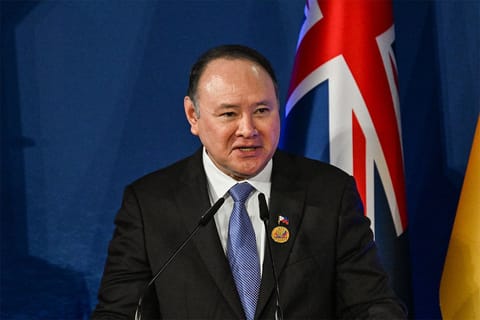
Philippine Secretary of National Defense Gilberto Teodoro delivers his opening remarks during the handover ceremony of the Association of Southeast Asian Nations (ASEAN) Defense Ministers' Meeting (ADMM), October 29, 2026. (Photo: Jam Sta Rosa - Pool/Getty Images)
In one report, Rhombus forecasted for Teodoro how President Ferdinand Marcos Jr.’s approval ratings were being affected by his cousin, Martin Romualdez, then the Philippines’ controversial speaker of the House. Rhombus’s report called Romualdez “a significant political liability” and examined how he could be removed from office “without appearing reactionary.”
Teodoro told Rhombus the document was “good,” but suggested it should also “capture that the recent dismal showing of administration candidates is due to Romualdez,” records show. Roy sent the feedback to staff and said, “See if we can add these pieces.” After receiving the amended report, Teodoro called it a “cold analysis” of the facts and said he would share it with Marcos’s staff.
Rhombus created more of those documents, including one after Romualdez resigned months later amid a corruption probe. But the company wanted a more fulsome relationship with the Philippines, one funded by U.S. Foreign Military Sales (FMS).
Syed Faraz, a Rhombus employee, had been working on the FMS since at least March 2025. Teodoro and Marcos were also helping by “putting heavy pressure” on the Philippine military to request Rhombus products, Faraz reported to Rhombus after an almost three-hour meeting with U.S. officials in Manila. The American side seemed “willing to work with us to smooth the process,” Faraz added.
But Rhombus kept hitting red tape.
On June 11, 2025, Roy wanted to ask Lieutenant General Josh Rudd for help. He was the deputy commander at PACOM at the time. “I need to know just one thing,” Roy told Faraz, “if I could get [Rudd] to talk to someone maybe his equivalent in rank, who on the acquisition side would it be?”
Spokespeople for U.S. Cyber Command, which Rudd now leads, declined to comment.
“I won’t call myself a ‘rainmaker’ but I’ll let the U.S. Department of State do it for me.”
Roy had pinged Rudd for help at least once before, records show. It’s unclear from the documents whether he did this time too, but by July 8, 2025, military contracting officials were feeling heat from somewhere.
“Given the high visibility on this,” a U.S. military official wrote in an email chain discussing Rhombus’s FMS request, “our leadership is pressing us for a determination.”
For Roy, the stakes were high. “We could be set for the next 30 years,” he had said to staff in 2025, “and we could sell more Ambient via FMS beyond Philippines.”
It took months, but things finally fell into place after Secretary of State Marco Rubio wrapped up a visit to Manila with an announcement that the U.S. was pouring $2.5 billion into Southeast Asia’s strategic infrastructure.
The investment included U.S. funding for Philippine access to Rhombus’s “predictive” capabilities.
“I won’t call myself a ‘rainmaker’ but I’ll let the U.S. Department of State do it for me,” Faraz wrote on LinkedIn, sharing the announcement. “I spent over 5 months in Manila working closely with our Filipino friends to get this $9.5M / year, multi-year deal. The goal is to build state capacity for both sides.”
Opened doors and sidestepped protocols

The Philippines deal, like much of Rhombus’s work that POGO Investigates reviewed, appeared to hinge on high-level relationships.
Even when the company failed to deliver, some senior U.S. leaders remained intrigued by Rhombus and its tenacious CEO, according to a memo Roy wrote documenting a conversation he had in October 2024 with Thomas Browning, acting assistant secretary of defense for mission capabilities.
Browning helped Rhombus get a deal to run a prediction pilot for the Joint Fires Network project after there had been “negative reviews” about Rhombus’s other work, according to the memo. Browning also counseled Roy on how to be successful in that work.
“While they were disappointed at the capability we eventually delivered (yes, I know we can keep arguing about that),” Roy wrote, “they continue to be bullish about what Rhombus can do.”
“Not a brag,” he added, “but they are sincerely bullish about me (Anshu), our technical prowess, and the way our team can potentially deliver.”
Browning, a political appointee, left the Pentagon shortly after the 2024 election and took on a new job a little over a year later: vice president for strategic capabilities at Rhombus.
Browning told POGO Investigates that Rhombus approached him after he left government and surpassed the one-year “cooling off period” for senior defense officials moving into the private sector. He said he cleared the job with the Pentagon’s legal counsel and “firewalled” himself from the contract he helped Rhombus obtain, which he added “ended shortly after I joined.”
“I want to ensure you are tracking unequivocally that it is inappropriate to utilize access to our government facilities to schedule additional facetime with [command] leadership outside the approved process.”
Rhombus’s tools often briefed well, their technical team was talented, and their demonstrations were sleek, people on both ends of the sales pitches said. The models gorged on heroic amounts of data and some tools could efficiently track standardized activities like satellite launches, a former employee explained.
“But as far as predicting something spontaneous or new, like a major operation or an election result,” the employee added, “the claims were just never supported.”
Records show PACOM staff working with Rhombus suspected the company of trying to use its relationships with senior leaders to overcome problems with its products. And the company did have a habit of sidestepping official contracting channels, according to other records.
In 2024, a Space Command officer reprimanded one Rhombus employee after he improperly tried to arrange a meeting with leadership.
“I want to ensure you are tracking unequivocally that it is inappropriate to utilize access to our government facilities to schedule additional facetime with [command] leadership outside the approved process,” Major Kathryn Norris warned Rhombus senior product manager Eric Russ.
Roy himself was chided in 2022 after Strategic Command (STRATCOM) notified contracting authorities that he had “been emailing their Commander directly,” emails show. That commander, Admiral Charles Richard, became an advisor to Rhombus after he retired. A spokesperson for Richard said he has since left the advisory role.
It was Rhombus’s work at STRATCOM, the military command responsible for nuclear deterrence, that anyone vetting the company would inevitably stumble upon — in this case, in the pages of Foreign Affairs.
As the hype around ChatGPT and other LLMs took off in 2023, WestExec’s Flournoy wrote an article for the magazine’s November/December issue, titled “AI is Already At War.”
In the piece, Flournoy said STRATCOM was using Rhombus’s AI tools “to help warn officials about the movement of nuclear-armed missiles that often evaded detection in the past.”
But behind the scenes, the article baffled STRATCOM staff, records show. In the days after Flournoy’s article was published, multiple personnel outside STRATCOM inquired about the claims with staff there.
As it turned out, according to the records, the effort Flournoy described in Foreign Affairs had ended long before the article was published.
A former official familiar with the work said Rhombus “failed to deliver what Flournoy wrote about.”
-
The following is the full statement from an unnamed spokesperson at Rhombus Power:
“Upon learning of Mr. Woodall’s allegations, Rhombus Power promptly retained Pillsbury Winthrop Shaw Pittman LLP, one of the nation’s most respected law firms, to conduct an independent investigation. The Pillsbury investigative team included a former Acting Deputy Attorney General of the United States, a former federal prosecutor, and government contracts attorneys with experience in compliance with requirements for the handling of sensitive information. The investigative team was tasked with conducting an independent thorough, comprehensive, and impartial review of the allegations, assessing whether any disclosure obligations were triggered, and ensuring that any legally required disclosures were made.
“In the course of the six-week investigation, Pillsbury reviewed email correspondence, contract and program files, and other internal communications relevant to the matters raised by Mr. Woodall. The investigative team also conducted 17 witness interviews, including Mr. Woodall, the CEO, and each employee identified by Woodall as having relevant information. There were no restrictions placed on the scope of inquiry or questions posed, and all witnesses participated voluntarily and responded fully. In conducting its review, the investigators were careful to ensure that no classified information was accessed, reviewed, or otherwise handled by the investigative team. All investigative activities were limited to unclassified materials and conducted in full compliance with applicable laws and regulations governing the protection of classified information.
“As described in detail in its report, the investigation found that no witness substantiated Woodall’s allegations, and the evidence consistently reflected Rhombus Power’s strong culture of compliance and commitment to safeguarding classified information, a commitment that is demonstrably led from the top of the organization. Pillsbury’s investigation also did not reveal any evidence of a loss, compromise, or suspected compromise of classified information.”
The following is the full statement from Robert King, a partner at King & Siegel LLP representing Colonel Douglas Woodall:
“Col. Woodall is a career intelligence professional who devoted 30 years to his country. It takes courage to confront a powerful government contractor like Rhombus, and we are proud to represent Col. Woodall.
"It is easy to hide behind anonymous statements that claim to describe the contents of a report Rhombus has still not produced in litigation, despite being required to produce all documents that it claims support its positions. Rhombus cannot quote the conclusions of that report to the press while withholding the report itself in the case.
"Rhombus chose and paid Pillsbury. By Rhombus’s own account, the investigators deliberately did not review any classified information, which means they did not examine the very material at the heart of Col. Woodall’s allegations. We look forward to litigating this case and seeing what the Pillsbury report found and what evidence it examined.”