45 Organizations Urge Congress: Reject the Pentagon's Request for FOIA Secrecy (Again)
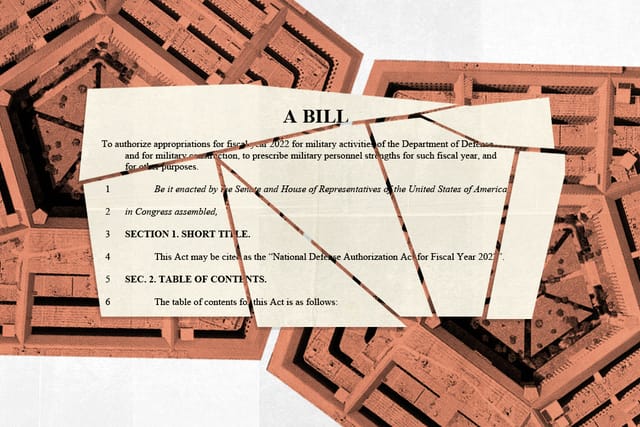
(Illustration: Renzo Velez / POGO)
To:
- The Honorable Jack Reed
Chairman, Senate Armed Services Committee
728 Hart Senate Office Building
Washington, DC 20510 - The Honorable Adam Smith
Chairman, House Armed Services Committee
2264 Rayburn House Office Building
Washington, DC 20515 - The Honorable James Inhofe
Ranking Member, Senate Armed Services Committee
205 Russell Senate Office Building
Washington, DC 20510 - The Honorable Mike Rogers
Ranking Member, House Armed Services Committee
2469 Rayburn House Office Building
Washington, DC 20515
Dear Chairman Reed, Ranking Member Inhofe, Chairman Smith, and Ranking Member Rogers:
The undersigned organizations urge you to oppose the Department of Defense’s proposal to alter the Freedom of Information Act (FOIA) through the National Defense Authorization Act for Fiscal Year 2022. The Pentagon’s proposed language would undermine FOIA by creating an unnecessary and overbroad secrecy provision at odds with the law’s goal of transparency and accountability to the public. The department’s proposal to exempt from disclosure unclassified information on “military tactic, technique, or procedure,” and on military “rule of engagement or rule for the use of force” would create an unnecessary and broad carve-out to public disclosure laws.1 Accountability and transparency are particularly important for the Pentagon, the largest executive branch agency with the largest discretionary budget. Because of the potential long-lasting effects on the public’s access to information, we urge you to reject this proposal.
This is now the seventh time the Pentagon has attempted to include this exemption, in various forms, since 2011.2 Each time, our community has sounded the alarm and pointed out that the department’s justification for the exemption does not include any indication that the language is necessary or that existing limits on disclosure have not sufficiently protected the effectiveness of military operations. This holds true for the Pentagon’s current attempt as well.3
Moreover, the department continues to propose these fundamental changes to FOIA despite not seeking input and concerns from the committees with jurisdiction over FOIA and FOIA-related issues.4 Input from those committees is necessary to ensure that any changes to FOIA promote consistent transparency and public accountability while allowing the government to withhold information that truly requires protection. A massive authorization bill, which has in previous years been marked up in secret in the Senate, is not the proper vehicle to amend FOIA for the largest executive branch agency.
FOIA already exempts “properly classified” national defense information from disclosure, which addresses concerns from the Department of Defense that it would be required to disclose information that would give potential adversaries advance knowledge of certain military tactics, techniques, and procedures.5 When pressed by congressional staffers and members of the open government community in years past, Pentagon representatives admitted that the department has never had to release information pursuant to a FOIA request that it would be able to withhold under this proposed exemption.6 Further, the department’s proposed language has no clear limits on what kinds of information could be concealed, meaning it could be used to conceal information about the military’s interrogation and treatment of prisoners; the department’s response to the January 6 insurrection at the Capitol; its handling of sexual assault complaints; its oversight of contractors; and other matters of compelling public interest.
The Department of Defense and all other federal agencies already have broad authority to withhold classified information under FOIA exemption one, and to withhold unclassified information under a variety of other statutes.7 According to Department of Justice FOIA data, the Department of Defense is already performing poorly by almost any metric. In fiscal year 2020, the Pentagon’s FOIA backlog was at an 11-year high. FOIA request denials that cite exemptions for why information is being withheld are at a five-year high.8 Recent analysis has shown a wave of increased secrecy at the Pentagon, with both an increase in information-withholding in response to FOIA requests and a large spike in administrative appeals resulting in a total reversal of the agency’s initial decision to conceal information from the public.9
Excessive, reflexive secrecy about completed military operations could also harm the troops, as exemplified by news reports that show soldiers’ health care was compromised by the military’s failure to acknowledge their exposure to chemical weapons in Iraq.10 The FOIA exemption in the Pentagon’s current legislative proposal appears intended to effectively overturn the 2011 Supreme Court decision in Milner v. Navy, which properly narrowed the interpretation of FOIA’s second exemption to cover only information about internal personnel rules and practices of an agency.11 This forced agencies to stop using that exemption to over-withhold information simply because it was used to instruct agency employees in the course of their jobs.
Although the Department of Defense has assured Congress that the exemption would not be used indiscriminately, there is no way to wholly prevent this department or another agency from interpreting this exemption in the future to withhold other kinds of information from public disclosure. The department’s inconsistent and unreliable implementation of FOIA should not continue through the addition of this unnecessary and overbroad exemption.
Our community is sensitive to the goal of ensuring that information that needs to be withheld to protect the safety of our troops and strategy of our military operations is not disclosed, but the Pentagon’s current proposal is not the way to do so. We cannot support the proposed language, but we encourage the Department of Defense to work with the committees of jurisdiction over FOIA to address the outstanding concerns without codifying language that could be easily abused to keep the public and Congress in the dark about our military.
Signed by:
- ACORN8
American Civil Liberties Union
Center for International Policy
Center on Conscience and War
Centro de Periodismo Investigativo
Church of the Brethren, Office of Peacebuilding and Policy
Citizens for Responsibility and Ethics in Washington (CREW)
Citizens for Safe Water Around Badger (CSWAB)
CODEPINK
Common Defense
Demand Progress
Eisenhower Media Network
Electronic Frontier Foundation
Endangered Species Coalition
Federation of American Scientists
George AFB – HTRW
Government Accountability Project
Government Information Watch
Ground Zero Center for Nonviolent Action
Hero's Journey Content
Malu Aina
Massachusetts Peace Action
National Freedom of Information Coalition
National Security Archive
National Security Counselors
National Taxpayers Union
Okinawa Times
Open The Government
Peaceful Skies Coalition
Project On Government Oversight (POGO)
Property of the People
Public Citizen
Reporters Committee for Freedom of the Press
Sage Information Services
SF Bay View
Taxpayers Protection Alliance
The Digital Democracy Project
The Komisar Scoop
The United Methodist Church – General Board of Church and Society
Transparency International – U.S. Office
Transparency International Defence and Security
Washington Coalition for Open Government
Whistleblowers of America
Win Without War
Women's Action for New Directions - Cc: House Committee on Oversight and Reform Chairwoman Carolyn B. Maloney
House Committee on Oversight and Reform Ranking Member James Comer
Senate Committee on the Judiciary Chair Dick Durbin
Senate Committee on the Judiciary Ranking Member Chuck Grassley