Contracting Scandals at DHS Underscore Need for Reforms
POGO calls on Congress to follow the money and increase oversight of contracts at DHS — and proposes solutions to cut down on waste, fraud, abuse, and corruption.
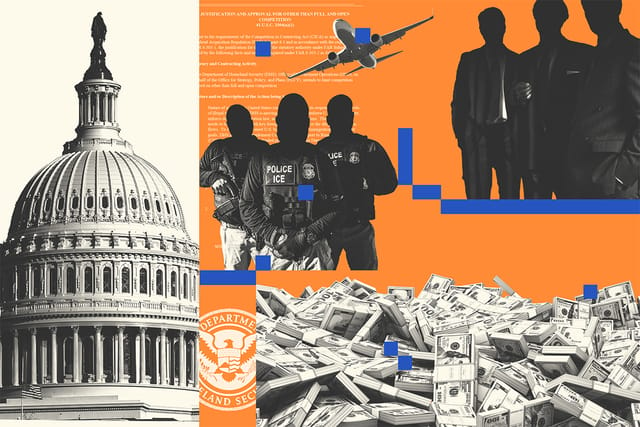
(Illustration: Luna Velez / POGO)
POGO has spent a lot of time and done a lot of work throughout our 45 years of existence analyzing and calling attention to problems in the federal contracting system. We’ve spent decades providing oversight with the goal of protecting Americans’ tax dollars from being lost to waste, fraud, abuse, and corruption. And we know from bitter experience that when the amount an agency spends on contracting skyrockets, as it has at ICE over the last year, the potential for waste, fraud, abuse, and corruption skyrockets, too.
We have documented myriad issues over the decades related to federal contractor misconduct, which includes concerns from corruption to cozy relationships. Our work in that area led the government to create a contractor responsibility database for contracting officials and the public as a way to avoid risky companies and individuals.
POGO has also been a strong proponent of a pro-taxpayer contracting system that is founded on adequate competition, accountability, transparency, and avoiding risky contract types. Taxpayers must be assured that the hundreds of billions of dollars spent annually on products and services is spent wisely. However, under the current system, we have witnessed too many examples of contracts that are overbudget and behind schedule, along with excessive profits, price gouging, overcharges, defective parts, and false claims.
For much of our time exposing these problems and proposing solutions to solve them, we focused largely (though not exclusively) on the defense contracting arena — POGO started as the Project on Military Procurement. Looking at where the largest total volume of money and largest volume of federal contracts are awarded has always been the best route toward finding and exposing problems. Put simply: We follow the money.
Continuing this tradition, we have noticed alarming trends and shocking instances of what look like potential corruption, conflicts of interest, and cronyism in the awarding of contracts by DHS. It is no coincidence that this reporting has followed a dramatic increase in immigration enforcement activities and a commensurate increase in funding flowing to DHS, especially the large infusion of additional funding that came through the budget reconciliation process last year. When activity and funding both rise dramatically, so too will the contract awards to the private companies that facilitate those activities.
So, we have followed the money at DHS — at least as far as we can, given structural issues in the federal spending tracking system. These structural flaws include poor-quality data that produces the “garbage in, garbage out” phenomenon, gaps in basic information standards, inconsistent or nonexistent end-to-end transparency, and large disparities in the quantity and categories of reporting across spending types.
The following is a non-exhaustive list of what POGO has found to date, all centering on problematic instances of real and potential corruption and conflicts of interest at DHS. Most of these examples relate to contracts awarded by the department.
- Just two weeks ago, POGO Investigates (PI), the independent journalism arm of POGO, with Mother Jones released a stunning investigation into the contractor behind former DHS Secretary Kristi Noem’s controversial luxury 737 jet, revealing the firm is part of a web of companies receiving various DHS contracts, all linked to the same well-connected individual. Another firm linked to the same individual reportedly received a nearly $1 billion DHS contract for self-deportation flights with only limited competition. According to previously unreported court documents, a DHS official acknowledged there was an “appearance of favoritism” in the decision to award the up to $915 million contract. This piece expanded on reporting in an October 2025 investigation co-published with Mother Jones detailing how that contract was awarded to a firm with “no track record” as a federal contractor through a “rushed” process that involved a DHS official with ties to the firm’s founder.
- Last month, POGO Investigates exposed a web of political connections and lobbying activities that involves some of DHS’s newest and biggest contractors. Included in these activities were specific advocacy efforts in favor of funding increases for DHS broadly, and for ICE specifically, in last year’s budget reconciliation bill — an infusion of cash that those contractors stood to potentially benefit from directly. Perhaps unsurprisingly, executives from two companies who provided significant political contributions saw their ICE revenue more than triple in a single year.
- In December of 2025, POGO and Mother Jonesreported on a number of former clients of White House Border Czar Tom Homan that have recently won “lucrative border and immigration-related contracts.” Given that Homan’s firm consulted for at least one of these companies as recently as 2024, ethics experts say there is at least an appearance of corruption.
- In November of last year, we highlighted a disturbing pattern of contract awards at the Department of Homeland Security through which the agency appeared to be circumventing its own leadership’s oversight by issuing a series of contracts for $99,999, just below the $100,000 threshold at which the former secretary had decided her sign-off was required.
- The month before, POGO and Mother Jones co- published an investigation that showed how the lobbying firm Ballard Partners, which has close ties to Trump administration officials, helped a surveillance and biometric company called BI² land a no-bid ICE contract worth millions of dollars. In fact, multiple Ballard clients have secured no-bid contracts with ICE worth tens of millions of dollars.
- In March 2025, we published an investigation exposing the political ties of CSI Aviation, a major ICE contractor. The firm, whose owner hosted a Trump campaign rally in the fall of 2024, “could make billions of dollars running deportation flights, despite its involvement in numerous high-profile controversies.”
- In January 2025, we released an investigation into the revolving door between the private prison giant GEO Group and the Department of Homeland Security, revealing that ICE’s former top detention official, Daniel Bible, had recently accepted a job with one of the agency’s largest contractors.
Each of these examples highlights a dangerous and troubling pattern of little or no competition for contract awards, rushed buying, or cozy relationships. While these situations are bad enough on their own, insofar as they represent possible corruption and corrosion of government policymaking and contracting decisions, they also serve to underscore a slew of interrelated and mutually reinforcing systemic problems.
The Problems
As a threshold matter, government officials with influence over the use of taxpayer dollars — such as through the award of federal contracts — should only make those decisions on the basis of a rigorous and competitive bid process through which merit and cost are the driving force behind the government’s contract awards.
According to ethics and contracting laws, preferential treatment based on personal and political connections should never be a part of the calculus. Unfortunately, as we know all too well and as we have seen all too often, the conditions of meritocracy, competition, and frugality are often missing or unevenly satisfied. Conflicts of interest and cronyism appear to persist unabated, despite the existence of certain laws, regulations, and internal rules meant to combat them.
One key factor in this reality is the sheer scale of federal funds awarded in contracts every year, which reached $793.3 billion in fiscal year 2025 (FY25). Of that total amount contracted out, $262.6 billion was awarded noncompetitively. DHS itself doled out $28.4 billion of that total contract award amount, including $2.5 billion in noncompetitive awards. It is important to note that the DHS-specific totals for FY25 do not reflect the additional $165 billion added to the DHS coffers via last year’s reconciliation bill. That single infusion likely led to an equally dramatic explosion in contracts awarded, as well as noncompetitive contracts awarded by DHS in fiscal year 2026 — $3.6 billion in six months thus far. The magnitude of this spending incentivizes both the scrupulous and unscrupulous to angle for a piece of the pie, either through legitimate means or through the more insidious mechanisms of influence-peddling and corruption of the process itself.
The contracting system is plagued by a lack of competition, insufficient transparency, failed accountability, and risky contracts.
An increase of agency spending of that magnitude should come with an equal increase in capacities, resources, and tools to conduct robust oversight, enhance accountability, and practice transparency throughout the entirety of the federal government. This parallel augmentation of oversight has not manifested meaningfully. In fact, recent trends have bent in the precise opposite direction.
It’s worth pausing to expand upon the previously referenced problem of noncompetitive or less-competitive contracting processes, including sole-source contracts. Without true competition for contracts, there can be no confidence in the integrity of the ultimate contract award decision. By definition, a contract awarded without competition or with limited competition cannot have been awarded on the basis of a rigorous comparison of approaches and options since there was only one option, or an artificially suppressed low number of options, to choose from. This reality can produce any number of suboptimal results, including inefficiencies in contract deliverables, higher costs, lower quality goods and services, and an increased risk of self-enrichment and corruption at the expense of the public.
Further complicating this picture, and further challenging the efforts of watchdogs like POGO as we follow the money, is the broken system currently in place for keeping tabs on federal funding, from award to contract completion. We have long called out and proposed solutions for this particular form of government dysfunction, especially as it pertains to how the government tracks funds (contracts, grants, loans, and any other form of spending) from the original prime recipient or awardee down to the sub-awardee level, such as to a subcontractor. A lack of transparency and reporting makes it difficult for watchdogs, investigators, and the public to identify which subcontractor received which cut of funding, which subcontractor performed which specific service, or even which subcontractor was responsible for which specific deliverable.
The contracting system is plagued by a lack of competition, insufficient transparency, failed accountability, and risky contracts. While agencies and contractors are to blame, so is Congress for listening too heavily to companies and their industry associations and gutting the system in the name of so-called “acquisition reform.” The public deserves a system that protects taxpayer dollars and ensures that those dollars are spent wisely.
The Solutions:
Addressing the issues of corruption, abuse, and conflicts of interest in the context of contracting at the Department of Homeland Security is a thorny task, but one that has a few clear pathways. The recommendations that follow largely aim to mitigate conflicts of interest by strengthening recusal rules and other guardrails designed to ensure the integrity of contract award decisions. Other reforms to improve transparency and allow the public to follow the money from end-to-end are also essential. Specifically, we recommend the following remedies:
Reverse the ills of so-called “acquisition reform.”
For 30 years, companies have lobbied Congress to remove red tape and ease the burdensome contracting system. Congress has capitulated on commercial products and services and other transactions and by gutting the Truth in Negotiations Act (now known as the Truthful Cost or Pricing Data statute) and Cost Accounting Standards. Now, Congress needs to reverse that trend — and the price gouging that takes place. Congress must ensure that commercial products and services are genuinely commercial, that agencies have access to certified cost or pricing data, and that Cost Accounting Standards (a standard process for contract costing) isn’t replaced by Generally Accepted Accounting Principles (a balance sheet). Agencies need tools to negotiate better deals, ensure contractors are accountable to taxpayers, and recoup costs if a company is noncompliant. Failure to provide those tools will result in less accountability and more corporate profits.
Enact statutory reductions and limitations on the amount of allowable sole-source contracts.
Historically, Congress has largely left it up to the executive branch to handle how federal funds will be awarded through contracts. There are certain statutory parameters in place to govern the competitiveness of the contracting process, but it is typically the Federal Acquisition Regulation that prescribes most of these rules. Given the problems with noncompetitive contracts highlighted over time and in our most recent reporting related to DHS, Congress should intervene and place strict limitations on exemptions and carve-outs that allow for no-bid, sole-source, and other kinds of noncompetitive or less competitive contracts to be awarded. Competition brings with it more innovation, lower costs, and, arguably of most importance, less opportunity for self-dealing and cronyism to seep in, infect the process, and corrupt its outcomes.
Establish a contracting commission dedicated to retrospective and real-time oversight of DHS immigration enforcement contracts.
Building on the model established by different iterations and variations of wartime contracting commissions, Congress should create and fund a similar contracting commission that would focus on oversight of DHS contracts related to immigration enforcement. Such a model has proven useful and effective in the defense/wartime contracting arena and could be similarly valuable in this context. Given that recent events have demonstrated the life-and-death gravity of immigration enforcement activities and the myriad opportunities for self-dealing and conflicts of interest in that context — not to mention large infusions of taxpayer funds into the DHS ecosystem — such an oversight mechanism would be timely and indispensable.
Reform and improve subaward reporting for enhanced contractor accountability.
It is crucial that executive branch agencies comply with existing subaward reporting requirements. If agencies continue to ignore or defy these preexisting requirements, Congress must step in and force compliance. Congress must also enact new requirements that implement additional subaward reporting standards, allowing for more comprehensive end-to-end tracking of subcontracts and other subaward types.
Strengthen recusal and conflict of interest safeguards in the federal contracting process.
There are already several statutory, regulatory, and procedural safeguards in place designed to mitigate and prevent conflicts of interest from corrupting the federal contracting decision-making process. Clearly, based on our decades of work and our recent investigative findings related to DHS, these safeguards are not working well enough. This is likely due to ineffective or nonexistent enforcement of current rules, as well as gaps and weaknesses in those rules.
Congress must open up key conflict-of-interest statutes — such as 18 U.S.C. Section 208 — and strengthen them. Congress should simultaneously conceive and construct better enforcement mechanisms. Congress should also direct the Office of Government Ethics to issue additional clarifying guidance and regulations on key ethical concepts related to contracting decisions by government officials, including but not limited to the “particular matter” standard and the “impartiality rule.” The Federal Acquisition Regulation (FAR) also contains provisions designed to prevent conflicts of interest and corruption in contracting, and Congress should do whatever it can to incentivize and, where necessary, coerce the executive branch into issuing FAR updates specifically aimed at preventing and mitigating conflicts of interest.
Resource and reinvigorate existing oversight practitioners.
While building new accountability, transparency, and oversight mechanisms is necessary, it is equally necessary to strengthen and preserve existing ones. Inspectors General (IGs), the Government Accountability Office, the Office of Special Counsel, the Office of Government Ethics, and others all play essential roles in conducting oversight or issuing important guidance on the meaning and application of key ethical standards.
One thing they all have in common is that they are chronically under-resourced (at best). In the case of IGs in particular, oversight practitioners are sometimes targets of executive branch efforts to undermine and attack their very functions and existence. Congress can help by sufficiently funding and resourcing these critical oversight and ethics stakeholders, and by empowering them to perform their roles consistently and effectively through the addition of protective safeguards against meddling and politicization.
Conclusion
DHS has been a particularly acute wellspring of problems related to contracting and potential corruption over the last year or so, and, frankly, for longer than that. But DHS did not create these problems, and they did not emerge out of nowhere. The problems highlighted above have plagued the federal government broadly and the federal contracting system more narrowly for decades.
Periodically, a series of scandals, or one especially provocative one, will spur responsive action from Congress and from the executive branch itself. We should view this moment, and these scandals at DHS, as that kind of opportunity. Given the seriousness and life-and-death consequences of what DHS does, especially in the contexts of immigration enforcement and protection of the homeland, it is critical to ensure the integrity and efficacy of decisions made at the agency.
By considering and enacting reforms like those I have offered above, Congress and the executive branch can enhance public safety and public trust while also taking more care in the stewardship andmanagement of precious public dollars. Increasing competition in federal contracting, lowering costs, promoting integrity, reducing real and perceived corruption, and improving the ethical posture of DHS will serve both the short- and long-term interests of the government, the public, and the country as a whole.
Based on POGO’s work, recent pay-to-play allegations against Corey Lewandowski, and the questionable ad and jet deals raised during Secretary Noem’s hearings prior to her firing, there are plenty of deals that deserve oversight from the DHS Office of Inspector General and a bipartisan Congress. That oversight is needed to expose how flawed the current system is. Do not be fooled; this isn’t an example of one or two bad apples: The problems in federal acquisition are deeply rooted at all federal agencies, including the Department of Homeland Security.
Related Content