Guilt by Association: Trump’s Illegal Boat Strikes
U.S. strikes on alleged drug boats are a new level of lawlessness — but Congress has the power to intervene.
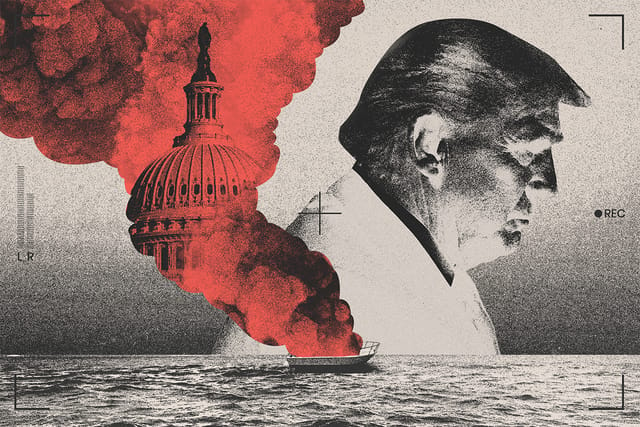
(Illustration: Ren Velez / POGO)
Think of all your acquaintances. Do you know everyone they know? How about everyone your acquaintances’ acquaintances know? The short answer is no, you don’t know all of them. But according to recent reporting, if the U.S. government sees someone on a boat in the Caribbean or eastern Pacific and believes one of their acquaintances’ acquaintances’ acquaintances is a member of a cartel, it might just blow them up.
Illegal Strikes
Since September, the United States government claims to have killed 80 people in strikes targeting boats it alleges — without any public evidence — are carrying drugs. Before then, the government had, appropriately, handled drug smuggling as a law enforcement matter, with the Coast Guard intercepting boats suspected of carrying drugs and arresting their crews. The administration claims the escalation to lethal strikes is justified because it deems cartels “narco-terrorists” and considers the act of smuggling drugs that may end up in the U.S. to be an “armed attack,” resulting in the U.S. being engaged in an “armed conflict” with cartels.
That is not true. As scholars and former officials steeped in the law of war have pointed out, these strikes are illegal. Smuggling drugs is simply not an armed attack; it is a crime. Doing so may make a person liable for criminal punishment, but it does not make them a combatant. And there is no evidence that the people killed in these strikes posed any immediate threat. As veteran national security reporter Charlie Savage succinctly put it, “In peacetime, targeting civilians — even suspected criminals — who pose no threat of imminent violence is considered murder. In an armed conflict, it is a war crime.”
This is not the first time a president has claimed the power to kill outside the law. Most notably, during the Obama administration, government lawyers in the Office of Legal Counsel concocted an argument to justify killing Anwar al-Awlaki, an American citizen who joined al-Qaeda. In that instance, the government claimed it would be legal to kill him, despite criminal laws against murder, an executive branch policy banning assassinations, and al-Awlaki’s constitutional rights under the Fourth and Fifth Amendments. We have long criticized that decision. As constitutional scholar Steve Vladeck notes, the boat strikes are even less justifiable.
In short, these strikes would be illegal even if the people being targeted were the most hardened cartel kingpins in the world. But apparently they are actually people who allegedly know someone who knows someone who knows a member of a cartel. In fact, they may not even be that. Some members of Congress have indicated that the administration may not know the identities of everyone killed in the strikes. It is hard to imagine a more fundamental abuse of power than killing people without process, in active violation of the law, without even knowing who they are.
Skirting Accountability
There is another law the administration is seeking to evade in these strikes: the War Powers Resolution. Under the Constitution, Congress, not the president, has the power to declare war. For decades, presidents have pushed that boundary, using military force in the absence of congressional authorization. The War Powers Resolution seeks to clarify the limitations on the president, reaffirming that Congress must authorize military action while recognizing that presidents have the power to use force to repel sudden attacks. Crucially, the law mandates that when presidents “introduce [the military] into hostilities” without congressional authorization, they must withdraw the military within 60 days unless Congress approves.
Recall that the administration has claimed the U.S. is in an armed conflict with cartels. Despite that, it is simultaneously claiming that the strikes do not amount to “hostilities” under the War Powers Resolution so the 60-day clock does not apply. The administration’s precise justification is not publicly known, but the legal sleight of hand once again has its most direct precedent in the Obama administration, this time in its air campaign in Libya in 2011.
In that instance, the Office of Legal Counsel initially blessed airstrikes without congressional authorization. But after they continued beyond the War Powers Resolution’s clock, even the Office of Legal Counsel could not justify continued military action. It fell to the State Department to develop the nonsensical argument that airstrikes did not count as “hostilities” and so the War Powers Resolution did not apply.
Without concerted action by Congress, we will only continue down a path where presidents can act as judge, jury, and executioner with no one to stop them.
It can be easy to get bogged down in semantics, but ultimately the issue is simple. Launching explosives at people or things is a hostile act. Congress meant for the War Powers Resolution to be broad — indeed, in addition to hostilities it places identical limitations on introducing the military “into situations where imminent involvement in hostilities is clearly indicated by the circumstances.” Claiming that airstrikes, whether against Libyan air defenses or people on boats in the Caribbean, do not meet that threshhold is a dangerous fiction invented by the very people ordering the strikes — exactly the abuse of power the Constitution and Congress intended to avoid.
What Congress Can Do
An administration that respected the law would stop these strikes. But if it won’t stop, there are things Congress can do. Most immediately, Congress can use the War Powers Resolution to bring votes to terminate the strikes — the administration’s claims otherwise notwithstanding. The Senate has failed to advance one resolution that would have ended the strikes, but the House has yet to vote, and the Senate could try again. Even if the administration rebuffs those votes, it is far better for Congress to be on record ordering the end of hostilities. And if the administration ignores those votes, Congress has options ranging from oversight all the way to impeachment.
In the longer term, structural reforms are necessary. To prevent presidents from seizing extraordinary powers for emergencies that do not actually exist, Congress should consider legislation like the bipartisan National Security Powers Act, which would clarify the meaning of “hostilities” and reassert Congress’s primacy in deciding to use military force. And as we’ve long argued, executive branch lawyers should be prevented from making secret law that inverts the Constitution to expand presidential power.
The strikes in the Caribbean and Pacific are a shocking escalation of an old problem. Without concerted action by Congress, we will only continue down a path where presidents can act as judge, jury, and executioner with no one to stop them.