Noem Must Go: Congress Needs to Impeach DHS Secretary
Kristi Noem’s Department of Homeland Security is a threat to the public. Congress must remove her before more harm is done.
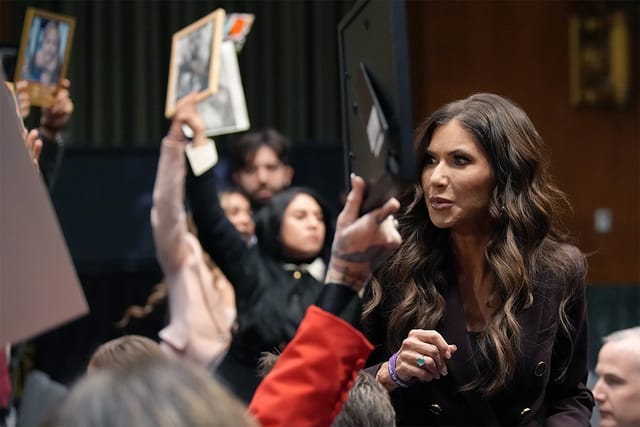
Protesters stand and hold photos as U.S. Secretary of Homeland Security Kristi Noem testifies before the Senate Judiciary Committee in the Dirksen Senate Office Building on March 03, 2026 in Washington, DC. (Photo: Andrew Harnik / Getty Images)
After her performance at yesterday’s Senate Judiciary Committee hearing, it’s clear the time has come for Congress to impeach and remove Homeland Security Secretary Kristi Noem.
In a different era, a sense of responsibility, integrity, or sheer political math after losing the support of multiple senators in her own party would probably have led Noem to resign. Senator Thom Tillis (R-NC) reiterated his call for her resignation at the hearing. But Noem offered no indication she would alter course, let alone take responsibility or accept consequences for her leadership. That leaves the ball in Congress’s court.
Even before the hearing, it was clear that Congress needs to step in. The Department of Homeland Security (DHS) has a long history of failures, constitutional rights violations, and unaccountability. But under Noem’s leadership it has transformed into a full-fledged secret police force, conducting what a federal judge in West Virginia recently described as “an assault on the constitutional order.” DHS has unleashed unjustifiable violence in American cities, undertaken a systematic campaign to undermine constitutional rights, and worked to thwart oversight at every turn. Impeachment is, at its root, a constitutional defense mechanism, and because Noem is ultimately responsible for the conduct of her department, it is warranted here.
The Standard for Impeachment
In 1970, future president and then-Representative Gerald Ford offered this definition: “An impeachable offense is whatever a majority of the House of Representatives considers it to be at a given moment in history.” This is not to suggest impeachment is trivial or should be routine. It is a weighty measure; there have been fewer than two dozen impeachments in U.S. history and fewer convictions. But as POGO wrote in 2019, the constitutional standard for impeachable offenses — “high crimes and misdemeanors” — does not directly correlate to criminal offenses that could result in an arrest and indictment. It covers a broader range of conduct, and conduct that directly undermines the Constitution readily qualifies.
The Case for Noem’s Impeachment
Noem’s tenure at DHS, and the immigration crackdown she has run in particular, have wrought so many abuses of power, abuses of people, and apparent corrupt acts that Congress could choose any number of them as the basis for impeaching Noem. As a starting point, though, we believe there are at least three distinct elements that show that under Noem’s leadership, DHS has become a threat to the safety and rights of people in the United States. Far from recognizing and addressing these abuses, Noem has ignored or encouraged them. We believe these elements require an impeachment inquiry and would justify Noem’s impeachment, conviction, and removal from office.
1. DHS is Conducting a Campaign of Violence Within the United States
By this point, scenes of masked, unidentifiable, and heavily armed agents snatching people out of cars or whisking them off sidewalks have become far too familiar across the country. So too have violent crackdowns by federal agents against protestors. Since September, DHS agents have shot at least 13 people, killing four. A 2025 incident in which an Immigration and Customs Enforcement (ICE) agent killed a U.S. citizen remained hidden from the public until being unearthed through a public records request. In multiple instances, the public narrative from DHS — that agents shot people who were attacking them — has been readily disproven, as in the killings of Renee Good and Alex Pretti and in court cases where prosecutors have been forced to admit DHS agents’ accounts were false.
Rather than reprimanding DHS violence against protesters, senior officials have publicly condoned it.
Lest someone attempt to dismiss these shootings as the result of individual agents’ bad actions, it is necessary to situate them in the broader context of the violence committed by DHS. Federal judges in multiple states have extensively documented unjustifiable violence directed at protestors, observers, and reporters. A federal judge in Chicago found in November 2025 that DHS “regularly and systemically targeted non-violent civilians and members of the press while they are exercising their First Amendment rights,” and noted that Noem “has instructed federal agents to ‘go hard and ‘hammer’ individuals for ‘the way they are talking, speaking, who they’re affiliated with.’” In February 2026, a federal judge in Portland documented a months-long and “escalating” pattern of DHS agents attacking protestors with tear gas, pepper balls, projectiles, and pepper spray. Moreover, the judge found that “rather than reprimanding DHS violence against protesters, senior officials have publicly condoned it,” supporting a conclusion that the agents’ actions indicated a “policy or custom of retaliation.”
It is true that some appeals courts have intervened to end some of these lower court orders. But that is because of questions within the judiciary of how prescriptively judges may limit executive branch activity, not because of any real dispute that DHS agents committed the abuses documented by the lower courts.
2. DHS is Systematically Undermining Constitutional Rights
DHS is acting in a variety of ways to undermine people’s constitutional rights, regardless of citizenship status. Much of the violence described in the prior section falls into this category; it was directed at people exercising their First Amendment rights, because they were exercising those rights.
But that is not the only way DHS is acting against the First Amendment. Recent reporting has exposed the ways in which DHS is apparently using surveillance tools, including facial recognition, and investigative tactics like subpoenas to technology companies, to identify and target individuals who protest or otherwise speak out against the agency’s activities. And POGO Investigates has documented the surge in referrals from DHS to federal prosecutors, seeking to charge people with allegedly interfering with agents. As the investigation shows, those charges are often baseless and fall apart in court.
DHS has undermined other rights as well. A whistleblower disclosure revealed that the agency’s general counsel signed off on a policy to allow immigration agents to enter people’s homes without a judicial warrant, upending decades of settled law on what the Fourth Amendment requires. If law enforcement agents can give themselves permission to force their way into people’s homes, nobody is safe.
Finally, DHS’s practice of indiscriminate arrests and indefinite detentions of people it seeks to deport violate a host of Fourth Amendment and Fifth Amendment due process rights. Here, a recent ruling by a federal judge is instructive:
Across the interior of the United States, agents of the federal government — masked, anonymous, armed with military weapons, operating from unmarked vehicles, acting without warrants of any kind — are seizing persons for civil immigration violations and imprisoning them without any semblance of due process. The systematic character of this practice and its deliberate elimination of every structural feature that distinguishes constitutional authority from raw force place it beyond the reach of ordinary legal description. … It is what the Fourth Amendment was written to prevent. It is what the Due Process Clause of the Fifth Amendment forbids.
DHS’s policy of mandatory, indefinite detention for anyone it seeks to deport has been rejected by federal judges thousands of times, at a rate of well over 10 judges finding it violates the law for every one judge who upholds it. The draconian nature of that policy and the total break with how DHS has traditionally interpreted the relevant statutes it represents should prompt congressional scrutiny. Supporters of the policy may point to the lack of a nationwide ruling that definitively settles the issue. But several judges have ruled that even if DHS wins its long-shot statutory argument, it is violating people’s constitutional right to due process. And other aspects of the administration’s detention policies lead to constitutional violations. In particular, judges have raised constitutional concerns about appalling conditions in many detention facilities, including negligent (if any) medical care and a lack of bedding and basic hygiene supplies. In addition, ICE’s practice of holding people incommunicado and moving them from district to district has the effect of cutting people off from access to counsel, let alone reliable access to the courts.
3. DHS is Systematically Violating Court Orders
During Noem’s tenure, DHS, and particularly ICE, has repeatedly violated court orders. In the words of the chief federal district judge in Minnesota, Patrick Schiltz, “ICE has likely violated more court orders in January 2026 than some federal agencies have violated in their entire existence.”
The violations in Minnesota that led to the judge’s admonition are shocking enough in their own right: The judge documented at minimum 96 court orders in 74 cases that ICE had violated. He later revised that tally to 97 orders in 66 cases — and identified another 113 violations, primarily since the end of January.
At a certain point, it becomes impossible to conclude that DHS cares about obeying court orders — and Noem’s failure to rectify the situation is disqualifying.
Nor were those cases unique. We first raised alarms about DHS’s court order compliance last spring, after the government ignored a federal judge’s order to return three planes carrying men in DHS custody to El Salvador. This month, the government admitted to violating 52 court orders by the federal courts in New Jersey since December 5, 2025. All the cases involved people in DHS custody. In Minnesota, judges have twice held government lawyers in contempt of court because ICE violated orders since Schiltz’s tally.
At a certain point, it becomes impossible to conclude that DHS cares about obeying court orders — and Noem’s failure to rectify the situation is disqualifying. A single violation of a court order is inexcusable. To have that many suggests a stunning indifference to the rule of law at best, and deliberate lawlessness at worst. And it is especially dangerous in conjunction with the widespread violence and rights violations DHS has perpetrated: The department isn’t just breaking the law, it’s failing to rectify things when it’s caught.
Noem Bears Responsibility
This list has focused on systemic patterns rather than individual instances of abuses. The head of an agency, much less a Cabinet secretary, is not responsible for every action by every person in their agency. But widespread, repeated behavior is ultimately a leader’s responsibility. And Noem’s responsibility goes beyond simply letting this occur on her watch. As explained above, she has encouraged agents to crack down on protestors. She immediately smeared Good and Pretti as domestic terrorists. At yesterday’s hearing, Noem blamed her statements on information she received from agents on the ground, rather than taking responsibility. And she has actively worked to undermine efforts to hold her agency to account, including by restricting congressional inspections of detention facilities and stonewalling inquiries from members of Congress.
The record is clear that under Noem, DHS has committed widespread abuses. If Noem will not resign, impeachment is warranted, and it is one of the few paths toward oversight still available to Congress. It is time for Congress to act to investigate, impeach, and remove Noem.
Related Content

DHS Secretary Kristi Noem Must Be Impeached and Removed, Says Nonpartisan Government Watchdog
Congress must hold the Department of Homeland Security accountable for trampling on our constitutional rights.