Supreme Court Allows Unconstitutional Racial Profiling
The Supreme Court’s order to allow immigration detentions without individual suspicion is wrong on the law and the facts — and dangerous to us all.
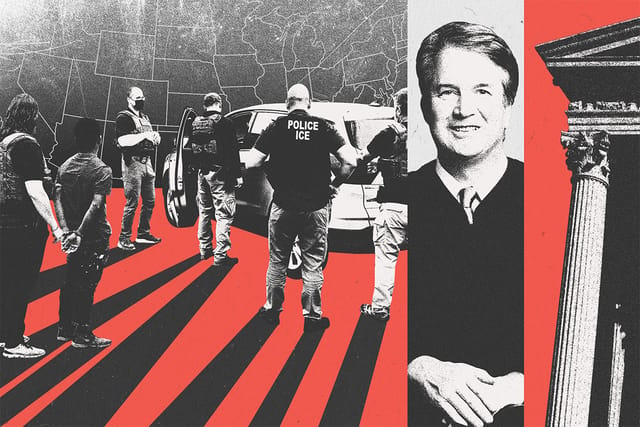
(Illustration: Ren Velez / POGO)
Earlier this month,the Supreme Court stayed a lower court decision that had limited racial profiling and arbitrary detention by federal immigration officials in greater Los Angeles —allowing federal officers to detain people solely based on their skin color, speaking Spanish, working in low wage jobs, or where they were located when agents stopped them.
As is often the case when the Supreme Court issues shadow docket orders, five of the justices who supported overturning the lower court’s decision declined to explain their reasoning. Justice Brett Kavanaugh did write a brief concurrence, which no other justice joined. But his opinion doubled down on harmful precedents, disregarded the factual record and legal reasoning of the lower courts, and drastically understated the harmful consequences of the Supreme Court’s actions.
The lower court’s order had a dramatic effect on immigration arrests in Los Angeles, which dropped by 66% in the two-week period that followed. The Supreme Court’s decision, however, threatens to enable more profiling and violent arrests in southern California — and sends a dangerous message to other cities where ICE is cracking down.
Flawed Precedents
Kavanaugh’s opinion relied heavily on two Supreme Court precedents that POGO has written about before: United States v. Brignoni-Ponce and City of Los Angeles v. Lyons.
Brignoni-Ponce, decided in 1975, is a case on what evidence federal officials need to stop a car and interrogate its occupants about their immigration status. The Supreme Court held that the Border Patrol needed “reasonable suspicion,” rejecting the government’s argument that “a person’s apparent Mexican ancestry alone” and general proximity to the U.S.-Mexico border were a sufficient basis. But as we wrote in a 2023 report warning about the Border Patrol’s overbroad power to arbitrarily search people and use racial profiling, the court authorized agents to rely on a long list of vague justifications for a stop, including “the characteristic appearance of persons who live in Mexico.” In the words of professor Reece Jones, Ph.D., the full list created “a broad range of possible reasons to stop someone, so broad that virtually any stop can be justified.”
City of Los Angeles v. Lyons, a 1983 case, dealt with the question of whether victims of government abuse could have their day in court. The plaintiff, Adolph Lyons, had been brutally choked into unconsciousness by a Los Angeles police officer. At the time of Lyons’ choking, Los Angeles authorized police to use chokeholds against “resisting” suspects even, as we wrote in 2020, “absent any evidence that officers were at risk of death or serious injury.” Lyons sued to force a change in the chokehold policy, and a lower court issued an injunction against it. The Supreme Court, though (we continued),
overturned it on the grounds that even though Lyons had clearly been a victim of the policy in the past, he could not prove that he was in particular danger of being choked by the police in the future… This was, of course, an impossible standard for Lyons or anyone else to meet.
Kavanaugh’s concurrence argued that under Brignoni-Ponce, “the Government has a fair prospect of succeeding” in arguing that its profiling of Los Angeles residents complies with the Fourth Amendment, and under Lyons, the plaintiffs could not show they were personally likely to be illegally profiled in the future.
Ignoring the Record Below
As harmful as the Lyons and Brignoni-Ponce precedents were, they did not require or justify the Supreme Court majority’s actions in this case. Both the trial court and 9th Circuit reviewed factual evidence and issued carefully reasoned decisions about why those precedents did not govern this case — but Kavanaugh’s opinion simply fails to address the lower courts’ findings and the supporting evidence. The record shows that agents’ conduct in Los Angeles was even worse than what those dangerous cases allow.
Without any citations, Kavanaugh characterizes immigration stops as situations where officers may briefly stop the individual and inquire about immigration status. If the person is a U.S. citizen or is otherwise lawfully in the United States, that individual will be free to go after the brief encounter. Only if the person is illegally in the United States may the stop lead to further immigration proceedings.
In fact, there have been multiple examples of immigration agents violently arresting and detaining both U.S. citizens and people with legal status — including some of the plaintiffs in this case.
Kavanaugh also claims that “plaintiffs have no good basis to believe that law enforcement will unlawfully stop them in the future.” As Justice Sonia Sotomayor points out in her dissent, immigration agents raided a car wash managed by one of the plaintiffs, U.S. citizen Jorge Viramontes, four times in just nine days.
The lower court record included 21 sworn declarations, which showed a pattern of masked agents violently arresting Latino residents of Los Angeles without asking them any questions at all, or refusing to accept their claims and proof of citizenship.
The record also included publicly reported statements from government officials, including White House Deputy Chief of Staff Stephen Miller ordering ICE officers to increase their arrest totals by targeting locations like Home Depot and 7-Eleven, as well as immigration officials telling officers to “turn the creativity knob up to 11,” and that “if it involves handcuffs on wrists, it’s probably worth pursuing.”
The worst part of Kavanaugh’s concurrence may be his cavalier dismissal of the harms of the majority’s decision.
Kavanaugh’s concurrence doesn’t cite the lower court evidentiary record at all. It does repeat an unsourced claim from the government’s briefs that “[a]bout 10 percent of the people in the Los Angeles region are illegally in the United States — meaning about 2 million illegal immigrants out of a total population of 20 million,” and argues that this is sufficient for “reasonable suspicion” that Spanish speakers and Latinos who work certain jobs are undocumented.
That number is higher than other estimates. Even if it were correct, it would not justify targeting working class Latino residents in the Los Angeles area for violent arrests based on racial and economic profiling. As the dissent notes, “nearly 47 percent” of the Central District of California’s population identifies as Hispanic or Latino, and “over 37 percent of the population of Los Angeles County speaks Spanish at home, and over 55 percent speak a language other than English.” The Supreme Court has held that facts that “describe a very large category of presumably innocent” people cannot form the basis for reasonable suspicion.
Harmful Effects
The worst part of Kavanaugh’s concurrence may be his cavalier dismissal of the harms of the majority’s decision. In addition to the false claims that people legally in the United States will only be questioned briefly and “promptly go free,” he writes that, “The interests of individuals who are illegally in the country in avoiding being stopped by law enforcement for questioning is ultimately an interest in evading the law. That is not an especially weighty legal interest.”
By the same logic, the Fourth Amendment rights of criminal defendants could also be characterized as “ultimately an interest in evading the law,” as could most of the Bill of Rights’ procedural protections.
The federal government has the legal power to detain and deport undocumented people, but there are also legal constraints on how it may exercise that power. It is not legal to disappear people without due process, before they can say goodbye to their children. It is not legal to detain them in inhumane conditions. It is not legal to randomly and violently stop people on the basis of their skin color and demand their papers. Ignoring those constraints does great harm to immigrants; to their parents; to their children going to school and to their children left behind; to their friends caught in raids; and to their communities experiencing frightening uses of force. There is even more evidence of this now than there was on July 11, when the district court first issued its restraining order.
Just a day before the restraining order was issued, immigration officials raided a licensed cannabis farm in Camarillo, California, and arrested over 360 people. One of them was U.S. citizen and Army veteran George Retes, who worked as a security guard there. Retes recently wrote a firsthand account of his arrest and detention:
An agent smashed my window and pepper-sprayed me. I was pulled from the car, and one agent knelt on my neck while another knelt on my back.
My wallet with my identification was in the car, but the agents refused to go look and confirm that I was a citizen. Instead, I sat in the dirt with my hands zip-tied with other detainees for four hours.
He was jailed for three days and nights, put on suicide watch, and denied access to a phone call or lawyer. Eventually, he was released without an explanation or apology. It was not, in Kavanaugh’s words, “a brief encounter,” nor was it a safe one.
Sometimes immigration officials’ tactics have fatal consequences, as they have for Jaime Alanís Garcia, Carlos Roberto Montoya, and Silverio Villegas González, all of whom died after attempting to flee from ICE or Customs and Border Protection.
We are all harmed by living in a “papers please” country where U.S. citizens, legal immigrants, and undocumented people alike can be violently arrested for their skin color. The Supreme Court’s attempt to pretend otherwise does not do away with the very real harms of the enforcement tactics it has allowed to continue. This case is far from over, and this dangerous order cannot be the final word on our legal protection for arrest and detention. We urged Congress to reform the shadow docket in 2021, and the need for reform becomes clearer every time the Supreme Court sets aside a lower court opinion protecting constitutional rights or separation of powers.
Related Content