Trump Administration Deregulatory Push Risks Corporate Capture
Trump’s deregulatory agenda weakens safeguards, sidesteps public input, and could give even more power to special interest groups.
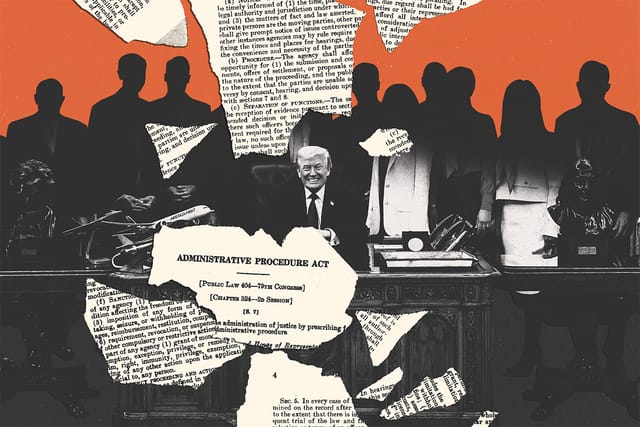
(Illustration: Ren Velez / POGO)
The federal rulemaking process is complex. Regulations impact so many aspects of daily life — such as public health and safety standards, or rules governing financial institutions to protect consumers — that creating or making any changes to them generally requires a careful, often lengthy process that spans multiple phases of research, review, and oversight. However, even when agencies are careful and adhere to the rulemaking process, it remains an imperfect process.
Too often, the U.S. political system allows those with significant financial resources to heavily influence policy decisions, often at the expense of the public. The regulatory system is not immune to such influences. One major issue is corporate capture, wherein private and special interest groups that have greater financial stakes and resources exert outsized influence in government, in this case over regulatory agencies meant to serve the public.
Corporations have long been entrenched in the American political system. Supreme Court decisions, such as Citizens United v. FEC (2010) and First National Bank of Boston v. Bellotti (1978), and a U.S. district court case in California, In re Tiburcio Parrott (1880), have enabled this longstanding trend. These cases reinforced conditions that weaken and prevent safeguards in the rulemaking process and leave it vulnerable to private interests shaping the policies that govern them. Disproportionate corporate representation amplifies well-resourced interests while systematically marginalizing communities and groups with limited capacity to engage, undermining the integrity of rulemaking and creating a regulatory landscape that unfavorably impacts underrepresented communities.
The Administrative Procedure Act, the statute that governs regulatory actions, was the result of a long effort to standardize and regulate the expansion of administrative agencies. The law outlines the general procedures that agencies must follow when creating, amending, or repealing a rule. In all three instances, the agency is required to plan and gather data before publishing a notice of proposed rulemaking, to provide at least 30 days for the public to comment (barring specified exceptions), to conduct various reviews, and to publish the final rule in the Federal Register. But the Trump administration appears to be directing agencies to stray from this process, thereby sidelining formal mechanisms that ensure the knowledge and views of stakeholders who are often overlooked, such as small businesses and tribal communities, are taken into consideration.
While prior administrations have pursued deregulation, this administration’s aggressive deregulatory agenda is widely considered an unprecedented effort by the executive branch to accelerate the dismantling of regulatory safeguards and risks creating a regulatory environment increasingly susceptible to corporate capture. Deregulation is not an exception in the Administrative Procedure Act, yet the Office of Management and Budget (OMB) seems to be treating it as one. However, removing a rule is still a form of changing federal rules, and the executive branch must comply with the statute.
Reverting to Outdated Regulatory Analysis Standards
In February 2025, the Office of Management and Budget revoked the 2023 version of OMB Circular A-4 — a guiding document for federal agencies on how to conduct accurate, evidence-based regulatory analysis, especially cost-benefit analyses — and reinstated the 2003 version. The circular plays an important role in the regulatory review process because it guides how agencies analyze the benefits and costs of proposed rules and, by extension, how the Office of Information and Regulatory Affairs (OIRA) evaluates those rules.
The 2023 version of the circular better reflected the current economic and scientific developments compared to the older version. The 2023 version provided stronger guidance on how agencies can perform distributional and equity-centric analysis. Analyzing distributional effects provides incredible insight to agencies on whether certain regulations are fairly benefiting or unduly burdening already disadvantaged or marginalized communities. The updated 2023 circular marked a move away from overreliance on monetized costs and benefits toward a more nuanced definition of regulatory benefits. Reverting to the 2003 version could essentially encourage deprioritizing the human effects of rules and regulations and reinforce the weight of economic gain instead, elevating corporate and business interests at the expense of human welfare and public interest.
Recent OMB Memo Asks Agencies to Redouble Efforts to Deregulate
Another deregulatory directive from OMB is Memorandum M-25-36. In it, the office instructs agencies to “redouble their efforts” to withdraw so-called “facially unlawful” regulations. Yet the memo creates ambiguity by granting agencies discretion to determine what is “facially unlawful” and when to bypass the Administrative Procedure Act’s requirements, a role traditionally reserved for the courts. Moreover, the memo encourages agencies to remove regulations through several questionable methods.
Requiring 10-to-1 Deregulation
In 2017, President Donald Trump released Executive Order 13771, a directive that required two regulations to be repealed for every new one introduced. In his second term, he has expanded that quota to make deregulation more far-reaching: For every one regulation an agency introduces, they must repeal 10 existing rules, regulations, or guidance. This is known as the 10-to-1 deregulation initiative.
Large-scale and aggressive mandates like this place an undue burden on agencies to eliminate existing regulations, including those that are shown to be beneficial to the public, simply to create a new one. This creates a false choice. Agencies may be pressured to repeal rules that are easier to remove, even if they provide significant public benefits, just to finalize a new rule. Rules that are easier to eliminate are often those that affect smaller industries, have less impact on major stakeholders, or are administratively or legally simpler. It becomes less about the substance of the rule and more about who can marshal greater advocacy resources — typically well-resourced special interest groups — resulting in an unbalanced arena for individuals and communities with less power. Be it 10 or two, mandating deregulation to create new regulations is arbitrary. Rulemaking is a procedure that merits thoughtful consideration, not quotas.
It is also a question of whether this initiative is the most efficient approach to addressing overregulation: The administration is asking agencies to nullify existing policies, rules, and regulations that have already gone through the lengthy process to be finalized. If the administration’s goal is to improve efficiency, a better way to accomplish that is to increase transparency in reviewing regulations and to improve the way agencies evaluate public comments.
Truncating the Review Time for Agency Regulations
The OIRA is a central office within OMB that can determine whether and how a rule proceeds. Per Executive Order 12866, anyone can interact with the office through meetings and public listening sessions, by submitting data or public comments, and more. OIRA typically has 90 days to review regulatory actions, with the possibility of a 30-day extension if it’s approved by the director of OMB. Under the new directive, however, OMB has imposed a shorter review period: Twenty-eight days for OIRA to review deregulatory actions and 14 days to review “facially unlawful rules,” except in cases where extensions apply. The call to “quickly withdraw regulations” further illustrates that the evaluation process is driven more by impulse than by careful, standards-based deliberation.
OIRA frequently takes more than 30 days to complete regulatory action reviews. The data suggests that it would be difficult for the office to consistently complete reviews in 28 days. Compounding that, OIRA’s scope has grown over time, and the current staffing level remains insufficient and disproportionate to that growth. Compared to previous years, OIRA’s current estimated staffing level remains stagnant, making a 28-day turnaround even more challenging for the office. In addition to the likely burden caused by this policy, shortening OIRA’s review period simultaneously reduces the public’s window to engage with the office on a specific issue and violates the spirit of Executive Order 12866.
It is common for new administrations, regardless of party, to review existing rules and regulations and to seek the repeal or rescission of those that do not align with their priorities. Interestingly, the Trump administration has unexpectedly echoed the same language used by preceding presidents of both parties when it comes to regulatory affairs. Trump and several preceding presidents are similar in their rationale for deregulation, which is that overregulation places an undue burden on regulatory operations and objectives and that economic benefits should be the priority. Like President Richard Nixon, Trump characterized regulations and reporting requirements as unduly burdensome. Echoing President Jimmy Carter, the Trump administration emphasized economic deregulation and the use of flexible regulatory alternatives. Under President Ronald Reagan, regulatory policy placed more weight on cost considerations. And consistent with Clinton-era practice, the current administration retained the requirement that agencies assess both the benefits and costs of regulations, but with the additional imposition of binding regulatory budgets.
OIRA has a responsibility to conduct oversight of multiple areas of rulemaking, such as significant rules, deregulatory actions, and guidance that have legal or policy implications. Compressing the OIRA review period from up to 90 days to just 28 is likely to undermine fair opportunities for meaningful public participation and risk privileging well-resourced special interests over broader public input. As a result, industry players become the dominant voices shaping government decision-making.
Undermining Federalism and Consultation Protections for States, Small Businesses, and Tribes
The Administrative Procedure Act is not explicit in requiring agencies to consult with certain entities before or during the rulemaking process. Consultation requirements typically stem from executive orders, separate statutes, or agency guidance. Through Memo M-25-36, OMB informed agencies that they are no longer obligated to consider federalism principles between the local, state, and federal governments or to consult with tribal governments and small businesses when they seek to deregulate. This effectively reduces opportunities for communication from impacted communities and decreases oversight of harmful agency actions.
This administration appears to rely solely on a textual technicality as justification to repurpose the intent of such executive orders. OMB asserted that when these executive orders were released during the late Clinton and early George W. Bush administrations, the administrations did not have deregulation in mind, so the executive orders do not apply to deregulation. This policy interpretation is not well-supported. OMB has offered no evidence that prior administrations intended these executive orders to exclude deregulatory actions, and the text of the orders themselves doesn’t make that distinction.
OMB’s instructions to disregard these older executive orders undermine clarity regarding agencies’ roles. Upholding such agency guidance is necessary both to advance Congress’s intent behind the Administrative Procedure Act and to prevent disproportionate harm to affected communities. At a minimum, it is essential to preserve the integrity of the rulemaking process and to commit to an additional layer of accountability.
Statutes alone frequently don’t include sufficient detail for agencies to execute their responsibilities and to fully effectuate the law’s purpose. These executive orders served as an additional safeguard to limit federal overreach and ensure that communities and entities have better opportunities to participate in shaping rules that impact them. Ignoring these executive orders under a false pretense would be to the public’s detriment by creating a more uneven playing field that ignores economically vulnerable and marginalized groups.
Agencies have historically fallen short in implementing these executive orders. A responsible executive branch should focus on improving compliance, not advancing an unsupported rationale that could violate constitutional principles, undermine tribal sovereignty, and diminish meaningful input from small businesses.
Reckless Deregulatory Actions Increase Risks of Corporate Capture
How any administration creates, amends, and repeals regulations matters. The Trump administration has prioritized evaluating rules and regulations through economic rather than social costs. From the guidance and memos released so far by OMB and the White House, the rationale behind this attempt to rapidly deregulate largely focuses on increasing economic competition and reducing costs. While these goals are not inherently harmful, the pace and scale of OMB’s actions are likely to reduce opportunities for public participation in the rulemaking process (including the rescission of rules), which in turn increases the risk of corporate capture, where private industry shapes regulations in ways that best suit their needs and profit rather than the interests of the public.
There are many ways corporate capture can occur in the regulatory space. First, there is the persistent issue of the revolving door, where industry officials leave the private sector to work in influential regulatory roles in government, and vice versa. Second, the rulemaking process can make it more difficult for the general public to weigh in (by reducing review times, for example), making engagement less accessible for stakeholders who lack industry clout. And third, when the rulemaking process prioritizes private profit or economic welfare over public welfare. The Trump administration’s policies facilitate each one of these contributing factors.
The deregulation prescribed by the administration is no easy feat. The directives are difficult for agencies to implement rapidly, and the rationale and guidance behind the directives are full of holes. This difficulty is evident from the most recent OMB deregulation memo’s directive for agencies to “redouble their efforts in this area,” a signal that perhaps agencies are not yet executing the administration’s deregulatory policies to the extent it desires.
The deregulatory policies set by Trump and OMB are not only burdensome for agencies but are a violation of the Administrative Procedure Act. Such reckless deregulation is inconsistent with best practices that ensure integrity in the rulemaking process — careful regulatory analyses and decision-making, engaging with hard-to-reach or impacted communities, and reducing barriers for public participation. There have long been calls to improve the regulatory process, and it most certainly can be improved. Agencies should adopt internal processes that ensure all rulemaking — whether new, amended, or repealed — is carefully considered to minimize potential problems and to maximize public participation. The solutions promoted by the Trump administration signal a move in the opposite direction.