Trump Must Justify Iran War to Congress Now
The War Powers Resolution requires the president to justify his actions to Congress immediately.
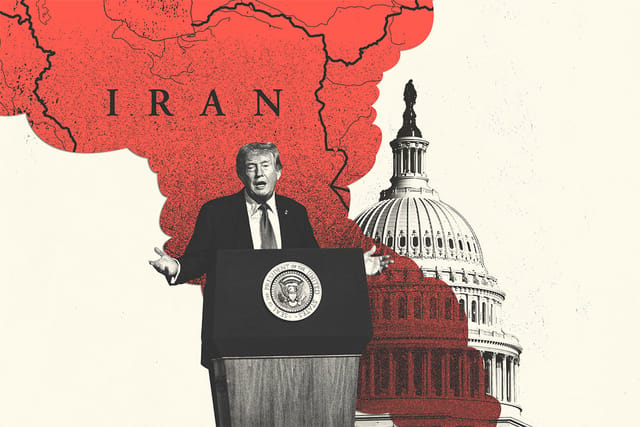
(Illustration: Luna Velez / POGO)
This week, Defense Secretary Pete Hegseth testified in front of Congress for the first time since the United States launched its unconstitutional, illegal war with Iran. Despite hours of testimony split between the House and the Senate, Hegseth once again failed to offer a coherent justification for the war, nor did he acknowledge the looming legal deadline for the war to end. Today, it is clearer than ever that Congress must step in. We spoke with David Janovsky, acting director of The Constitution Project, to ask about the legal rights and responsibilities of Congress and the president when it comes to war powers.
What does it mean to say this is an “unconstitutional, illegal war”?
As we’ve argued, the United States’ conflict with Iran is already illegal on multiple grounds. First, there has been no public evidence that Iran posed anywhere near the imminent threat that would have permitted President Donald Trump to use the military in self-defense. Indeed, in his testimony yesterday, Hegseth claimed the United States had destroyed Iran’s nuclear facilities last year, and that the current war was justified because Iran still aspired to create a nuclear weapon in the future. A foreign nation that “had not given up their nuclear ambitions,” as Hegseth described Iran, is not an imminent threat — much less engaging in an armed attack that must be repelled immediately. And in the absence of an imminent threat, the Constitution requires that Congress, not the president, approve the use of the military.
Despite several attempts to force an on-the-record vote where the people’s representatives would have to assent to sending our service members into harm’s way, as of today Congress has not held a vote to approve this war. Until Congress approves, this is an unconstitutional war.
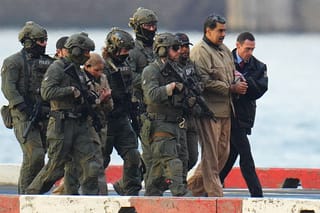
Second, because the war is not a form of immediate self-defense, it violates international law, including provisions codified into U.S. law through treaties the Senate ratified. In the past, the executive branch has claimed that presidents can ignore these laws, but the Supremacy Clause of the Constitution makes clear that treaties, along with U.S. law and the Constitution itself, are “the supreme Law of the Land.” This same issue was implicated by the military operation to seize Venezuelan President Nicolás Maduro in January.
If the war is already unconstitutional and illegal, what’s the significance of this 60-day deadline?
One way the administration has been arguing that this war isn’t illegal is to claim the president didn’t start a war, but rather undertook “combat operations” with the goal of “eliminating imminent threats from the Iranian regime.”
We disagree with this characterization (see our last answer), but the 60-day mark is important because — even if we accept the administration’s own logic — that’s when the president must receive authorization from Congress to use the military, immediate threat or no.
A 1973 federal law, the War Powers Resolution, prohibits presidents from engaging in military hostilities for more than 60 days unless Congress explicitly authorizes the use of force.
What does the law require?
The War Powers Resolution itself is clear about when it applies, including “in any case in which United States Armed Forces are introduced into hostilities or situations wherein involvement in hostilities is clearly indicated by the circumstances.”
The resolution also requires a report from the president to Congress 48 hours after hostilities begin, but it also sets a second, important deadline for 60 days later.
At that point, absent congressional action, the resolution mandates “the President shall terminate any use of the United States Armed Forces with respect to which such report was submitted (or required to be submitted).”
Alternatively, the president can certify in writing to Congress that “unavoidable military necessity respecting the safety of United States Armed Forces requires the continued use of such armed forces in the course of bringing about a prompt removal of such forces.” In that case, the president can take an additional 30 days — but it’s important to pay attention to the language here. It’s not a 30-day blank check; it’s a one-month deadline extension to facilitate removing forces from hostilities.
What about the ceasefire? Does that affect the clock?
During his Senate testimony, Hegseth claimed that the 60-day clock is currently paused because Trump has announced a ceasefire. We believe this is incorrect on two grounds. The War Powers Resolution is written in very broad terms — as quoted above, it refers to “hostilities,” not “war,” and it even covers situations where hostilities are imminent but not actually occurring.
Despite the ceasefire, there is very good reason to think the current state of affairs in the Persian Gulf constitutes ongoing hostilities. The Navy is actively enforcing a blockade against Iranian shipping — an act of war in its own right, and one that has included U.S. troops boarding multiple Iranian ships.
Circumstances also suggest additional hostilities could be imminent. The U.S. is continuing to amass firepower in the region, including deploying three aircraft carriers and their battle groups to the Middle East, while Trump publicly states that widespread bombing or naval combat with Iranian forces could restart at his whim.
In short, the military is actively engaged with a foreign nation, and the decision whether to escalate or bring hostilities to a close continues to rest with one person — precisely the sort of situation the Constitution and, failing that, the War Powers Resolution, should prevent.
How have presidents responded to the War Powers Resolution in the past?
The executive branch has long accepted that Congress had the power to impose the 60-day limit on unauthorized action. The notoriously pro-presidential power Office of Legal Counsel established that position in 1980. However, some presidents have violated the War Powers Resolution. One of the most glaring examples came in 2011, when the Obama administration joined an international campaign of airstrikes against the regime in Libya. In that case, the State Department concocted a legal claim that airstrikes somehow failed to qualify as “hostilities,” and the administration continued beyond the 60-day mark.
An earlier, though potentially more complicated, example came under the Clinton administration, when the NATO air campaign in Kosovo lasted 78 days. Clinton ordered that operation without the specific authorization required by the War Powers Resolution, but Congress did take several actions to indicate its support for the campaign.
What happens next?
By the terms of the War Powers Resolution, the onus is on the administration to comply with the law and withdraw forces, either immediately or over the course of 30 days if it can articulate a compelling need. In reality, though, Congress is going to need to do something to make it clear it cares about the law.
For decades, presidents have expanded their power to unilaterally use military force, and Congress has met those abuses with a consistent shrug. The resulting one-way ratchet of emboldened presidents and a weakened Congress has brought us to today, where a president has led the country into a months-long war with significant consequences, including the injuries and deaths of American service members and Iranian civilians, disruptions to the global economy, and significant harm to our nation’s reputation, all without articulating a strategy or even a credible justification to the public.
Just because Congress hasn’t pushed back against presidents in the past doesn’t mean it shouldn’t or can’t now. There is at least some hope that it might force some accountability for the least popular war in American history. While the Senate has so far rejected a series of resolutions that would terminate hostilities, a handful of Republican members of Congress have raised concerns about the 60-day mark and suggested Congress will need to act at that point.
What can Congress do?
The simplest approach would be for Congress to pass a resolution directing the president to terminate hostilities. While the War Powers Resolution already demands that outcome if Congress does nothing, an affirmative step by the current Congress would send an unequivocal message.
Some members are reportedly considering a different approach, namely seeking to pass an authorization to continue the use of force against Iran. This would also resolve the issue of the 60-day limit, but it would do nothing to address the other ways in which the war is illegal. And it would set a dangerous precedent by signaling that Congress will not only tolerate, but ultimately endorse, future unconstitutional and illegal actions by future presidents.
Beyond directing the termination of hostilities, Congress must step up and conduct rigorous oversight. This war raises serious questions, both about how the administration decided to start the war without legal authorization and about how it has affected military readiness more broadly. And if Congress decides to take a stance against this war, it should consider all the tools it has available to provide accountability for the people who led the country into an illegal, unconstitutional war.
Finally, Congress needs to avoid the trap of treating this like a one-off situation. Restoring the constitutional balance of power between Congress and presidents over matters of war will require ongoing, concerted effort, with Congress rigorously policing the boundaries of presidential power.
The representatives closest to the people they serve must resist presidents’ attempts to stretch existing authorizations beyond recognition, and Congress should examine how to strengthen the checks the War Powers Resolution was intended to create. If Congress fails to act, there is no reason to think this will be the last illegal, unconstitutional war the country is forced to endure.