What is Habeas Corpus? The Latin Phrase Designed to Ward Off Tyranny
Trump administration officials’ attempts to redefine or suspend “habeas corpus” threaten a foundational principle of free societies.
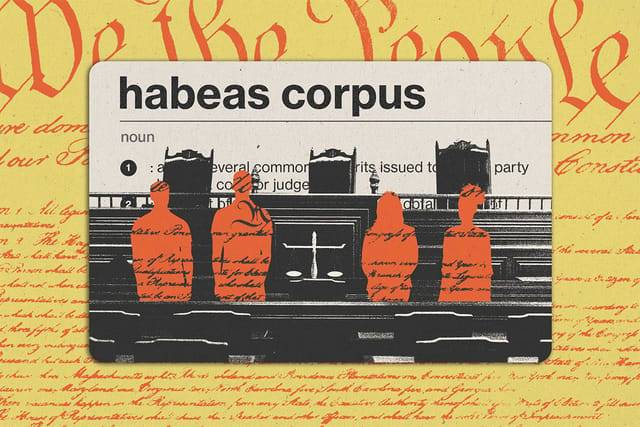
(Illustration: Ren Velez / POGO)
On May 20, Homeland Security Secretary Kristi Noem testified before the Senate’s Committee on Homeland Security and Governmental Affairs, ostensibly to present her department’s budget request for fiscal year 2026.
There was one terse exchange, with Senator Maggie Hassan (D–NH), however, that dominated headlines.
Reacting to White House Deputy Chief of Staff Stephen Miller’s claim that the Trump administration was “actively looking at” suspending the writ of habeas corpus, Hassan asked Noem to define the term. Noem described habeas corpus as “a constitutional right that the president has to be able to remove people from this country and suspend their rights.”
Senator Hassan’s reaction, in part: “That’s incorrect.”
It remains unclear if Noem’s initial definition was an unintended mistake or on message — or both. But this much is clear: The threat to redefine or suspend the writ of habeas corpus is a threat to American democracy.
What is Habeas Corpus?
Habeas corpus, often translated from Latin as “you should have the body,” is a legal principle that predates the U.S. Constitution by more than a century, with roots hundreds of years further back in the past. Put simply, habeas corpus requires governments to justify the detention or imprisonment of any person, citizen or not. A writ of habeas corpus — or, as former Chief Justice John Marshall called it, the “great writ” — is used to bring a detained individual before a judge to determine if their imprisonment is legal and valid.
There are other protections in the legal system — due process guarantees — that are supposed to prevent injustice and abuses of power. But when all of these fail, habeas corpus is what stands between a person and the power of the state.
Habeas corpus has a lot of applications. As explained by Cornell Law School’s Legal Information Institute, the writ can be used as a “post-conviction remedy” to challenge illegal applications of law that resulted in a person’s detention or imprisonment.
Habeas corpus may also protect:
- someone facing unlawful deportation,
- someone detained by the military,
- someone interned as an “enemy alien” solely due to their identity,
- someone denied reasonable bail,
- someone denied a fair hearing,
- someone held indefinitely without adequate evidence, and more.
Perhaps most crucially to the early leaders of the United States, habeas corpus protects against authoritarian tendencies.
Having just declared their independence from a king, the framers of the Constitution considered habeas corpus essential enough to enshrine it in the Constitution before the Bill of Rights existed, codifying its importance in Article I, Section 9, Clause 2 — also known as the Suspension Clause.
This clause detailed the only times the writ could be revoked, carving out an extreme exception of not just “Rebellion or Invasion,” but rebellion or invasion coupled with a credible threat to public safety. And crucially, according to most legal scholars and Supreme Court precedent, only Congress has the power to enact the Suspension Clause.
So when Noem answered Hassan’s question, POGO Senior Legal Analyst Katherine Hawkins said, “It was an aggressive stating of the opposite of what its actual meaning is.”Coupled with the far-reaching implications of Miller’s threat to suspend habeas corpus, Noem’s answer underscores a larger, existential question facing American democracy.
Habeas corpus is the foundational right that separates free societies like America from police states like North Korea.
“The whole executive branch is supposed to be faithfully executing the law,” Hawkins says. “And when they’re sitting before Congress, confidently stating that [habeas corpus] means the opposite of what it says, and up is down, that is obviously deeply worrisome.”
Hawkins offers a helpful analogy in determining the amount of danger inherent in such comments. “If someone testified to Congress that the First Amendment meant that the president could stop you from criticizing him, I think elementary school students would recognize that that was a completely wrong thing to say,” Hawkins explains.
“I’m not sure we’re at a similar point with habeas corpus and how well it’s understood by the public. … But it really is as important and as fundamental as the First Amendment.”
Habeas corpus is not just a right: It’s a critical guardrail against executive overreach and government corruption.
Habeas Corpus: A Check on the Executive
From its inception, habeas corpus has served as a check on tyranny. In his famous Commentaries on the Laws of England, jurist Sir William Blackstone wrote, “confinement of the person, by secretly hurrying him to gaol, where his sufferings are unknown or forgotten; is a less public, a less striking, and therefore a more dangerous engine of arbitrary government.”
Constitutional advocate and “founding father” Alexander Hamilton later cited this passage in The Federalist Papers, adding that “the practice of arbitrary imprisonments have been in all ages the favourite and most formidable instruments of tyranny.”
Habeas corpus acts as a shield, demanding justification for a person’s detention. Throughout American history, leaders have recognized habeas as a fundamental check on the executive branch’s power, and often, as the defining human right that separates our democracy from authoritarian states elsewhere.
Even in questioning Noem, Hassan invoked this idea: “If not for that protection, the government could simply arrest people, including American citizens, and hold them indefinitely for no reason,” she said, adding that “habeas corpus is the foundational right that separates free societies like America from police states like North Korea.”
Without habeas, other fundamental human rights to free speech, fair trials, property, and proportional punishment are easily compromised. Without a legal obligation to justify a person’s detention or imprisonment, the executive branch could more easily target people based on political beliefs, activism, or identity. Calls to lock up a political opponent, a government employee who held power to account, or a large swath of immigrant communities suddenly become much more viable threats.
“Although our society does not always actually protect everyone’s rights very well, although the courts have an imperfect record, it is some form of recourse,” Hawkins explains. “It doesn’t protect people as well as it should, but it’s much better than the executive being able to lock people up on their own say-so and mere accusation.”
Being able to ensure that the government is actually following the law instead of one person’s word being the law is a big part of habeas.
Even Stephen Miller’s suggestion that the suspension of habeas corpus would depend on the courts’ actions signals an act of intimidation. If our country allows the executive branch to suspend habeas corpus without authorization, the right becomes a hollow promise.
“A court that is afraid to rule against the executive because the executive might just start ignoring them is a court that lost much of its authority and ability to protect people’s rights,” Hawkins says. “And so I don’t think that we’re going to see a proclamation suspending habeas corpus in its entirety and imposing martial law, you know, in the near future. But attempts to deprive some people of their rights tend to spread.”
Habeas Corpus: A Guardrail Against Corruption
Habeas also limits a government’s ability to silence those holding them accountable. And thus, it is a tool that helps prevent corruption.
Hawkins offers a simple hypothetical that illustrates this point. She says you can imagine a society where a journalist uncovers corruption by an executive leader. Without habeas, they could easily be locked up under false pretenses.
“So,” Hawkins explains. “Being able to ensure that the government is actually following the law instead of one person’s word being the law is a big part of habeas.”
Habeas corpus applies to everyone. It protects a government whistleblower or watchdog just as powerfully as it protects any person. Without this protection, arbitrary imprisonment of those trying to hold the government accountable would almost certainly occur.
“If the accusation becomes all the evidence you need, then the government can do that to anyone,” says Hawkins.
Protecting Habeas and the Rule of Law
The good news? Habeas corpus is as deeply enshrined in American law and practice as any right. The threats to suspend it without congressional approval face an uphill battle against legal precedent and the guardrails meant to protect the Constitution from a would-be authoritarian. This is where the check in “checks and balances” gets cashed — if the courts and Congress keep their courage.
But we must be vigilant. Habeas can be compromised, and often quietly. Hawkins cites examples such as the statute that allows for “expedited removal of aliens,” which can essentially remove a person’s due process before it can be determined if their deportation is legal. She cites infamous cases, such as Guantanamo Bay, where people are still detained under the justification of wartime rules for a war that has, ostensibly, ended.
When dealing with threats to due process, Hawkins says, “it’s very important to push back on these, to pop these trial balloons before things escalate.”