What’s Wrong With DOGE? Its Glaring Conflicts of Interest
For an entity ostensibly focused on cost cutting, Elon Musk and those associated with DOGE may in fact be reaping big rewards.
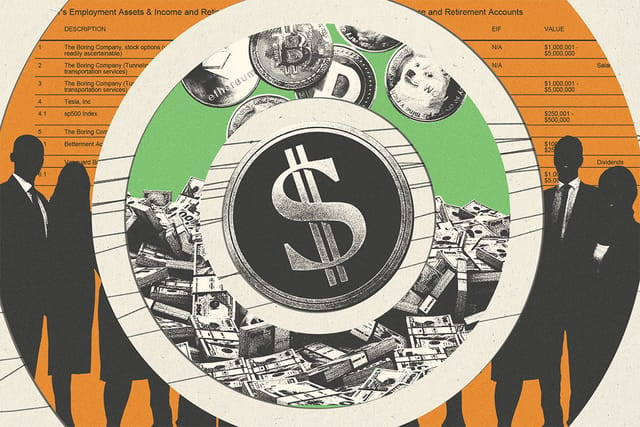
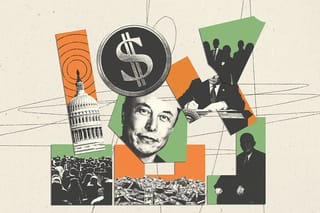
(Illustration: Ren Velez / POGO)
Since President Trump created the Department of Government Efficiency (DOGE), members of Congress and watchdogs have raised questions about conflicts of interest as they relate to Elon Musk, the nominal head of DOGE, as well as the department’s staff. As POGO previously wrote, DOGE’s opacity when it comes to structure and staffing makes it difficult for the courts, Congress, and the American public to hold it accountable. But for an entity ostensibly focused on cost cutting and its “Wall of Receipts,” Musk and those associated with DOGE ― including DOGE staff ― may in fact be reaping big rewards.
Ethical Frameworks and the Trump Administration
Before diving into specific conflicts of interest that have emerged since the creation of DOGE, it’s important to zoom out and recount the ethics rules in place to hold government employees accountable to the public.
Some DOGE employees, including Elon Musk, are “Special Government Employees.” Special Government Employees, or SGEs, are a category of employment within the federal government intended to be temporary in nature. SGEs adhere to a more limited set of rules and guidelines than typical federal workers, but SGEs are covered by criminal conflict of interest laws. However, they can keep outside employment and draw outside salaries, and they are subject to some, but not all, of the ethics provisions that govern regular employees. Typically, the SGE category was used to allow experts to serve on government boards and commissions, but Trump has installed SGEs as top agency advisors (both within and outside of DOGE) who help to set and execute policy.
Other staffers associated with DOGE appear to be White House staff (who work for the U.S. DOGE Service directly) or full-time agency staff (including detailees, political appointees, and full-time non-political employees). These staffers, like other regular federal employees, are held to the general standards of ethical conduct, which include criminal penalties for violating the law. While these rules are nuanced and can vary slightly by agency, there are 14 overarching principles that apply to all employees, SGE’s included. They include that employees “not hold financial interests that conflict with the conscientious performance of duty,” “not engage in financial transactions using nonpublic Government information or allow the improper use of such information to further any private interest,” and “not use public office for private gain.”
Trump has yet to issue his own ethics pledge this time around, despite POGO and other good-government organizations urging him to do so.
In addition to these specific rules, the Trump administration is operating within a broader ethics framework. One of Trump’s first actions in office was to rescind President Biden’s 2021 ethics executive order. But unlike during his first term, Trump has yet to issue his own ethics pledge this time around, despite POGO and other good-government organizations urging him to do so.
Trump has also struck at watchdogs and watchdog agencies intended to monitor the conduct of federal employees. Congress established offices of inspectors general to guard against waste, fraud, and abuse of power within government agencies. On January 24, Trump fired 17 inspectors general (and an additional inspector general was fired on February 11). On February 7, Trump fired the head of the Office of Special Counsel, which enforces federal whistleblower laws and the Hatch Act, which limits federal employees’ political activities. On February 10, he fired the head of the Office of Government Ethics, the independent agency that oversees financial disclosures and ethics rules for the executive branch.
Elon Musk’s Conflicts of Interest
De facto DOGE leader Elon Musk is the world’s richest man, and his companies — including X, SpaceX, Tesla, xAI, the Boring Company, and Neuralink — collectively receive millions of dollars in government contracts. He also owns at least three cryptocurrencies. Musk’s businesses have regulatory matters before and contracts with the federal government. Given the broad scope of DOGE, it’s reasonable to expect that Musk might come across a number of potential conflicts of interest in the course of his work.
Typically, government ethics officials would decide whether an employee, including an SGE, has a conflict of interest. But White House Press Secretary Karoline Leavitt said on February 5 that Musk would “excuse himself” from conflicts of interest. Trump firing David Huitema, the head of the Office of Government Ethics, does not help in terms of holding Musk accountable.
It’s worth noting that Musk and his team’s access to sensitive databases across the government could also give them access to information that benefits his companies or disadvantages rivals. For example, imagine a scenario in which Musk or a top aide can access details of a competitor’s new technology or the draft text of a nascent regulation.
While not an exhaustive list, the following examples illustrate the breadth of potential conflicts of interest confronting Musk.
Tesla
In February, the State Department appeared to walk back a plan to award Tesla a $400 million contract to buy armored vehicles. Then, in March, Musk and Commerce Secretary Howard Lutnick both publicly promoted Tesla. Trump himself turned the south lawn of the White House into a “Tesla showroom,” which drew criticism. In response, POGO asked the Office of Government Ethics to investigate “the continued violation of federal ethics laws prohibiting acts affecting a government official’s personal financial interests, preferential treatment, and use of public office for private gain, including the endorsement of products or services.”
SpaceX
SpaceX, run by Musk, is one of NASA’s largest private contractors, and Trump’s nominee to run NASA is an associate of Musk. A number of Democratic representatives have sent a series of letters to NASA noting Musk’s many conflicts of interest with the agency.
Starlink, a satellite internet service operated by SpaceX, has popped up at government campuses, including on the grounds of the White House. SpaceX is leasing Starlink kits and service to the Federal Aviation Administration for free, prompting one watchdog to raise alarm.
In early April, SpaceX was awarded nearly $6 billion in Department of Defense contracts to support launches of satellites. As POGO Executive Director Danielle Brian commented to the New York Times in response to an earlier report of SpaceX benefiting from Musk’s work at DOGE and his proximity to the president, “We will never know if SpaceX would authentically win competitions for these awards because all of the offices in government intended to prevent corruption and conflicts of interest have been beheaded or defunded.”
Avoiding Investigation
Musk’s role leading DOGE has also seemingly made it easier for his companies to avoid oversight from federal agencies. Food and Drug Administration officials reviewing Musk’s Neuralink were fired as part of massive cuts to the agency, directed by both agency officials and DOGE. In November, the Consumer Financial Protection Bureau finalized a rule expanding its oversight over digital payments, including X’s forthcoming mobile payment system. The bureau, an early and frequent target of Musk, was investigating complaints about Tesla when it was shuttered by DOGE and the administration in February. These are just a few of many instances in which Musk and his companies have benefited from DOGE’s efforts to shrink the federal government.
Musk has called for getting rid of all government regulations, and DOGE has been directed to work with agency heads on deregulation. The administration has moved to deregulate the cryptocurrency industry. The Securities and Exchange Commission has dropped more than a dozen cases against crypto firms. And the Department of Justice recently disbanded the National Cryptocurrency Enforcement Team and wrote in a memo that it would “no longer pursue litigation or enforcement actions that have the effect of superimposing regulatory frameworks on digital assets.” It’s not clear whether Musk could be benefiting from this move due to his leadership of DOGE, his closeness to the president, or some combination thereof.
DOGE Staff Conflicts
Potential conflicts of interest as they relate to DOGE do not end with Elon Musk. In February, POGO published an investigation raising serious concerns about DOGE staffers’ vetting and the ethical issues surrounding their employment. DOGE teams have been granted access to sensitive information, such as Medicare and Medicaid payment databases and Social Security Administration data, but it remains unclear as to whether they have received the proper vetting and clearances. A handful of DOGE staffers also appear to be employed by multiple government agencies at the same time, raising questions about the breadth of their reach. As part of an ongoing lawsuit over DOGE’s access to Social Security Administration data, a former nearly 30-year employee of the agency said in a deposition, “I am not confident that DOGE associates have the requisite knowledge and training to prevent sensitive information from being inadvertently transferred to bad actors.”
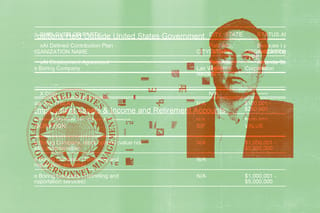
In March, POGO revealed Musk’s deep financial ties to three Office of Personnel Management political appointees. The department serves as one of the central hubs for DOGE’s efforts inside the federal government. Financial disclosure records show that these officials either hold large financial stakes in Musk’s companies or are on a leave of absence from one of his businesses. While DOGE has been intentionally opaque about its staff, both ProPublica and the New York Times are continuously working to identify DOGE and DOGE-affiliated staffers and to discover whether those staffers have ties to Musk or Musk’s companies.
An opaque entity existing against a backdrop of weakened ethics standards and decapitated watchdog offices makes for fertile ground in which corruption, conflicts of interest, and abuses of power can thrive.
Other outlets have reported on DOGE staffers still employed by (and potentially receiving salaries from) employers outside the government. Katie Miller, a top aide to Musk (and wife of close Trump aide Stephen Miller), is still employed by a consulting firm. James Burnham, a lawyer at DOGE, is still employed by the litigation fund he founded. And Tom Krause, CEO of the tech firm Cloud Software Group, also oversees the Department of Treasury’s $5 trillion payment system. While outside employment is allowed for SGEs, Richard Painter, an ethics expert who served as an ethics lawyer for President George W. Bush, said to the Wall Street Journal, “This is just taking this loophole to an extreme.”
While these specifics are troubling, with so much of DOGE and its work shrouded in secrecy, there are likely even more conflicts of interest than have been reported.
Conclusion
An opaque entity existing against a backdrop of weakened ethics standards and decapitated watchdog offices makes for fertile ground in which corruption, conflicts of interest, and abuses of power can thrive.
Several members of Congress have already sent letters to the White House, Musk, and federal agencies to get more information about DOGE’s potential conflicts of interest. We support the complete and timely release of relevant information to fulfill those requests and urge Congress to continue its efforts to investigate and perform critical oversight.
In addition, we recommend Congress pass legislation to tighten the ethics rules by which SGEs need to abide. POGO has endorsed a bill from Senator Ben Ray Luján (D-NM) and Representative Dave Min (D-CA) to help prevent SGEs from profiting from their position in government, as well as a bill by Senator Elizabeth Warren (D-MA) and Representative Melanie Stansbury (D-NM) to strengthen transparency and ethics requirements for SGEs. We’ve also endorsed Representative Kathy Castor (D-FL) and Representative Min’s bill that would prevent SGEs from receiving any federal contracts, grants, and awards.
More broadly, we support legislation that would strengthen government watchdogs like the Office of Government Ethics, the Office of Special Counsel, and inspectors general. POGO has also called for the president to issue a new ethics pledge (and for Congress to codify ethics executive orders) and urge the Department of Justice to investigate reported violations of ethics law as it relates to federal employees, including those affiliated with DOGE.