Executive Overreach Could Shut Down the Government
So-called “pocket rescissions” could be the final blow to an already-dysfunctional appropriations process.
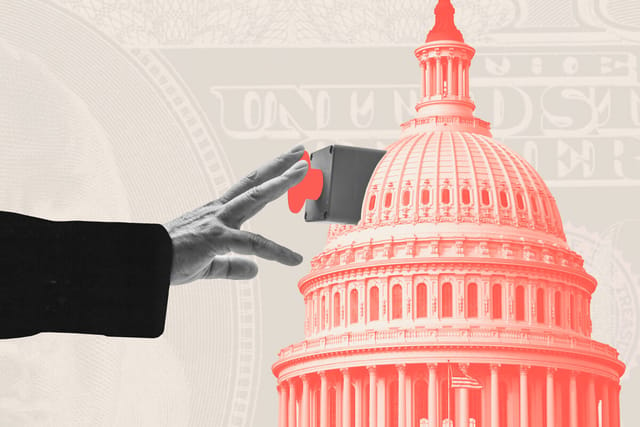
(Photos: Getty Images; Illustration: Leslie Garvey / POGO)
Every year, the president delivers a budget to Congress expressing the administration’s plans for the next fiscal year. Exercising their constitutional spending powers, members of Congress debate the president’s proposal, negotiating between the needs of the nation and those of their districts to strike bipartisan compromises that they agree will best serve all the people. Congress passes 12 appropriations bills to fund the federal government before the next fiscal year begins.
No, wait.
That’s just an old Washington fairy tale. Reality is far messier.
While Congress has the authority typically known as “the power of the purse” (the authority to collect federal taxes and decide how money should be spent), the process outlined above has happened only four times in nearly 50 years. Instead, today’s budget and appropriations process tends to be a mix of temporary spending measures, big package deals, or ― at its most dysfunctional ― partial or total government shutdowns.
During appropriations, Congress is usually in the driver’s seat. So when the process goes awry, it’s usually safe to place the blame at Congress’s feet. But this year, the story is more complicated.
Repeated executive overreach ― and some members’ willingness to cede their fundamental powers ― have pushed an already unstable appropriations process even closer to breaking by making it even harder for Congress to negotiate. At multiple points in the budget process, the Trump administration has withheld information that Congress needs to dutifully exercise its power of the purse. The administration’s threat of a “pocket rescission” may just be the tipping point.
Where’s the Budget?
An early indicator that the process for FY 2026 would be atypical was the administration’s failure to send its budget to Congress. The president’s budget is less a dictate to Congress than it is an aspirational policy document, outlining areas where the administration hopes Congress will invest, or not invest, our tax dollars in the following year. As such, it serves as a valuable starting point for members of Congress to kick off spending negotiations.
It’s not unusual for a president to deliver a budget later than the deadline (the first Monday in February) during the first year of a new term. But the Office of Management and Budget (OMB), the agency that administers the federal budget, did not send Congress even a basic budget until May 2. And a full, detailed budget proposal never followed. OMB Director Russell Vought defended the decision to avoid providing a detailed budget, saying doing so “wasn’t in [the administration’s] interest.”
Leaving Congress in the dark, particularly when both chambers are controlled by the same party as the president, appears to have made it more difficult for appropriators to begin negotiations.
Apportionments Go Dark
Withholding a full budget isn’t the only way this administration has dodged transparency. In March, OMB took down a website that tracked how the federal government allocates the funding appropriated by Congress, known as apportionments. Apportionments are legally binding plans that show what money an agency can spend and when they can spend it. Publishing this data allows Congress and the public to determine whether and how the executive branch is abiding by the appropriations laws passed by Congress.
Despite a law requiring the information to be public (long championed by POGO), OMB Director Vought claimed that this information was too sensitive to be revealed to the public. The shutdown of the website as the administration was implementing rampant funding freezes, contract cancellations, and grant pauses underscored its importance as an oversight tool.
After losing a lawsuit, OMB put the database back online in mid-August. But it’s clear the administration is still trying to direct federal spending. Documents released as a part of the suit reveal that the executive branch is demanding agencies provide spending plans demonstrating how they are following the administration’s policy priorities before their funding is released. These plans don’t have the force of law, as appropriations bills do, but they are seemingly being used to withhold funds. It’s yet another example of the administration working to wrest further control over spending away from Congress.
An Opaque Rescissions Package
The modern budget and appropriations process was established by the 1974 Congressional Budget and Impoundment Control Act. The law made it illegal for the executive branch to withhold funds appropriated by Congress except via a specific process, called a rescission. When an administration decides it does not want to spend money that Congress has appropriated, OMB must notify Congress. Congress has 45 days to vote on the proposed rescission(s); the administration can pause funding during that time. If Congress passes the rescission(s) package, the funding is withdrawn. If it votes down the package or fails to vote, OMB must release the funding.
According to the Bipartisan Policy Center, recent presidents have asked for rescissions only rarely, and Congress has approved those requests even more rarely. But that (recent) streak was broken when Congress approved President Trump’s rescissions package, rolling back around $9 billion in appropriated spending this July.
What is notable was not necessarily the use of this tool in and of itself, but the administration’s opacity around what specifically would be cut by the package. The lack of transparency raised concerns on the Hill, including from members of the president’s own party.
Senator Susan Collins (R-ME), chair of the powerful Senate Appropriations Committee, explained her decision to vote against discharging the package from committee, stating, “The rescissions package has a big problem — nobody really knows what program reductions are in it. That isn’t because we haven’t had time to review the bill. Instead, the problem is that OMB has never provided the details that would normally be part of this process.” Indeed, she voted against the final package.
Senators Mitch McConnell (R-KY) and Thom Tillis (R-NC) also expressed their concerns about the package, though both ultimately voted for its passage. McConnell, the former Republican leader in the Senate, said that “OMB is the problem. They won’t tell us how they’re going to apply the cut.” And Tillis warned that this rescissions package would make it difficult to vote for any future rescissions if the administration approached them the same way.
The administration took a gamble that Congress would pass a rescissions package even if it was not forthcoming about specifics, and it paid off. But by advancing a package light on details, Congress ceded key ground in their control over federal spending. The administration essentially said, “just trust us,” and many in Congress complied.
The Danger of “Pocket Rescissions”
The reticence of the administration to provide details about its budget, its spending, and its rescissions package is troubling on its own. But so-called “pocket rescissions” could be the last straw when it comes to the appropriations process.
The theory behind a pocket rescission is this: If the administration transmits a rescission(s) package to Congress in the last 45 days of the fiscal year, and Congress doesn’t vote on the package in time, the year ends and the funds expire ― allowing the executive to claw back funds at will anytime between mid-August and the end of September.
The administration’s aggressive pursuit of the power of the purse at the expense of Congress weakens the separation of powers upon which our system of government rests.
Here’s an example. Say Congress passes an appropriations law funding a new bridge. The president doesn’t want to build the bridge, but he doesn’t think a simple majority in Congress will vote to rescind the funds. (It’s a popular bridge.) Using a “pocket recission,” the administration could wait until late August to send a rescission(s) request to Congress to withdraw funding for the bridge. If Congress fails to act before September 30, the end of the fiscal year, the funds technically expire. The bridge is defunded, and members of Congress who persuaded their colleagues to support this project have to start all over again — with no guarantee the funds would ever make it to the bridge project.
POGO believes that “pocket rescissions” are not legal. Many scholars, advocates, the Government Accountability Office, and even some members of Congress agree that they represent a misinterpretation of the Congressional Budget and Impoundment Control Act. But the administration, led by OMB Director Vought, seems eager to put this interpretation to the test, regardless of the harm it could cause.
Where Does This Leave Us?
It’s difficult not to see the “pocket rescission” as a fatal blow to whatever is left of bipartisan appropriations negotiations. If the executive branch can rescind congressionally approved funding with impunity, then there is ultimately very little need for Congress to weigh in on spending at all. Decisions about how to direct taxpayer dollars will be made by effectively one person, the president, instead of by the people’s elected representatives.
The administration has made no secret that it believes that the president should hold the purse strings. Vought, the main proponent of the pocket rescissions theory, told reporters that “the appropriations process has to be less bipartisan.” (The OMB director’s extreme views on the power of the purse were one reason why POGO opposed his nomination to lead the agency.)
In the long term, the administration’s aggressive pursuit of the power of the purse at the expense of Congress weakens the separation of powers upon which our system of government rests.
More immediately, if the administration attempts to rescind funds in September, it will be that much harder for members of Congress to engage in good faith bipartisan appropriations negotiations.
What use is bipartisan compromise to get to the 60 votes needed to pass an appropriations bill when a simple majority of 51 votes can pass an opaque recissions package ― and no vote at all is required for a “pocket recission” of funding?
What Can Be Done?
If September 30 comes and goes without a spending deal, the government will shut down. Government shutdowns are harmful to our families and communities, regardless of our individual policy priorities or political agendas.
That’s why Congress must reassert its power of the purse.
Public criticism about the way the budget and appropriations process has unfolded thus far, including the rescissions package, indicates that some members are no longer comfortable ceding their spending powers. Members of Congress should continue to speak out, especially in a bipartisan fashion, to counter executive overreach.
The Congressional Power of the Purse Act, introduced in prior congresses and supported by POGO, would address much of the executive overreach outlined above. The bill would make it easier for Congress to exercise control over appropriated funds and strengthen the authority to counter impoundment. If reintroduced, it (or similar legislation) should also make explicit the illegality of “pocket recissions” as an end run around Congress.
Time is running out, but Congress still has an opportunity to prevent the total collapse of the appropriations process. Members must refuse attempts to impound or rescind funds that bypass their branch and continue to seek bipartisan negotiations and honor deals struck with each other. The Trump administration isn’t unique in trying to test Congress’s power of the purse: President Joe Biden’s student loan forgiveness comes to mind. But members of Congress from both parties need to remember that, while this administration isn’t the first to overreach, it certainly won’t be the last. As OMB consolidates executive power over spending, it’s inevitable that future administrations — regardless of party — will see the Trump administration’s gains as their own starting point.
If Congress does not act now, it may cede its spending power permanently.