Fact Sheet: How Housing Conditions are Failing Military Families
Service members and their families endure dire housing conditions, while negligent landlords continue to dodge accountability.
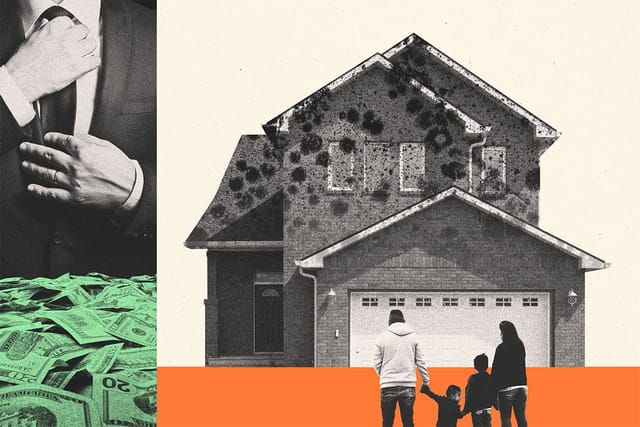
(Illustration: Ren Velez / POGO)
The Problem
Private companies have expanded to control 99% of military family housing in the U.S. under lucrative long-term contracts. In recent years, they have become mired in a crisis of their own making: mismanagement and safety negligence that risk compromising the well-being of service members and the readiness of the Department of Defense (DOD) itself.1
The absence of federal mold standards and weak legal requirements have allowed privatized military housing companies to take a lax, inconsistent approach to addressing systemic problems that affect many military families. This pattern of mismanagement has harmed service members and prompted lawsuits alleging negligence against privatized military housing providers.2
In 2024, the DOD revealed that there had been at least 4,588 reports of mold found in Air and Space Forces privatized housing.3 Among service members and their families in both the Navy and Marine Corps, mold was identified as the most commonly cited issue in tenant complaints.4 Certain molds produce mycotoxins that can be very harmful to the immune system.5 This makes proper mold testing essential to the well-being of service members and their families. However, private housing companies have skirted proper mold testing and remediation amid an absence of federal mold standards.6
This revelation followed a congressional inquiry citing a POGO investigation, which exposed poor living standards, weak tenant protections, and legal loopholes that housing companies exploited to commit widespread fraud and abuse, potentially subjecting the roughly 700,000 service members and their families living in privatized military housing to unsafe conditions.7
Another challenge facing military families is an obscure legal loophole that shields private housing providers: the federal enclave doctrine, which limits families’ ability to seek recourse. This doctrine designates military installations as federal jurisdictions rather than state ones, meaning that present-day environmental, housing, and consumer protection laws have limited application on military bases.8
To make matters worse, private housing providers subject tenants to non-disclosure agreements, effectively preventing them from speaking out against negligent landlords or sharing their experiences with unsafe housing conditions.9 The practice has been so coercive in nature that it prompted senators to send a letter to then-Secretary of Defense Lloyd Austin, urging the DOD to end it.10
The Solution
As more service members and their families step forward to share their stories of dire conditions in military housing, Congress must waste no time in addressing these grievances and enacting reforms to establish a federal mold standard, limit the application of the federal enclave doctrine, and prohibit the issuance of non-disclosure agreements to tenants. The DOD needs your help, and so do service members. There are sections in this year’s proposed National Defense Authorization Act (NDAA) which POGO recommends that do exactly that and must be supported in conference:11
- Sen. Sec. 2824. Directs the Secretary of Defense to implement mold mitigation measures at affected installations, develop mold-resistant construction standards for new housing on military installations, and incorporate mold-related illness training for military health professionals.12
- Sen. Amdt. 3544. Limits the application of the “federal enclave doctrine,” a legal defense used to strip military families of rights afforded to their off-post neighbors.13
- Sen. Sec. 2826. Prohibits landlords from requesting non-disclosure agreements from tenants of privatized military housing.14
Moreover, there are bills worth supporting in both chambers that aim to reform military housing. Senate bill S. 2047, introduced by Senator Elizabeth Warren (D-MA), would establish a DOD council to oversee and improve privatized military housing through review, recommendations, compliance monitoring, and coordination. A bipartisan House bill, H.R. 10342, led by Representatives Sara Jacobs (D-CA), James Moylan (R-GU), and Marilyn Strickland (D-WA) seeks comprehensive reforms in response to reports of unsafe and unsanitary military housing conditions.15
Contact
Omar Tabuni, Government Affairs Manager, Project On Government Oversight, [email protected]