Fact Sheet: Why and How the Hatch Act Must Be Strengthened
Congress must bolster the law limiting federal employees’ on-the-job political activity to enable better accountability when political appointees don’t comply.
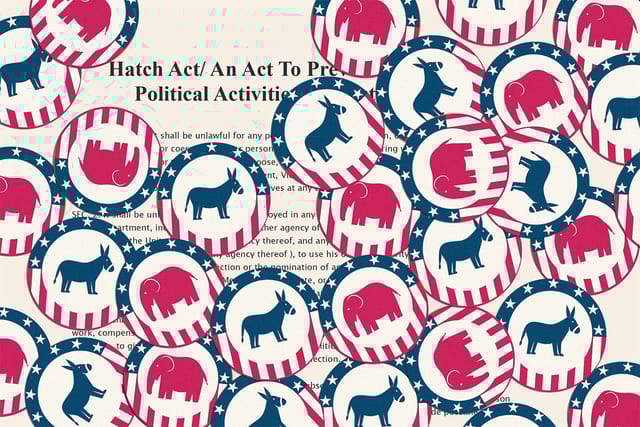
(Illustration: Ren Velez / POGO)
The Hatch Act is a foundational legal cornerstone of the government’s merit system and a necessary safeguard against a spoils system: It prevents executive branch employees1 from misusing their official positions and authority to benefit any political party, candidate, or group.
The law does this by limiting the political activities federal employees can engage in while on duty in the workplace. This helps ensure that our government serves in the best interests of the people, rather than in the interests of a political party.
The agency responsible for enforcing the Hatch Act, the Office of Special Counsel (OSC), receives and investigates alleged violations. OSC’s mission is to protect the nonpartisan merit-based system.2 If it finds that an employee violated the law, it can file a complaint with another agency, the Merit Systems Protection Board, to seek disciplinary action against a violator, which can include civil penalties, suspension, termination, or debarment from federal employment for up to five years.3 Accountability under this law requires strong, consistent, and impartial enforcement, as well as OSC’s independence from the White House and executive branch. Without those guardrails, powerful actors can more easily evade accountability.
The Problem
OSC’s enforcement of the Hatch Act has often been weak, negligent, or selective.4 There is often a double standard in enforcement, where harsh penalties are levied on rank-and-file federal employees while senior officials skate by, even though violations by senior officials are usually much more serious because of the influence they wield through their elevated positions.5 This law should be a valuable tool for holding powerful government actors accountable when they use their positions of trust to benefit political parties or partisan political groups — but Congress must demand it.
To ensure its mission, OSC must remain independent from any administration, yet OSC itself has reduced that independence and weakened enforcement and accountability. Under acting leadership, OSC recently rolled back key Hatch Act reforms, rescinding advisory opinions from just last year that increased transparency and enforcement.6 Under this policy change, instead of pursuing disciplinary action against senior White House officials through the independent Merit Systems Protection Board, OSC will refer Hatch Act violations back to the White House to determine whether to discipline their own officials.
The Solution
Congress should conduct more rigorous oversight of Hatch Act enforcement and legislate to strengthen transparency, fairness, and accountability to better protect the public from a fully politicized federal government. There is a bill to help address this issue: H.R. 1688/S. 806, the Hatch Act Enforcement Transparency and Accountability Act.7 This bill would require OSC to
- report to Congress the number of allegations of Hatch Act violations by political appointees it receives, the number it investigates, and the number it refers for disciplinary action;
- report confidentially to Congress the names and positions of political appointees it declines to investigate, including descriptions of the allegation and outcome; and
- make publicly available detailed written explanations for decisions not to pursue disciplinary action against political appointees found to have violated the Hatch Act.
POGO commits to working with Congress to pass this bill to increase oversight of Hatch Act enforcement and help ensure that powerful officials are held to account.
Contact
Joe Spielberger, Senior Policy Counsel, Project On Government Oversight, [email protected]
Related Content