Weekly Spotlight: Shutdown Opportunists
The shutdown is now in its third week. But while Congress has failed to pass a spending bill fix for the 10th time, the White House has been an active and united front, using the shutdown as an opportunity to make unencumbered headway in reshaping the government.

Join our fight for a more effective and accountable government. Sign up for our Weekly Spotlight newsletter and occasional updates on POGO’s work.
Editor’s Note: There will be no Weekly Spotlight this coming week. We will be back in your inbox on November 1, 2025.
EXECUTIVE POWER GRAB
Shutdown opportunists
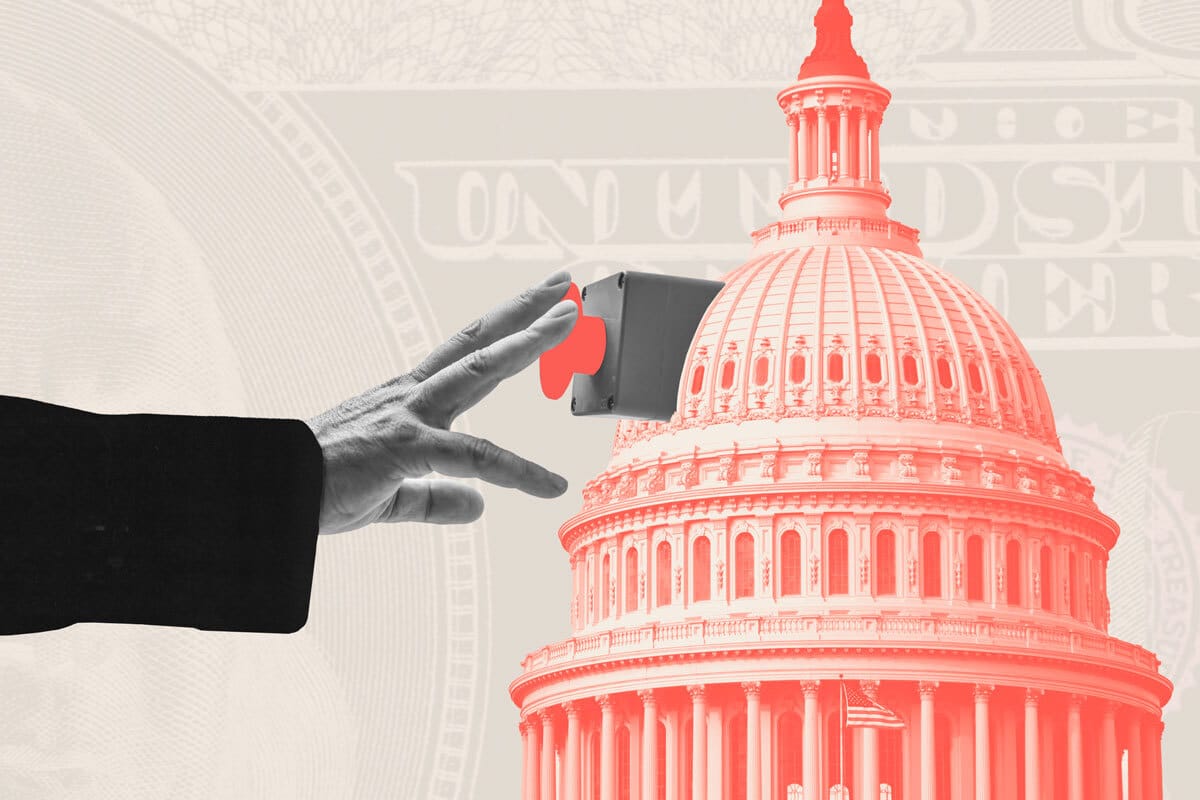
(Photos: Getty Images; Illustration: Leslie Garvey / POGO)
The shutdown is now in its third week. But while Congress has failed to pass a spending bill fix for the 10th time, the White House has been an active and united front, using the shutdown as an opportunity to make unencumbered headway in reshaping the government. Much of the power Congress has ceded has gone to the Office of Management and Budget, and into the hands of one man in particular: Russell Vought. Over the past 18 days, Vought has spurred layoffs of at least 4,200 federal workers and frozen up to $28 billion in federal funding. The “Grim Reaper” is making good on his promises to slash and burn the government, unchecked by Congress. As President Trump said, “We are being able to do things that we were unable to do before.”
- Not so fast — A federal judge blocked the administration from seeing through its planned mass layoffs, for now. That did not stop Vought from threatening “north of 10,000” firings while the shutdown continues.
- The Trump administration is selectively shielding certain agencies from the blowback so the immigration crackdown and National Guard deployments can continue unhindered while other government functions slow and sputter.
- Read More: Trump’s shutdown architect: Russ Vought’s plan to deconstruct the government was years in the making (CNN)
A sixth strike
At least 29 people have now been killed by unauthorized and unprovoked U.S. military strikes. President Trump announced a fifth strike on a vessel off the coast of Venezuela that he alleges was “trafficking narcotics.” Just a few days later, the administration struck a sixth vessel, killing at least two people and taking two survivors into custody. The flimsy justifications are unacceptable. These deaths are unacceptable. Not just under international humanitarian law, but under our country’s own war-making laws. The reason Congress, the branch that represents the voice of the people, has a final say on whether we enter conflict is because the costs are so grave. With these strikes, the Trump administration is breaking precedent and the law. POGO condemns these reckless acts of murder and urges Congress to intervene, prevent any escalation, and seize back its constitutional war powers at once.
- A proposed authorization for use of military force (AUMF) that could clear the way for the president to essentially target and kill anyone so long as he calls them “narco-terrorists” is circulating the White House and Congress. Congress must oppose this. A failure to do so could enable the administration to further abuse its power and use a war authorization to justify deploying troops on American soil.
REPORTING BACK

Season 2 of our podcast Bad Watchdog brought home the gold for both Best Limited Series and the Best Individual Episode in News and Politics at the Signal Awards. We are proud to have been nominated alongside big names and grateful that we are able to give a platform to these critical issues at a critical moment. Season 2 of Bad Watchdog traces the history of the Department of Homeland Security from its founding post-9/11 to its current laser focus on detaining and deporting migrants. Host Maren Machles asks: How did we get to a point where every undocumented person is seen as a possible national security threat? Stream Bad Watchdog on Spotify, Apple Podcasts, Amazon Music, or wherever you get your podcasts.
DEPARTMENT OF INJUSTICE
This one’s personal, too
Late last week, New York Attorney General Letitia James was indicted on charges of alleged mortgage fraud. The indictment came after months of very public pressure from the president himself (who allegedly fired the previous prosecutor on the case, Erik Siebert, when he expressed concerns about the lack of evidence). That pressure may come back to bite: The Justice Department is not supposed to deal in retributive justice. James Comey, another target of Trump’s retribution campaign who was also indicted by the same court in recent weeks, is challenging his indictment. The courts must ensure that the law and the facts, not revenge, are the basis of the justice system.
- Lindsey Halligan, the prosecutor who replaced Erik Siebert, used to be a personal lawyer for President Trump and lacks prosecutorial experience.
- Former Special Counsel Jack Smith, who resigned from his post in the Justice Department before the Trump administration took office, spoke out against the purging of employees in the department: “I think the attacks on public servants, particularly nonpartisan public servants — I think it has a cost for our country that is incalculable.”
YOUR RIGHT TO KNOW
Pentagon shuts the door on the press

(Illustration: Ren Velez / POGO)
Exactly a month ago, the Defense Department issued a memorandum forbidding reporters from reporting news that isn’t authorized for release by the Pentagon — essentially attempting to convert the free press to an internal PR agency. The memorandum plainly violated the First Amendment. Almost every major news outlet refused to comply, with but a few exceptions. As of October 16, all the reporters who didn’t agree to the terms were suspended, meaning the Pentagon press has been essentially eliminated overnight. What does this mean for the public’s right and ability to know about our national security? Two POGO experts — Pulitzer Prize-winning Pentagon reporter Mark Thompson and veteran Marine Corps public affairs officer Virginia Burger — explain their concerns in a new FAQ. Read now on pogo.org.
POGO ADVOCACY TRAINING SERIES
Writing a Letter to the Editor
Join POGO’s advocacy experts and Director of The Constitution Project at POGO David Janovsky for our second training on how and why to write to the editor.
Session Focus: The militarization of American cities and the crisis of executive overreach.
Wednesday, October 29, 2025 | 7:00 PM EST | Zoom
Space is limited, so RSVP to save your spot today!