Assessing Inspector General Nominees
Four simple criteria for evaluating inspector general nominations
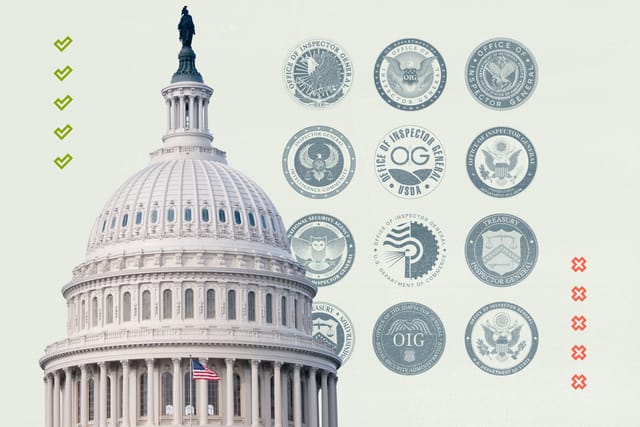
(Photo: Getty Images)
Updated December 19, 2025
The Project On Government Oversight (POGO) has long worked to strengthen independent oversight of the federal government. This endeavor is essential to achieving a more effective, ethical, and accountable government worthy of the people it represents and serves. Among the most critical components of the oversight ecosystem are inspectors general (IGs), who work for both the public and our elected officials to investigate and publicize waste, fraud, and abuse of power. Effective inspectors general inform congressional oversight, protect our taxpayer dollars, and hold our government accountable.
President Donald Trump struck a devastating blow to inspectors general in the first few weeks of his second term. In violation of federal law governing their removal, he fired 18 inspectors. These firings put into question the independence of those IGs who remain, including people serving in an acting capacity at the agencies targeted by the firings. It’s not clear whether and how inspectors general as a system will recover in the months and years ahead. But so long as these offices exist, they have a mandate from Congress to continue their work on behalf of the American people. And thus, the people Trump nominates to lead these offices remain critical to the mission of effective, accountable government and must be seriously considered.
Inspectors general must be apolitical, experienced, ethical, and independent. We urge members to carefully consider whether they meet these criteria.
The Inspector General Act, passed in 1978 in the wake of Watergate, set out requirements for inspector general nominees. Specifically, they must be appointed “without regard to political affiliation and solely on the basis of integrity and demonstrated ability in accounting, auditing, financial analysis, law, management analysis, public administration, or investigations.” The offices they lead are tasked with overseeing agency work, promoting effective program management, and keeping both the head of their agency and Congress informed. In addition, inspectors general, and those in their offices, may also receive information from whistleblowers and must generally protect the confidentiality of those individuals.
The Council of the Inspectors General on Integrity and Efficiency ― a body that oversees inspectors general ― states in its Quality Standards for Federal Offices of Inspector General that, “The Inspector General (IG) and Office of Inspector General staff shall adhere to the highest ethical principles.” Further, it explains that inspectors general report both to the heads of their respective agencies and Congress, and must remain independent and objective.
The statute and quality standards, when considered side-by-side, provide a framework against which to evaluate inspector general nominees: They must be apolitical, experienced, ethical, and independent. As the Senate holds hearings and votes on those nominated to serve as inspectors general, we urge members to carefully consider whether they meet these criteria.
Criteria for Inspector General Nominees ― and POGO’s Concerns
Apolitical
Inspectors general are required to audit and investigate federal agencies. Close affiliation with one political party could impact their desire to hold an agency or its personnel accountable. An inspector general with close ties to the president, or deeply ingrained in partisan politics, may hold back the results of an audit, and conversely, an inspector general opposed to the president’s agenda may push for investigations they otherwise would not. Even if an inspector general is not swayed by the association with one political party, the appearance of such could cast a pall on the validity of their findings.
Experienced
Per the statute, as stated above, an inspector general must have “demonstrated ability in accounting, auditing, financial analysis, law, management analysis, public administration, or investigations.” Further, Offices of Inspectors General (OIGs) are held to specific standards governing investigations and audits, including rules about evidence and forensics. A person with little to no experience in the type of work done by OIGs may not be as effective at rooting out waste, fraud, and abuse. Further, some OIGs, like those overseeing Health and Human Services or Veterans Affairs, are tasked with overseeing billions of dollars and hundreds of people. POGO believes that IGs of bigger agencies should have experience managing large operations.
Ethical
As leaders of offices tasked with uncovering waste, fraud, and abuse of power, inspectors general are expected to conduct themselves with integrity. By nature of their work, their actions and character must be beyond reproach. Specifically, the quality standards name integrity, independence, professional judgment, and confidentiality as ethical standards by which inspectors general must adhere.
Independent
The quality standards state that “IG and OIG staff must be free both in fact and appearance from personal, external, and organizational impairments to independence,” and list seven threats to that independence: self-interest, self-review, bias, familiarity, undue influence, management participation, and the office’s structural integrity. POGO believes that it is essential that inspectors general not only remain independent from political pressure (see ”Apolitical,“ above), but also from agency leadership to help ensure their work is objective.