Congress Must Protect the GAO from Executive Overreach
The Trump administration is attacking GAO, the legislative agency that investigates wasteful spending and improves government efficiency.
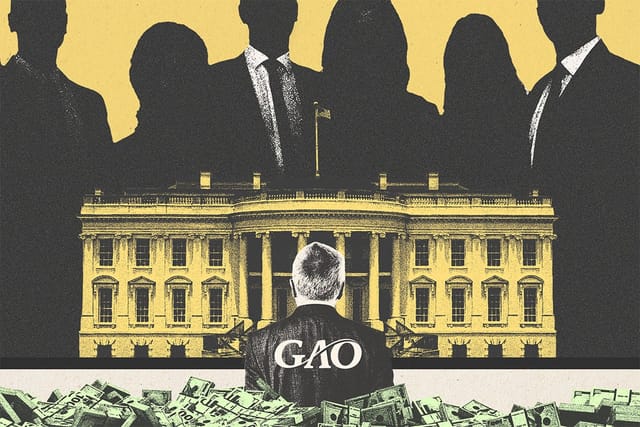
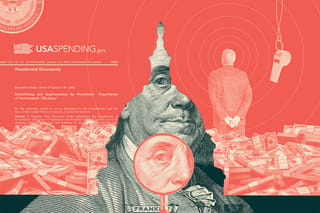
(Illustration: Ren Velez / POGO)
Since January, the Trump administration has undermined different sectors of the federal government responsible for ensuring that it is operating efficiently and upholding accountability and transparency. Recently, the administration has lobbed unfounded criticisms at the Government Accountability Office (GAO), a nonpartisan watchdog agency residing in the legislative branch, for simply doing its job to investigate waste, fraud, and abuse.
Thus far, GAO has resisted the administration’s attempts to curtail its regular operations, though it has faced scrutiny from the administration as a result. In May, the Department of Government Efficiency (DOGE) unsuccessfully attempted to embed a team within GAO under the executive order that established DOGE. GAO rejected DOGE’s efforts, correctly asserting that, as part of the legislative branch, it is not subject to executive orders.
Currently, multiple GAO investigations are underway examining the administration’s actions surrounding the freezing of federal funds and impoundment. The congressional watchdog has recently determined that the administration acted illegally in two of the 39 (and counting) impoundment investigations. The first decision from GAO asserts that the U.S. Department of Transportation withheld congressionally appropriated funds for the National Electric Vehicle Infrastructure Formula Program as authorized by the Infrastructure Investment and Jobs Act. In the second decision issued a month later, GAO illegitimized President Donald Trump’s Executive Order 14238, determining that the Institute of Museum and Library Services — an independent agency that manages museum, library, and information services across the nation — violated the law by withholding funds.
In response to GAO’s findings, several executive branch officials were vocal in their criticism. After the Department of Transportation decision was released, the Office of Management and Budget and a spokesperson for the Transportation Department called it incorrect and “legally indefensible.” The Office of Management and Budget’s general counsel, Mark Paoletta, and director, Russell Vought, also accused the congressional watchdog of being partisan.
These are just the first of many decisions GAO will release, potentially putting the agency at greater disfavor with the administration.
Before the Trump administration, GAO was rarely excoriated to this extent for its findings and performance. However, this response is in line with the administration’s broader pattern of undermining oversight and good government practices, consistently criticizing anything misaligned with its policy goals. The outcry has dominated the actual problem at hand.
To be clear, GAO does not exist to pander to whatever administration is in office at any given time. Its job is to inform Congress, with the fundamental goal of ensuring taxpayer dollars are being spent properly and not going to waste. And it is Congress’s job to defend the agency that has armed the legislative body with institutional knowledge on federal spending — regardless of which party has the majority in Congress.
GAO’s Widespread Impact on Quality of Governance
GAO’s creation in 1921 was a response to the increasing need for improved oversight and accountability over the management of federal funds after World War I. Over time, the legislative agency’s role has expanded and become multidisciplinary. This has enabled the agency to better meet the growing demand for comprehensive audits and reports.
Without both inter- and intra-branch collaboration with GAO, Congress and federal agencies would lose the valuable ability to request in-depth, comprehensive information in preparation for, or in response to, committee hearings. To this day, GAO continues to answer continuous demands from Congress. In the past four years, the congressional watchdog agency has received an average of more than 600 requests per year, and in Fiscal Year 2024 alone, GAO submitted more than 50 testimonies and produced over 700 products. Additionally, over the last ten fiscal years, GAO has saved taxpayers an average of $83.91 billion by investing in the institutional experts who make up the agency and examine the discrepancies in government.
The cost-saving efforts GAO performs aren’t small. This doesn’t even include the other legal work the agency does, such as resolving federal contract award disputes (also known as bid protests) and providing legal opinions and decisions.
The Project On Government Oversight (POGO) has also relied on GAO’s work to conduct investigations and produce analyses that help expose waste, fraud, and abuse. Some examples of government corruption and abuse that we were able to expose thanks to GAO’s work include:
- The unlawful employment of “acting leadership” in the Department of Homeland Security.
- The lack of federal spending transparency.
- Federal agencies’ violations of the law.
Taken together, these examples underscore why GAO remains critical to holding the government accountable, creating a more informed legislative body, and ensuring that both the House and Senate properly uphold appropriations laws.
Baseless Attacks on GAO are Problematic for Oversight
The Trump administration’s claims against GAO are unfounded and thereby harmful to the important work carried out by Congress.
Congress has often given significant deference to GAO’s work to support informed decision-making, regardless of political party. Historical examples include former-Senator William Proxmire (D-WI) calling GAO a “professional operation” and praising it as a resourceful agency with “integrity,” as well as then-Senator John McCain’s (R-AZ) frequent reference to and reliance on GAO investigations. More recently, in May of this year, Chairman of the House Committee on Oversight and Government Reform James Comer (R-KY) commended GAO reports, calling the agency’s work “excellent.”
Even DOGE has “taken note of GAO’s critical work.” In February, POGO testified at the first hearing of the House DOGE subcommittee on wasteful government spending. The subcommittee drew directly on GAO’s work, including findings that $236 billion in improper payments were issued in FY2023 and approximately $2.7 trillion in improper payments have been made since 2003.
GAO is clearly respected and continues to be useful. The agency holds a long-standing reputation across the aisle for being credible and nonpartisan, and is rigorously held to a prestigious standard amongst members of Congress. The administration saying otherwise is a dangerous, baseless assertion that can lead to significant misunderstandings and consequences.
In the face of growing attacks on GAO, Congress must uphold the separation of powers to prevent further politicization amid growing interbranch tensions.
We are already seeing the effect of such misinformation unfold. For example, America First Legal, a conservative 501(c)(3) nonprofit organization founded by the Trump administration’s deputy chief of staff for policy, Stephen Miller, is suing GAO for denying the organization’s FOIA request. However, GAO is responsible to Congress and is not required by law to respond to FOIA requests. This led America First Legal to inaccurately assert that GAO was an “executive agency.” Again, this is not true.
Case law has made clear the separation of powers between executive and legislative functions. As then-Chief Justice Warren E. Burger stated in a 1986 Supreme Court case, the person who leads GAO — the Comptroller General — is an agent of Congress. Just as the executive branch cannot take on congressional functions, Congress cannot take on executive functions.
Congress Must Defend GAO
In the face of growing attacks on GAO, Congress must uphold the separation of powers to prevent further politicization amid growing interbranch tensions.
POGO recommends that Congress take the following three initiatives:
- Advocate for sufficient appropriations for GAO’s budget. In light of the House Legislative Branch Appropriations Subcommittee’s attempt to slash the agency’s funding by 49%, the House and Senate Appropriations Committees must understand that cutting funding for GAO is cutting capacity for Congress. Comptroller General Gene Dodaro notes that insufficient funding for the agency could increase wait times in responding to Congress, forego tens of billions of dollars in cost savings, lead to loss of in-depth and institutional expertise about federal programs and how our taxes are being spent, and more.
- Take a stronger public stance protecting GAO in the press. Members of Congress should be vocal about protecting the watchdog agency. They should refrain from making false claims attacking GAO’s credibility. As proven by its track record, GAO has been utilized by members of Congress on both sides of the aisle. It is inconsistent to attack the very agency from which members of Congress are actively requesting information. Additionally, no administration has ever been faced with as many investigations by the GAO — because no other administration has been as outwardly willing to push legal boundaries and operate outside of the Impoundment Control Act. Congress should be prepared to push back against any attempts by the administration to weaponize that.
- Pass legislation to broaden GAO’s oversight role, and strengthen Congress’s appropriation powers as granted by the Constitution. To strengthen transparency and reporting, Congress should work with GAO to identify any violations of appropriations laws. Lawmakers should support legislation that authorizes GAO to initiate its own investigations, expand their information access, and require that its findings be used to inform the legislative decision-making process.
Fundamentally, the attack on GAO is not based on merit but serves as a distraction from two key facts: The administration has been found to have acted illegally, and the administration has threatened to withhold congressionally appropriated funds from agencies through impoundment if Congress’s appropriations laws do not align with the executive branch’s policy agenda. If the administration is willing to overreach its executive authority and infringe upon the legislative branch, as evidenced by the freezing of federal funds, then GAO investigations into those acts of overreach will naturally follow suit. Instead of taking accountability for wrongdoing, the administration is trying to shift blame onto the watchdog agency that’s diligently trying to root out actual waste, fraud, and abuse.
Congress must uphold its oversight authorities as required by law. Historically, Congress defended GAO against attempts to weaken the agency during the Hoover and Roosevelt administrations. Because Congress rose to the challenge to safeguard the government watchdog, the agency was able to continue providing much-needed oversight and saving taxpayer dollars for decades. Congress is once again being called to protect its watchdog agency. They did it before, and it’s crucial that they do it now.
Related Content