ICE Barring Congress from Detention Facilities Is Illegal
Congress has the right to inspect where ICE detains people. Rather than complying with the law, the agency is hiding its abuses.
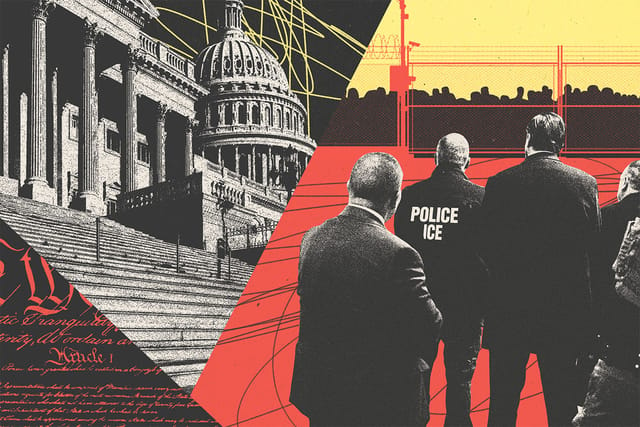
(Illustration: Ren Velez / POGO)
As Immigration and Customs Enforcement (ICE) expands its detention of immigrants exponentially, not only is the agency obscuring what happens inside detention facilities, it is blocking Congress from carrying out its congressional mandate for oversight. By June of this year, the agency was detaining over 57,000 people, the most since it began releasing regular updates in 2019. Those numbers are sure to skyrocket. In July, ICE moved to make almost everyone it detains ineligible for release on bail during their legal process to challenge deportation, and Congress recently gave the agency $45 billion to fund expanded detention.
Conditions in ICE detention have long been inhumane. For years, POGO has documented shocking abuses, including medical neglect that led to people dying of eminently treatable conditions, extensive use of solitary confinement, unsafe drinking water, crumbling facilities, sexual assault, and slave labor. This is all but certain to get worse with the hasty and massive expansion of the number of people in the custody of an administration that has publicly reveled in dehumanizing treatment, and after the Department of Homeland Security (DHS) dismantled the offices responsible for providing oversight and responding to rights abuses.
One of the few remaining ways for policymakers and the public to find out what happens in ICE detention is through congressional oversight — and ICE is working hard to dismantle that, too. As a new lawsuit alleges, ICE has denied at least a dozen members of Congress access to its facilities.
Illegally Impeding Oversight
On paper — which is to say, in federal law — members of Congress have an ironclad right to conduct in-person oversight of ICE facilities. By law, ICE may not prohibit a member of Congress from entering “any facility operated by or for the Department of Homeland Security used to detain or otherwise house” immigrants, including when members arrive unannounced at a facility. Congressional staff is likewise entitled to access with one day’s notice.
The issue of congressional access to ICE facilities exploded into national news in May, when federal authorities charged Representative LaMonica McIver (D-NJ) over a scuffle at the Delancey Hall ICE detention center in Newark, New Jersey. While ICE had allowed McIver to enter the facility in that instance, it has since become clear that ICE is in fact thwarting congressional oversight.
In June, ICE issued an updated guidance memo for congressional access to detention facilities. Despite the plain text of the law, the memo stated that members of Congress would be required to give 72 hours’ notice before a facility visit, and a DHS spokesperson suggested as much as a week’s notice would be necessary. The June memo no longer appears on the DHS website. But the ICE Office of Congressional Relations website reflects the seven-day advance notice policy, with exceptions at the discretion of DHS Secretary Kristi Noem. This is plainly against the law.
A more subtle, but still problematic, impediment to congressional oversight has been in place since at least February. ICE will not permit members of Congress to speak with anyone detained at an ICE facility unless the member submits a privacy waiver signed by the individual being detained, or the agency is given 48 hours to post a sign-up sheet in the facility to let people in detainment sign waivers. The problem with this is that it’s very hard to accurately learn about conditions in a facility without speaking to the people detained there. And it’s not at all clear how a member of Congress is supposed to obtain a signed privacy waiver from someone already in detention. In at least one instance, a member of Congress had their request to speak with specific people in detention denied, in part because of purported paperwork errors.
The simplest solution is, of course, for ICE to follow the law. Congress and the public should expect nothing less.
The notification and privacy waiver processes are not the only tricks ICE is using to thwart congressional oversight. As the government detains more and more immigrants across the country, ICE has held people captive in facilities that were not intended for overnight habitation. In one of the most notable recent instances, people were held in an arrest processing facility in a federal building in New York City, with ICE data indicating some people were held for days, even over a week, in spaces intended for hours-long stays. Leaked video from the facility shows people in a room with no furniture, open toilets, and little bedding beyond mylar blankets on the floor.
But ICE has repeatedly refused to allow members of the New York congressional delegation to inspect the site, claiming that there is no detention facility there. Based on the evidence, it is simply untrue to claim that the facility is not “used to detain or otherwise house” immigrants. This is not an isolated incident, but apparently an ICE policy decision. Members of Congress have also been denied access to a facility in Illinois, and ICE has stated that it will not allow access to field offices, regardless of whether people are detained there.
Congress’s Constitutional Right
It’s worth noting that even if the oversight statute did not exist, Congress has the constitutional power and responsibility to conduct oversight of the executive branch. The juxtaposition of a crystal-clear law with ICE’s obstruction puts the situation in stark relief: The agency is hiding abuses from Congress and the public. But even if the oversight law didn’t exist, ICE would still have the obligation to disclose what it is doing to people in its custody.
The simplest solution is, of course, for ICE to follow the law. Congress and the public should expect nothing less. Unless and until that happens, though, it is essential for members of Congress to keep up their efforts and not fold in the face of ICE’s illegal intransigence. The lawsuit by representatives who have been turned away from ICE facilities opens a new avenue for forcing ICE to comply with the law. While judicial enforcement of congressional rights comes with its own challenges, the courts can and should intervene to ensure ICE follows the law.
Members who seek access to these facilities are legally in the right, and oversight is more essential now than ever. Otherwise, we run the risk that abuses perpetrated by the government in the public’s name will only come to light from those lucky enough to be released from detention.