It’s Finally Time to Ban Congressional Stock Trading
Congress must capitalize on the recent surge in support and momentum for a congressional stock trading ban.
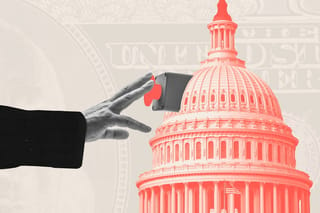
(Illustration: Ren Velez / POGO)
With deeply troubling events happening on a daily basis, ranging from the deployment of masked federal agents and military troops to the streets of American cities to illegal and abusive executive branch power grabs, it’s easy to lose sight of the more mundane (though still critically important) ongoing examples of government corruption and conflicts of interest. A persistent vector of corruption on the part of government officials — members of Congress, in this case — is the scourge of congressional stock trading.
Though this practice is obviously and evidently corrosive from an ethical standpoint, it bears repeating: Congress has extraordinary power to shape markets and influence the financial performance of entire economic sectors as well as the fortunes of individual companies. As the legislators, overseers, and investigators who wield that power, members of Congress allowing themselves to tie their own financial portfolios to the performance of those sectors and companies is, without exaggeration, a moral and political stain upon the entire institution. This is why the Project On Government Oversight (POGO), along with a wide range of other stakeholders from across the political and ideological spectra, have long called for restricting congressional stock trading.
A Surge of Momentum
As we said earlier this summer in the Washington Examiner, the effort to ban congressional stock trading has gained momentum recently, especially this year. Prominent figures from both political parties, including President Donald Trump, Speaker Mike Johnson, House Minority Leader Hakeem Jeffries, and former Speaker Nancy Pelosi, have weighed in with support for banning congressional stock trading. Just last month, Treasury Secretary Scott Bessent became the latest high-ranking government official to join the chorus of support for this long-overdue commonsense reform.
Even more important than the statements of support by a diverse set of public figures, and perhaps just as important as the super-majority public support for banning congressional stock trading, is recent concrete movement from the Senate. More specifically, the Senate Committee on Homeland Security and Governmental Affairs — the committee of jurisdiction for the stock trading issue in the Senate — voted in July on a bipartisan basis in favor of a robust stock trading ban bill, the HONEST Act. POGO was enthusiastic in our support for the bill and for the Senate’s commitment to moving forward on the issue.
One substantive wrinkle that’s worth noting about the HONEST Act is its inclusion of the president and vice president in the bill’s prohibition on stock trading. While we take a backseat to no one when it comes to consistently calling for anti-corruption and ethics reforms for all government entities and the officials who lead them, including for the president and the rest of the executive branch, including them in the HONEST Act is not the right tactical approach. Congress should focus first on getting its own house in order, so to speak, and demonstrate that it can address its own ethical gaps. President Trump’s response to the Senate committee vote shows how making this bill too unwieldy could doom the reform effort to a slow but sure demise by galvanizing opposition, both from supporters of banning congressional stock trading and from those who would seize any opportunity to kill the bill on its own terms.
Alongside the Senate’s recent progress on this issue has been the House of Representatives’ long-awaited, recently introduced compromise bill, rumored for some time to be in the final stages of negotiations between several bipartisan leading members of the House who each have their own respective stock trading ban bills. POGO was also involved in this process and pleased to support the bill that emerged from it, the Restore Trust in Congress Act, a bill co-led by a robust cohort of bipartisan representatives. This development represents a pivotal moment in the fight to pass this reform this year.
Adding complications to the delicate process playing out in the House has been the persistent threat by one member to bring up a discharge petition in order to force a vote on a stock trading ban bill. While such forceful legislative maneuvers have merit, especially on an issue that enjoys such broad-based, bipartisan support, doing so now may also derail the momentum around banning congressional stock trading. Both Speaker Johnson and Minority Leader Jeffries have expressed support for voting on a stock trading ban this year. The introduction of the Restore Trust in Congress Act represents the best and most conducive opportunity to force both congressional leaders to take action and make a vote happen.But if the discharge petition process blows up without successful passage of a bill, congressional leadership and skeptical rank-and-file members would have the perfect off-ramp to use as a means of scuttling the whole enterprise.
Strategic, tactical, and procedural considerations aside, the unavoidable and inexorable truth is that the practice of stock trading by members of Congress is unconscionable and the time to end it is now. Though the 2026 midterm elections are over a year away, the matter of stock trading and its ethical implications have already become fodder for campaign messaging. Beyond being the unequivocally right thing to do from the standpoint of integrity for public officials, one has to imagine that putting this issue to rest once and for all would make being a member of Congress or a candidate to become one a little easier.
The Time to Act is Now
It cannot be overstated how time-sensitive and urgent it is for Congress to act on this issue now. Specifically, Senate Majority Leader John Thune and Minority Leader Charles Schumer should immediately work together on an agreement to either dedicate specific Senate floor time to debate and vote on the HONEST Act or negotiate toward agreement upon attaching that bill to a must-pass legislative vehicle, such as government funding legislation or this year’s National Defense Authorization Act (NDAA).
The House has both a simpler and more complicated path toward moving a stock trading bill in short order. As noted above, any member of the House can file a discharge petition, and, so long as they obtain enough signatures from a majority of the House’s membership, they can bring a bill directly to the House floor for a vote. Since opposition to banning stock trading is bipartisan and does not cut neatly along standard party lines, a discharge petition would likely require substantial numbers of signatures from both parties in order to get the requisite number to constitute a majority.
There are numerous ways Congress could get a stock ban done and do so quickly if they choose to act.
Since the committee of jurisdiction in the House — the House Administration Committee — has not held a hearing to consider and vote on a stock trading bill, the path through regular order for such a bill in the House is more daunting and would take longer. Similar to the Senate, the House could choose to negotiate on a bipartisan basis to attach the Restore Trust in Congress Act to government funding or the NDAA as a means of maximizing prospects for its eventual passage. Additionally, either chamber could negotiate with the other chamber to facilitate a process through which one chamber moves its version of a stock trading bill and the other chamber agrees to take that bill in whole and hold a vote on it.
In short, there are numerous ways Congress could get a stock ban done and do so quickly if they choose to act. It has never been institutional mechanics or procedural hurdles that have stopped this reform from happening. It has always been and always will be a lack of political will and civic courage that has prevented it.
To their credit, there is a large contingent of members of Congress from both parties who have introduced stock trading ban bills, cosponsored such bills, or otherwise expressed support for the idea. To this point, congressional leadership has been the primary impediment, but that appears to be changing. With bipartisan support in Congress itself and expansive bipartisan support in the public at large, not to mention support from the president and some of his top cabinet officials, the time has never been better and conditions have never been more fortuitous. Put simply, Congress must act to pass a congressional stock trading ban — and it must act now.