Reclaiming Democracy: How to Build a Government That Deserves Our Trust
We must create a new vision for government accountability that will withstand the test of time.
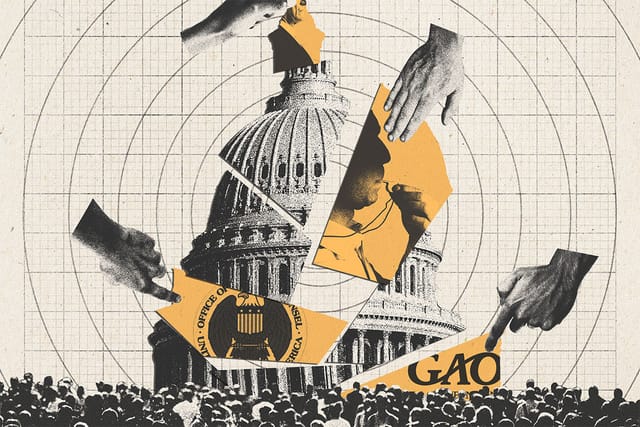
(Illustration: Ren Velez / POGO)
We’ve reached a critical moment in the American experiment. The erosion of trust in our federal government and the steady drift toward authoritarian governance raise profound questions about the resilience of our system. To realize a brighter future, we must fully understand the weaknesses being exploited by President Donald Trump, and we must think boldly about how we can build a more resilient government when Trump leaves office.
This is why POGO is launching a program that will provide a roadmap for the accountability mechanisms that will need to be created post-Trump. We do not intend to simply rebuild existing structures. Instead, we will bring together current and former practitioners and the best thinkers about democratic practice to create a new vision for oversight that will provide the kinds of checks and balances that can withstand executive overreach.
Despite deep partisan divides, research repeatedly shows that Americans share a desire for an accountable, effective, and ethical federal government that serves everyone. While we might debate how best to achieve this ideal, the belief in government “of the people, by the people, for the people” endures. However, corruption consistently emerges as the critical obstacle preventing us from reaching that vision.
For decades, Americans across the political spectrum have rightly perceived corruption not merely as individual misconduct, but as a systemic problem where political elites and powerful interests thrive at the expense of the public good. Episodes involving congressional stock trading scandals, bribery convictions, opaque financial dealings, and a failure to act on clear ethical violations have reinforced perceptions of corruption as bipartisan and entrenched.
Yet today, instead of confronting these challenges with accountability and transparency, we see concerning trends toward authoritarianism. Those in power claim they are seeking “accountability” but are really carrying out vengeance, targeting political opponents rather than addressing systemic corruption. Similarly, leaders are using “effectiveness” to justify harmful mass layoffs of federal employees, the gutting of critical agencies, and declarations of manufactured emergencies that expand unchecked executive power.
The institutions designed to maintain checks and balances have, over many years, allowed incremental power grabs that undermined our constitutional safeguards. By allowing secretive legal opinions, unauthorized military actions, and unaccountable law enforcement practices, policymakers opened the door for profound abuses, like the deployment of troops to Los Angeles over the objection of the governor.
Our founders explicitly rejected concentrated power in the hands of a single individual, designing a three-pronged system of checks and balances in which Congress, as the people’s direct representatives, holds primary responsibility for legislation and oversight. Yet Congress has too often abdicated these responsibilities, allowing unchecked executive expansion.
This is our moment to build a government truly worthy of public trust, reflecting the shared vision of the American people.
And existing oversight systems and structures that have historically served as guardrails against corruption and abuse of power — whistleblowers, the independence of inspectors general, the Government Accountability Office, and the Office of Special Counsel — are themselves under attack, further weakening our democratic safeguards.
Addressing this crisis demands action beyond incremental reforms or bureaucratic streamlining. Meaningful change requires revitalizing Congress as a powerful, engaged, and representative body capable of rigorous oversight and ethical governance. It necessitates reforms that emphasize transparency and accountability and that protect those who courageously expose wrongdoing.
POGO will lead the way in reimagining the accountability structures needed to ensure that our crucial system of checks and balances operates as it should. We will bake in, from the beginning, a commitment to make sure our governmental institutions serve the needs of all the people, not just the politically powerful.
The crisis we face today presents an opportunity. By recommitting to the core ideals of transparency, accountability, and ethics, we can forge common ground that transcends partisan divisions. Structural reforms, yes — but driven by empowered, informed, and vigilant citizens.
This is our moment to build a government truly worthy of public trust, reflecting the shared vision of the American people. That government does not yet exist — but we have the power and the obligation to create it.