Pentagon Cuts to DOT&E Could Endanger Troops
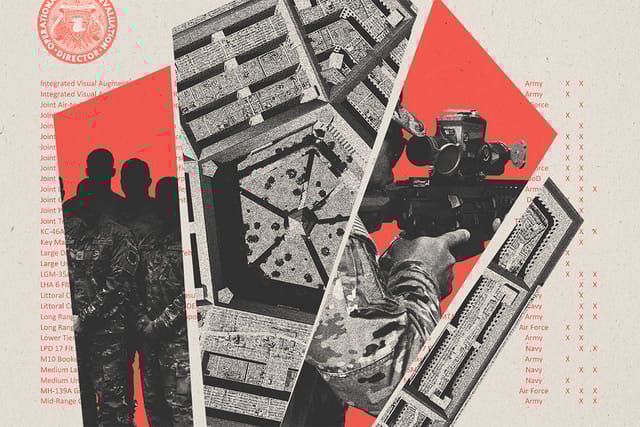
Recent cuts to DOT&E reduced the agency’s Oversight List by 99 programs, including operational testing for the Army’s new rifle.
(Illustration: Ren Velez / POGO)
In 1983, after years of embarrassing failures of weapons systems such as the Sergeant York Division Air Defense (DIVAD) system and deadly combat malfunctions of the M16 rifle, Congress created the office of the Director, Operational Test and Evaluation (DOT&E) to provide independent assessments of new weapons systems. This past May, Defense Secretary Pete Hegseth slashed the agency’s staff by more than half, making it unclear how DOT&E would continue to fulfill its mission. In the last month, DOT&E has scaled back its plans, aiming to provide operational testing for just 152 programs versus the 251 programs it oversaw last year.
Ironically, one weapon for which DOT&E chose to drop operational testing is the Army’s new rifle, the XM7, part of the Next Generation Squad Weapon family of weapons. The XM7 is intended to be the first successor to the M16/M4 series of rifles, which had so many malfunctions it helped lead to the creation of DOT&E. We can only hope this drastic reduction in testing doesn’t lead to the same kinds of deadly combat failures that occurred with the M16.
DOT&E’s Crucial Testing Process
To understand why DOT&E’s work is so important, it helps to know what the agency does and how. Developing a new weapons system involves many types of testing, and those tests are performed by a combination of military and civilian employees of the federal government, experts contracted directly by the government, and the manufacturers of the weapons themselves. As a weapon is developed, prototypes may be built and tested that are different from the final design used to build production units. Tests may measure a weapon’s performance against a quantitative specification, or whether the weapon meets a qualitative and sometimes subjective standard of usefulness.
Testing is divided into three types — Developmental, Operational, and Live Fire. These types of testing are always coupled with evaluation, so they are abbreviated as “T&E” (testing and evaluation), which results in DT&E, OT&E, and LFT&E.
Developmental testing and evaluation (DT&E) is used to iteratively assess whether prototypes are performing according to contractual and technical specifications. These tests may be done by the weapon’s manufacturer and may be performed using pre-production prototypes. As results are gathered and analyzed, designs are generally updated to address any shortfalls relative to specifications.
Operational testing and evaluation (OT&E) is used to assess whether production units actually meet operational goals under realistic conditions. To ensure the manufacturer doesn’t influence the outcome of these tests, they are legally prohibited from participating in them. As described in DOT&E guidance, testing must be performed on weapons built to the final design using production facilities and maintained using production documentation and procedures. These tests are the “fly” in the “fly before buying” principle and result in official reports that go directly to the secretary of defense and congressional committees. Those reports state whether the tested weapons “are effective and suitable for combat.” A decision to build more than a few (10% of the total purchase in many cases) units may not be made until these reports are delivered to Congress.
It should be noted that the secretary of defense can choose to proceed with full-rate production and Congress can provide funding even if these reports describe serious deficiencies, as they did in the case of the F-35 fighter jet. While we hope that the secretary of defense and Congress will avoid this mistake more often in the future, it is nevertheless important that DOT&E provides these reports, and that voters and taxpayers have some visibility and insight into these decisions.
The final type of testing is live fire testing and evaluation (LFT&E), which assesses the lethality and/or survivability of a weapons system under realistic conditions. LFT&E was made part of DOT&E’s responsibilities by law in 1986, after revelations about testing of the Bradley Fighting Vehicle had already inspired investigations. Before this law, there were no explicit requirements that weapons systems be tested using live rounds. As a result, then-Colonel James Burton, U.S. Air Force, struggled for years to get the Army to approve test firing live antitank weapons at the Bradley under realistic conditions, including while the vehicle was fueled and loaded with the machine gun, cannon, and missile ammunition it would normally carry in combat. His fight is described in his book, The Pentagon Wars: Reformers Challenge the Old Guard.
Congress should step up to ensure the staffing, funding, and access to other resources DOT&E needs to oversee the testing of weapons it and Congress deem crucial to the safety and success of our armed forces.
Of these three types of testing, DOT&E is responsible for reviewing and approving Test and Evaluation Master Plans and Test and Evaluation Strategies (TEMP/T&E) for all programs the agency deems worthy of its oversight. By ensuring each TEMP/T&E calls for adequate operational and live fire testing, confirming that the tests described in the TEMP/T&E were actually conducted, and evaluating the results, DOT&E fulfills its statutory duty to oversee operational and live fire testing.
DOT&E declares to program managers and individual military services which programs it will oversee by maintaining an Oversight List of programs for which it oversees testing. While DOT&E oversight is required by law to cover all programs above a certain cost threshold and any designated as Major Defense Acquisition Programs by the secretary of defense, the law also provides that DOT&E can add programs to this list at its discretion. Historically, DOT&E has followed Congress’s requests to add programs to the Oversight List, and Congress has provided funding to cover those costs.
In a July 31, 2025, hearing on the confirmation of Dr. Amy Henninger as the next DOT&E, Senator Elizabeth Warren (D-MA) made a point of asking Henninger if she is committed to following this practice. Henninger declined to say so. A week later, with Congress on recess and Henninger not yet confirmed, DOT&E released an updated Oversight List with 152 programs flagged for OT&E instead of the 251 programs flagged as of May.
History Repeating
Among the weapons dropped from the Oversight List is the Army’s new infantry rifle, the XM7. The parallels between the XM7 and the M16, whose combat failures contributed to the creation of DOT&E, are eerie to say the least. Both rifles introduced a new ammunition caliber and both were controversial for that reason. In fact, the M16 and XM7 are the only two rifles since World War II that have introduced new standard-issue rifle cartridges, and with them a requirement for new tactics and new training. In the words of retired Army Brigadier General Larry Q. Burris, then-director of the Soldier Lethality Cross Functional Team, “We should note that this is the first time ... in 65 years [that] the Army will field a new weapon system of this nature. … This is revolutionary.” And with advancement often come setbacks: The latest DOT&E annual report indicates, “The XM7 with mounted XM157 demonstrated a low probability of completing one 72-hour wartime mission without incurring a critical failure.”
The revolutionary nature of the XM7 would seem to merit more testing, not less. In addition to introducing a new cartridge size (6.8 millimeters rather than 5.56), the XM7 also has an electronic, computerized sight, a suppressor (commonly but incorrectly referred to as a “silencer”), and a mix of general- and special-purpose ammunition. In order to assess whether this “revolutionary” combination of new features adds up to increased lethality, they need to be tested together. In particular, operational testing is needed to assess whether a squad of soldiers with XM7s each carrying 140 rounds of ammunition is more effective than a squad carrying M4s (the latest M16 variant) each carrying 210 rounds. We need to see whether the high-tech sights, ammunition, rifle, and updated tactics add up to more effectiveness. By removing operational testing of the XM7 from the Oversight List and leaving only live fire testing, DOT&E dangerously restricted the scope of testing for this rifle.
Congress has begun to take steps to protect DOT&E’s ability to conduct independent operational testing, including Warren’s call for a commitment to test weapons deemed appropriate by Congress, and Representative Donald Norcross’s (D-NJ) amendment to the House’s version of the National Defense Authorization Act (NDAA) to clarify DOT&E’s access to resources it needs to perform adequate oversight.
Our armed forces do not deserve another fiasco like the M16. In the words of a Marinein 1981:
The weapon has failed us at crucial moments when we needed fire power most. In each case, it left Marines naked against their enemy. Often … we take counts after each fight, as many as 50% of the rifles fail to work. I know of at least two Marines who died within 10 feet of the enemy with jammed rifles.
DOT&E was created to avoid such tragedies. We need to ensure it has the freedom and resources to do so for years to come. Congress should step up to ensure the staffing, funding, and access to other resources DOT&E needs to oversee the testing of weapons it and Congress deem crucial to the safety and success of our armed forces. This includes the rifle our frontline troops use as their primary weapon.