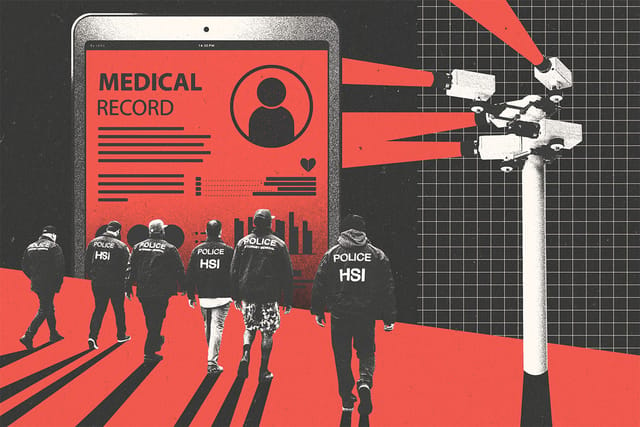
Tens of millions of Americans understand that when they help an aging parent or young child apply for Medicaid coverage, or when they apply for coverage themselves, it is an arduous process. The time and effort required to complete an application for assistance involves submitting numerous pieces of sensitive information. As anyone who has switched to a new doctor’s office has experienced, health-related data is hard to share without jumping through hoops. It used to be rightfully assumed that no matter the political winds, this information would only be used to determine one’s eligibility to receive Medicaid benefits and to pay doctors for their services. Not anymore. Now, Immigration and Customs Enforcement (ICE) will have access to much of that information at the click of a button.
As first reported by the Associated Press and detailed by WIRED, ICE signed an “Information Exchange Agreement” with the Centers for Medicare and Medicaid Services (CMS). This agreement will allow access to “names, addresses, birth dates, ethnic and racial information, as well as Social Security numbers for all people enrolled in Medicaid.”
Although the text of the agreement has not been made public, several media outlets have reported on this unprecedented arrangement. ICE has also confirmed it. According to WIRED, ICE officials will receive login credentials providing access to a CMS database hosting the aforementioned sensitive data, as well as IP addresses and banking information. The text of the agreement is reportedly unclear as to whether ICE will have access to all of this data or a more limited view. This same database, the Transformed Medicaid Statistical Information System, or T-MSIS, also contains “sensitive medical information, including detailed records about diagnoses and procedures.” This database collects Medicaid and Children’s Health Insurance Program (CHIP) data from across the country. The agreement is renewable and initially lasts for 60 days. Twenty states are suing the Trump administration over the sharing of this sensitive data.
ICE Acting Director Todd Lyons’s claim that “ICE is always focused on the worst of the worst” is contradicted by ICE’s own data. The agreement grants ICE access to the health records of every enrollee in America, which includes millions of families and children, not the “worst of the worst.” As ICE is being sued for racial profiling and unlawfully detaining Latino individuals, including U.S. citizens, during immigration enforcement operations, the law enforcement agency will have access to the racial and ethnic information of approximately 79 million people. This represents an unprecedented level of data sharing granted to a law enforcement agency, in this case, enabled by the circumvention of longstanding privacy laws and protections under the Privacy Act of 1974, the Social Security Act, and the Health Insurance Portability And Accountability Act (HIPAA) — the long term implication is the creation of an equally unprecedented surveillance weapon that could target millions based on their identity.
The Construction — and Deconstruction — of Data Privacy Protections
In the wake of Watergate, COINTELPRO surveillance abuses, and the increasing technological capabilities of the government to collect and centralize information, Congress passed the Privacy Act of 1974. For decades, the Privacy Act stood as a bipartisan agreement that the federal government should not have the power to build the information-sharing capacities that could lead to warrantless mass surveillance of Americans. In normal times, for millions of Americans, the Privacy Act would generally protect the information submitted to the federal government from being shared between federal agencies without consent. But these are not normal times. An executive order signed early in the administration to eliminate “information silos” is the primary motivator and dubious legal authority upon which the administration is assembling its most powerful surveillance weapon yet. This has contributed greatly to the events of the last eight months.
Like a standing domino unable to resist the force pushing against it, the sharing of CMS data with ICE is the latest — and perhaps the biggest — example of the administration obliterating privacy protections in a federal agency under the auspices of immigration enforcement or rooting out waste, fraud, and abuse.
In March, the Department of Housing and Urban Development entered into a data-sharing agreement with the Department of Homeland Security. After major opposition within the IRS, several officials were removed or resigned, allowing what likely are loyalists to assume control of the personal information spigot. By mid-April, the Social Security Administration fell in line. In late April, the U.S. Postal Inspection Service, reportedly fearful of control of the Postal Service being seized more broadly by the administration, preemptively yielded.
The sharing of CMS data with ICE is the latest — and perhaps the biggest — example of the administration obliterating privacy protections in a federal agency.
Numerous lawsuits are targeting the administration’s, and particularly DOGE’s, attempts to destroy privacy protections and share personal data. However, as courts move slowly to address these cases, the administration continues to move quickly and virtually unabated in executing its plans to centralize data. This will disproportionately impact undocumented populations who, in the absence of a comprehensive national privacy law, already have few, if any, protections in place.
To what end? The answers are horrifying. In response to DOGE pressure, IRS records obtained by ProPublica indicate plans for a home address “on demand” location information system, which could lead to immigration raids — already under fire for ignoring the need for basic protections such as search warrants — occurring at addresses no longer held by ICE’s intended target. According to ICE records reported by 404 Media, tens of millions of dollars have been paid to Palantir, a company specializing in surveillance technology, to make target analysis even more powerful. This, as ICE is poised to receive billions more in funding.
The highly sensitive information at CMS has not historically been permitted to be shared with other agencies except to 1) “administer a federal health benefits program,” or 2) investigate “waste, fraud, or abuse of the program.” ICE does neither. In fact, ICE officials’ stated intent to use the data to locate people they wish to deport directly contradicts the Department of Homeland Security’s patently false assertion that the goal of this information exchange agreement is merely to “ensure that illegal aliens are not receiving Medicaid benefits that are meant for law-abiding Americans.” The repercussions will be far-reaching.
Medicaid’s Broken Barriers
Multiple federal laws protect Medicaid information. The Privacy Act of 1974 limits the disclosure — even within the government — of information about American citizens and permanent residents. The Social Security Act, which governs Medicaid, stipulates that any sharing of Medicaid data must be pursuant to “purposes directly connected” with the administration of the plan. And the Health Insurance Portability and Accountability Act, better known as HIPAA, prohibits disclosure of personally identifiable information from health systems, with tightly defined exceptions. Despite reported objections from CMS officials over the legality of sharing Medicaid enrollee data, the administration granted ICE access to the massive trove of data to “retrieve information concerning the identity and location of aliens in the United States.” Although there are no federal laws prohibiting all immigrants from qualifying for health care generally, most undocumented migrants and even some lawfully present immigrants are prohibited from receiving Medicaid. Even if some people have managed to enroll in Medicaid and receive benefits they are not permitted to, there is no reason that ICE, the agency tasked with deportations, would have any logical role to play in rooting out suspected abuse of the Medicaid system.
Crucially, federal law has an exception — Emergency Medicaid — which allows for anyone needing lifesaving care to get it at an emergency room while reimbursing hospitals. And a handful of states have allowed their residents to enroll in Medicaid regardless of immigration status, with the state footing the bill for their care rather than the federal government. In other words, there are perfectly legal reasons for someone without citizenship to be enrolled in Medicaid. Many of the people best poised to understand and uphold these Medicaid protections have already been undercut by this administration. As POGO’s Maren Machles reported, the Department of Health and Human Services plans to cut a majority of its Office of the General Counsel (OGC) staff, effectively removing and restricting the employees most experienced in protecting Medicaid recipients and preventing Medicaid fraud and abuse. ICE officers cannot enforce regulations in the same way — and that was never the intent.
It starts today with immigrants, but once proof of concept is established, any administration will be able to turn this weapon on the disfavored.
Simply put, this is another stone turned over — in this case a massive boulder — to help ICE execute a political promise: a dehumanizing mass detention and deportation campaign that is targeting people of color, their families, and their communities, by the millions. The personal information those people handed over to the government in good faith is now in the hands of an entirely different federal agency that will use it to target them. And American citizens’ data will be disclosed as well.
Like all surveillance, this raises grave questions about the chilling effect on people that have a statutory right to health care, but will delay or reject it at their physical peril to avoid being put in the crosshairs of ICE agents with quotas to meet.
Mass Surveillance and Mass Targeting in Plain Sight
What we are witnessing is part of a much larger pattern developing. As we have written, “Mass arrests cannot happen to scale without surveillance, including location tracking, racial profiling, and warrantless searches, electronic or otherwise.”
It did not take long for the creeping lawlessness of this administration to set off authoritarian alarm bells. This is how surveillance under the auspices of immigration enforcement radically shifts the relationship between government and the people it exists to serve.
Although much of this Congress has already cast its lot with authoritarianism, every member still has a duty to represent their constituents and uphold the rule of law. A new Congress is elected every two years. Members of Congress must start working now on significant reforms to protect Americans and immigrants alike from government surveillance. In asserting its power of oversight, Congress should demand a public accounting of how data sharing and access are limited. People must speak out and demand that privacy protections remain in force. Most immediately, career public servants at agencies must continue to follow the law and demand such from political appointees.
We are rapidly moving beyond the “collect it all” ethos among the federal government in the early 21st century and moving into an era far more sinister and existential. Driven by a fundamentally racist immigration policy, the administration is systematically steamrolling longstanding statutory privacy protections to unlock the ultimate potential of surveillance — not just monitoring, but targeting, millions of people at a time on a whim. It starts today with immigrants, but once proof of concept is established, any administration will be able to turn this weapon on the disfavored.