Is the Surveillance Reckoning Finally Here?
As people across the country rise up against cameras tracking their every move, Congress must act to protect privacy and dismantle the surveillance state.
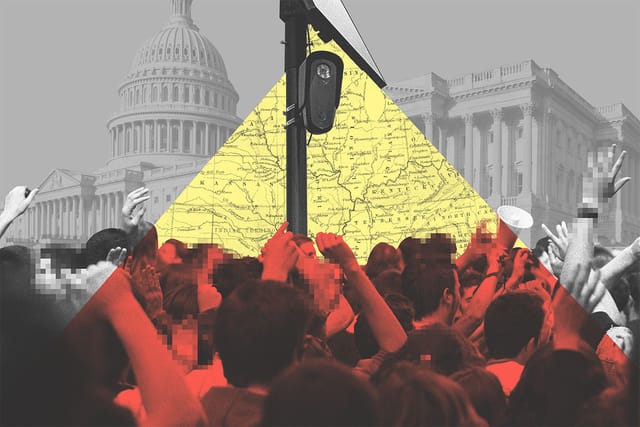
(Photo: MiracleMiles / Wikimedia Commons (CC BY 4.0); Illustration: Luna Velez / POGO)
People across the political spectrum are saying enough is enough when it comes to surveillance. From social media to angry town hall meetings, the backlash against the government watching people’s whereabouts by reading their license plates crosses political and geographic boundaries. Automated license plate readers (such as those made by Flock Safety) have become one of the most readily identifiable surveillance tools today, and the public pushback has led to momentum for policy change. To date, over 150 locations around the country have suspended, paused, or ended Flock camera contracts.
The overwhelming response from the public highlights one of the most important characteristics about Americans: Despite the incessant spread of technology and surveillance, we still care about our privacy. But license plate readers are just one piece of a much larger network of surveillance, newly turbocharged by AI, which needs to be dismantled to restore our privacy.
The rapidly shifting landscape has left policymakers rushing to catch up or change their views outright to align with Americans. According to a poll by Americans for Responsible Innovation, 76% of Americans expressed concern that artificial intelligence “could enable unprecedented government surveillance of American citizens.” A surveillance reckoning has arrived.
Congress can respond to that reckoning and protect our privacy, but it is asleep at the wheel. It's time to wake up.
Automated License Plate Readers and Flock Safety
Automated license plate readers are cameras that do what their name suggests: automatically track the license plates of cars as they drive by. They also capture other details, such as the make, model, and color of a vehicle, and distinguishing features like dents and bumper stickers. They can be mounted in fixed locations or on police vehicles.
The technology is not new, but recent years have brought two major new developments. The first is the massive spread of cameras across the country, often without any public debate or local oversight. The second development is the rapidly increasing use and capabilities of artificial intelligence, including with license plate readers. Founded in 2017, Flock Safety has become a multibillion-dollar behemoth in this space. There is no national registry of these cameras, but according to open-source information, somewhere between 80% to 85% of the approximately 120,000 to 140,000 cameras deployed across the country are managed by Flock. Thousands of law enforcement agencies at the federal, state, and local levels employ Flock daily. Even private companies are in on the mass surveillance business: Lowe’s and Home Depot are known to employ automated license plate readers at their stores, as have companies with curbside services like White Castle, and many other smaller businesses.
This creates an extraordinarily vast network of cameras, monitoring the movements of vehicles and, by extension, people, 24/7. The sheer number of vehicles scanned creates a system of dragnet surveillance, where everyone is under the watchful eye of government even if they are not under suspicion of doing anything wrong. Flock’s network alone captures over 20 billion images a month.
The system cannot work without AI — because such a massive data set would be useless to law enforcement without a way to quickly collect, sort, and recall specific information from it. Depending on how long the data is stored, the system can produce a detailed history of where a vehicle has traveled, with far-reaching implications on how law enforcement can identify our travel patterns, associations, and possible political leanings.
Privacy Under Assault
While Flock and many in law enforcement argue that cameras allow for crimes to be solved faster and can assist in everything from tracking stolen cars to finding missing persons, the mass collection used by these cameras means that while every car entering the field of view is tracked, on average less than one percent of all license plates scanned are actually connected to investigations or crime.
This is where the backlash comes in.
The simple fact that everyday people are being quietly monitored as they go about their lives is enough to give many people pause. It is akin to an officer taking a note every time you travel down Main Street: They may never use that information, but if they do, it can say a lot about you. The dangers of these cameras run deeper. On one hand, they give worrying amounts of power to people who can access the data. This kind of power has already been abused by individual police officers in law enforcement agencies around the country, with at least 100 police department employees charged with or accused of using the technology for unauthorized purposes. Flock has made efforts to address police misuse, but most of the changes seem unlikely to fully stem the drumbeat of controversies that seem inherent with this kind of mass collection technology.
AI-powered surveillance is a threat to our rights, and automated license plate readers are the latest technology becoming supercharged with these new and rapidly expanding capabilities.
Privacy issues extend far beyond individual abuse. Many communities installed cameras via free trials or grant funding, often with no public vote or local oversight. Without a vetting or voting process, essential questions over how long data is kept, how many cameras are installed around the community, where they are installed, and whether communities participate in national data sharing were overlooked. In February 2026, a Flock camera in Sherwood, Arkansas, misread the license plate of an SUV, leading officers to detain an innocent couple at gunpoint while their six-week-old baby sat alone in a car seat in the back of the vehicle. In a separate instance, a woman was held in jail for 13 days because of an error. There have been other controversies as well. In Illinois, license plate data was shared with U.S. Customs and Border Protection, despite a state law prohibiting data sharing for the purposes of immigration enforcement. In at least one reproductive care investigation, the cameras were used to track and find an individual. And as recent reporting suggests, cameras have been used to “monitor” protests. AI-powered surveillance is a threat to our rights, and automated license plate readers are the latest technology becoming supercharged with these new and rapidly expanding capabilities.
This confluence of events has led to a massive public response. The anti-Flock uprising across the nation has led to results, from the “Free State of Florida” deciding that its thousands of automated license plate readers were a bridge too far, to Texas pausing its massive investment in surveillance cameras, to Connecticut towns being engulfed in controversy over the proliferation of Flock cameras. While some have quietly moved to another license plate reader company, many have taken cameras down altogether.
A Tool of the Surveillance State
The backlash we’re witnessing reflects an understanding around the country that the extraordinary shift in technological capabilities, combined with the utter lawlessness of this administration, has put us at a tipping point. The omnipresence of surveillance was always real to people in border communities and historically overpoliced cities, and now people in small towns see it every day while driving down their street. At a time when we are seeing the rise of data centers, it becomes really scary, really fast. This is just the tip of the iceberg. As we have written, license plate readers are just one tool of the surveillance state being used by law enforcement around the country.
Things like facial recognition technology and data brokers — who sell your data to federal law enforcement agencies that can then use AI to build dossiers on individuals or surveil an entire community — are urgent threats to our constitutional rights and to free expression in our democracy. Congress has failed to keep up with the technology, and thus, has failed to keep up with the threats it poses.
New Era, New Rules
We’ve written about the dangers of the surveillance state, and the dramatic change in the relationship between the people and their government is coming to fruition. The stakes are profoundly high. Congress has failed miserably to stop the tide. Despite a smattering of new legislation to deal with cameras now, the legislative year is all but over. If this Congress cannot reach a last-minute consensus, the upcoming 120th Congress needs to act. Otherwise, the surveillance will only get more personal, more pervasive, and more dangerous.
If the federal government is allowed to use unrestrained AI to spy on the American public, one of our most important rights — the right to privacy — will be obliterated. We must chart a new path forward that protects our privacy in this new era. Congress has a critical role, and it should be bipartisan. Congress can support what states and municipalities are doing by banning the use of license plate readers by law enforcement and stop government from purchasing its way around the Fourth Amendment by closing the data broker loophole. Conducting oversight of big tech companies can play an important role here as well. People are rising up against Flock and surveillance cameras. Congress must hear the people, and do the work of dismantling the surveillance state.