Todd Blanche vs. the Public Interest
The new attorney general’s promises to put the law before the president’s demands are unconvincing in light of his record.
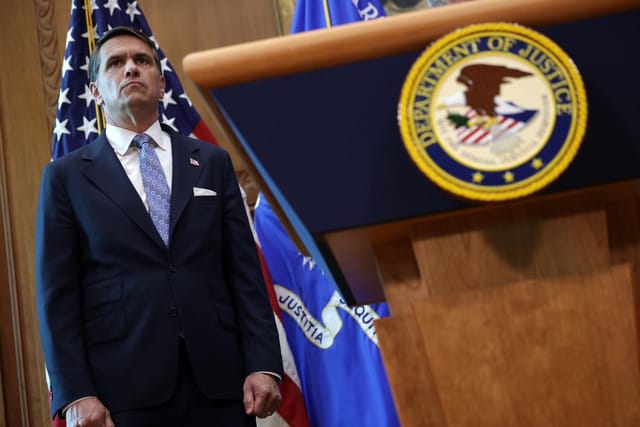
U.S. Attorney General Todd Blanche listens during a news conference at the Justice Department on August 12, 2026 in Washington, DC. (Photo: Alex Wong / Getty Images)
Shortly after being confirmed as attorney general, Todd Blanche made the rounds on television to try to counter (well founded) concerns that he would simply do President Donald Trump’s bidding in his new role. Those efforts seem to have backfired. Blanche pushed back on questions of independence, saying, “There’s a big difference between saying we will always do our job and investigate any case and act independently of the White House. No, I’m not going to pledge that.” His remarks touched off a new round of discussion about the appropriate level of independence the Justice Department should have from the White House.
Some, like the Washington Post editorial board, tried to dismiss criticism of Blanche’s comments with a civics lesson. Yes, the attorney general is chosen by, and reports to, the president. And it’s absolutely true that Justice Department leadership works to some extent to execute presidents’ policy agendas.
But this misses the point. The concern about the independence of the Justice Department, and about Todd Blanche in particular, isn’t about whether the department is hermetically sealed from the White House. It’s about the extraordinary efforts Trump has already undertaken to reshape and direct the department in ways that benefit him personally, at the expense of his perceived enemies and the law. And it’s about Blanche’s prominent role in those efforts prior to his confirmation.
There’s good reason to be concerned that Blanche would acquiesce to an order that benefits Trump at the expense of the public interest. But when asked about exactly that scenario, Blanche deflected rather than tackling it head on:
There is this extraordinarily false narrative that the president wakes up in the morning and calls me and says, “Todd, go prosecute X or Y.” He does not do that. He has never done that. He will never do that. And so if there’s something that he wants to do, that he needs to know that there’s a challenge or that we can’t do it, of course, I will tell him.
If that’s true, we should be so lucky. But we know that Trump did exactly that with Blanche’s predecessor, Pam Bondi, even posting on social media a directive to prosecute former FBI Director James Comey, Senator Adam Schiff (D-CA), and New York Attorney General Letitia James. The Justice Department subsequently indicted Comey and James (and had already opened an investigation into Schiff). A platitude that such a thing would never happen is cold comfort when it already has.
Blanche has proven willing to exert inappropriate influence over prosecutions.
And Blanche, for his part, has been a major player in the department’s efforts to benefit Trump and crack down on the president’s preferred targets. Perhaps most glaring is his involvement in the settlement agreement with Trump that gave rise to the so-called anti-weaponization fund and sweeping immunity for Trump, his family, and others. That alone nearly (and should have) doomed Blanche’s nomination. As POGO highlighted at the outset of that case, there was never a genuine basis for Trump’s lawsuit against the government, undercutting any excuse for a settlement, let alone one as generous to Trump. Blanche personally signed off on the agreement and, despite claiming otherwise and putting out a unilateral order to “rescind” the fund, has not done anything that would actually prevent the fund from being implemented.
Beyond the settlement, Blanche has proven willing to exert inappropriate influence over prosecutions. For instance, his public statements were a key reason for a federal judge tossing criminal charges against Kilmar Abrego Garcia, the man mistakenly deported to the brutal CECOT prison in El Salvador in 2025. The judge found the prosecution was based on a “vindictive motive” based on Blanche’s own admission that the Justice Department reopened an investigation into Abrego Garcia after he vindicated his rights in court by challenging his deportation.
Blanche also played a leading role in the Justice Department’s failure to comply with the Epstein Files Transparency Act, which Congress passed last year with unanimous consent from the Senate and a single “no” vote in the House. In ongoing litigation over the matter, a federal judge ruled that the department had failed to counter claims that Blanche violated the law, including by redacting certain names and “withholding certain materials mentioning President Trump.” Additional rulings on the legal adequacy of the department’s document releases are likely.
So when both the president and attorney general abuse the rule of law and the Justice Department’s mission, what’s to be done to ensure fair and impartial administration of justice? In the short term, oversight — by Congress, the press, and what remains of the department’s internal watchdog offices — is more important than ever. And when the dust settles, it is essential to catalog the failures and abuses by the Justice Department and to implement reforms to increase internal safeguards, increase accountability, and bolster the other checks on law enforcement abuses, especially the courts. What we cannot do is take Todd Blanche at his word. His actions speak louder.
Editor’s Note: This commentary was updated August 31, 2026, to include the Justice Department’s response to the Epstein Files Transparency Act.
Related Content
Blanche AG Confirmation Would Undermine DOJ Independence
Blanche’s track record risks politicizing the Department of Justice even further.

President Trump is Weaponizing the DOJ Against Prominent Civil Rights Organization
The Project On Government Oversight (POGO) condemns the administration’s latest attack on non-profits

The White House is Weaponizing the DOJ to Silence its Political Opponents
Congress has the right and responsibility to ask questions. This is a hallmark of authoritarianism.