Weekly Spotlight: Day 432
Fourteen months and counting of National Guard deployment in Washington DC. Plus, a dismissive new process for investigating complaints in the military and Attorney General Todd Blanche hits the town.

The question of domestic deployment

(Photo: Paul Becker / Flickr, CC BY 2.0 (modified); Illustration: Leslie Garvey / POGO)
On Wednesday, a federal appeals court took up the question of whether there are limits on how a president can deploy the National Guard and whether the ongoing deployment in Washington, DC is illegal, as a lower court ruled back in December 2025 — and which POGO has long maintained. Domestic deployment is an extreme response that should be reserved for utmost emergencies. There is simply no present justification for troops trained for war to be patrolling neighborhood streets. Having a massive military presence on street corners and parks is just costing taxpayers and eroding the fundamental democratic norm of no standing armies in peace time. The administration intends to keep the National Guard stationed in the city until the next Inauguration Day in 2029. This was not normal on day one, it is not normal on day 432, and it certainly should not drag on for two more years. The court should order it to end — now.
- The president said earlier this year that he would not be opposed to deploying the military and ICE to polling locations, an illegal and chilling move that would do little to uphold the purported aim of "honest elections." Just a few weeks ago, he refused to rule out using the Insurrection Act to deploy troops during the elections. We have ample reason to be concerned. It’s all the more urgent that the courts draw the line and firmly assert the rule of law here.
- Dig deeper: The Posse Comitatus Act prevents using the military for civilian policing — or at least, it is supposed to. A glaring exception to the law exists in the Insurrection Act, which allows the president to deploy the military in emergency situations. In the face of these new threats, POGO is urging Congress to reform the Insurrection Act.
- An internal document from the National Guard shows that the Department of Homeland Security sent National Guard troops into an immigration raid with no warning and little guidance, MS Now reports.
“We don’t want to hear it”

(Photos: Getty Images; Illustration: Leslie Garvey / POGO)
... is the message Secretary of Defense Pete Hegseth is sending with his announcement of a new process for investigating personnel complaints in the military. Under the directive, military leaders can dismiss complaints they don’t deem credible, anonymous disclosures are discouraged, and it is much more difficult for a complaint to trigger an investigation. The Defense Secretary’s new guidelines make it much riskier — and much more futile — for military personnel to speak up. Our service members need to have responsive, secure channels through which they can escalate concerns about toxic leadership, abuse, harassment, and discrimination. The Office of the Inspector General (IG) needs to reassert its independence, and aggressively defend against any attempts to transfer core IG functions to the military chain of command.
- TESTIMONY POGO to Congress: Whistleblowers Protect National Security: Read POGO Senior Policy Counsel Joe Spielberger’s 2025 testimony to the House Committee on Oversight and Government Reform on the importance of protecting military and intelligence whistleblowers.
Hegseth’s ‘Project Meridian’ is a conflict of interest in the making

(Illustration: Ren Velez / POGO)
"Putting major weapons contractors in charge of forging a strategy, that, depending on its main outlines, could greatly enrich their own companies is the height of folly,” writes POGO’s Bill Hartung. Read more on The Hill.
Spending Isn’t a Defense Strategy

(Illustration: Luna Velez / POGO)
Breaking down what a $1.5 trillion defense budget means, from process failure to contractor enrichment. By POGO’s Virginia Burger. Read on pogo.org.
Todd Blanche takes the stage
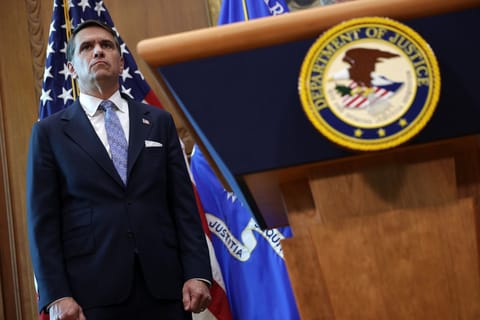
U.S. Attorney General Todd Blanche listens during a news conference at the Justice Department on August 12, 2026 in Washington, DC. (Photo: Alex Wong / Getty Images)
In recent weeks, Attorney General Todd Blanche has made appearances at political rallies and conventions, even taking the stage to praise the president and the administration. This is a “seismic shift” from what we expect from the country’s chief law enforcement officer, who is supposed to lead an independent Justice Department and embody those principles himself. Of course, that is not what we have seen from this DOJ: It has readily turned itself into a tool of retributive justice and corrupt self-dealing. After Blanche faced criticism, the Justice Department put out a memo relaxing its code of conduct for Senate-approved appointees around political actions like giving addresses and endorsing or opposing candidates. The DOJ can’t just rewrite the rules it wants to break.
- DOJ’s latest target: Representative. Ilhan Omar. The Washington Post explains how the raid on her house and the pre-midterm election timing defy a longstanding norm at the agency.
- Related: Reshaped civil rights mission at Justice Department transforms its work, workforce (NPR)