POGO to Congress: Whistleblowers Protect National Security
Enhancing lawful disclosure processes and legal protections for whistleblowers is key to strengthening our national security.

(Photos: Getty Images; Illustration: Leslie Garvey / POGO)
Testimony before:
House Committee on Oversight and Government Reform,
Task Force on the Declassification of Federal Secrets on "Restoring Public Trust Through UAP Transparency and Whistleblower Protection"
Chairwoman Luna, Ranking Member Crockett, and task force members, thank you for the opportunity to testify here today about the importance of strengthening whistleblower protections, especially in the context of national security.
I am a senior policy counsel at the Project On Government Oversight (POGO), a nonpartisan, independent watchdog organization that investigates and exposes waste, corruption, abuse of power, and when the government fails to serve the public or silences those who report wrongdoing. We have decades of experience helping whistleblowers bring disclosures to light and advocating in Congress and executive branch agencies to address their disclosures and shield them from retaliation.1
The Historic Importance of Whistleblowers
Whistleblowers are a crucial first line of defense against wrongdoing in our government. Because they are the first to witness or learn about waste, abuse of power, or corruption in federal agencies, whistleblowers are often the first to raise the alarm.
It is understandable that past presidents of both parties have often taken a hostile approach toward whistleblowers: Their disclosures can embarrass the president and their political party or even lead to a national scandal. But whistleblowers have played a vital role during both Democratic and Republican administrations. We must ensure whistleblowers are treated fairly and have their rights protected, regardless of who they are or what issues they disclose.
Congress depends on whistleblowers coming forward so that it can fully exercise its own oversight and legislative authorities. Indeed, much of Congress’s learning about corruption and abuse of power is thanks to whistleblowers, who take grave risks in speaking out. Whistleblowers help Congress and the public identify and understand what corruption in our government looks like. Their disclosures fuel investigations and allow us to address wrongdoing and hold those responsible to account. That’s why there has historically been a strong bipartisan consensus about the necessity of protecting whistleblowers: Doing so protects the country and ensures our government is responsive and accountable to the people.2
Unfortunately, blowing the whistle comes at great personal risk. Whistleblowers risk losing their jobs, careers, livelihoods, and reputations. By speaking out they expose themselves to potential retaliatory investigations, lawsuits, or even serious criminal charges. That retaliation can cause significant mental, emotional, and psychological harm. They take on all of that risk simply by trying to do the right thing and ensure that agencies fulfill their core missions and serve the best interests of the people.
Agency officials who retaliate against whistleblowers do not just violate whistleblowers’ legal rights. They also inflict real harm on our government and betray the public’s trust. Targeting whistleblowers instead of the corruption they expose wastes agency resources while allowing wrongdoing to continue unaddressed. Furthermore, retaliation doesn’t just impact an individual whistleblower. It has a chilling effect across an agency, quieting dissent and free speech, fostering a climate of fear and distrust, and deterring potential whistleblowers from coming forward in the future.
When people of conscience, integrity, and good character refuse to speak up — out of fear, complacency, or self-preservation — and leave corruption to fester behind closed doors, that is perhaps the most dangerous risk of all.
If we are serious about increasing government transparency and restoring the public’s trust, we need public servants who are committed to speaking the truth. That means we need to ensure they can safely come forward without putting themselves and their careers at risk. This is nothing new: For decades, POGO has been sounding the alarm about the need to strengthen processes and protections for whistleblowers.
While Congress has made important strides to pass bipartisan whistleblower legislation, these laws need to be updated and expanded so that whistleblowers truly receive the protections they deserve, retaliators are held accountable, and we can help achieve the type of government the people deserve.
Why National Security Whistleblowers Are More Vulnerable
National security whistleblowers are an especially important check on wrongdoing in our government. The misdeeds they expose can have a direct impact on public safety, civil liberties, or the security of our country.
Whistleblowers already must rely on a patchwork of different laws for protection, rather than more uniform standards. This leaves significant gaps in how someone who wants to expose wrongdoing can lawfully blow the whistle and how their rights are enforced.
This is particularly true for those working in national security and intelligence. Despite the invaluable role they play protecting our safety and security, they are excluded from more comprehensive whistleblower laws, and therefore are uniquely burdened: National security whistleblowers have fewer opportunities to safely disclose through proper channels, and they’re afforded limited protection from retaliation when they do. They can face greater risk of retaliation than their civilian counterparts. And without more independent appeals processes, they are often forced to appeal for protection to the very same agencies they allege retaliated against them.
A few examples illustrate the problem:
- National security whistleblowers must navigate a reporting system that’s more complex, facing more hurdles than other whistleblowers. For example, if an intelligence community whistleblower wants to report an urgent concern to Congress, they must first go through their inspector general and alert their agency that they intend to communicate with Congress.
- National security whistleblowers also face additional possible forms of retaliation, including security clearance adjudications, which agencies can abuse to subject whistleblowers to undue scrutiny, retaliation, or discrimination, potentially even ending their careers, without any real means of redress.
- Legal protections for national security whistleblowers lack an independent enforcement mechanism, which makes them even more toothless. Unlike most civilian employees, who can bring retaliation cases to independent agencies like the Office of Special Counsel (OSC) and the Merit Systems Protection Board (MSPB), national security whistleblowers must go through an internal administrative process. While entities like intelligence agencies’ inspectors general may investigate retaliation complaints, they are not authorized to enforce corrective action. That means that when whistleblowers do experience retaliation, enforcement of whistleblower protection law is ultimately left to the agencies that allowed the retaliation to occur in the first place.
Civil servants working in national security and intelligence have shown their dedication to making our country safer. They have been thoroughly vetted when issued security clearances, and we trust them with our most sensitive secrets. They are exactly the people we want to use their best judgment and keep Congress informed when they learn of wrongdoing.
But current, ineffective protections provide little incentive for those with access to sensitive information to come forward. And processes that let agencies police themselves only create opportunities for more protection for senior leadership and more retaliation against lower-level employees.
Whistleblower protections should not compromise the integrity of classified information, but significant reforms can be made before approaching that line. POGO has testified before about the tension between transparency and protecting legitimate government secrets, and the need to address overclassification.3 In fact, failing to provide national security whistleblowers with more secure and effective ways to make disclosures lawfully actually increases the risk of exposing information that truly should remain classified by sending whistleblowers to the media instead of Congress.4 This makes strengthening whistleblowing processes and protections a critical issue of national security.
Recommendations
Whistleblowers deserve safe channels to make legal disclosures and expose wrongdoing. Congress needs to legislate in order to increase whistleblower protections and ensure those protections are strongly enforced.
POGO has identified several steps Congress should take:
- Establish an independent mechanism for intelligence and military whistleblowers who face additional institutional hurdles to make lawful disclosures, and empower independent adjudicators to provide appropriate and timely due process relief for whistleblowers who face retaliation.5
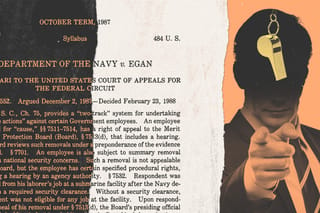
- Legislate to overturn Navy v. Egan, the 1988 Supreme Court decision which has provided almost total carte blanche deference to agency decision-making in security clearance adjudications.6
- Amend the Pentagon’s burden of proof standard in military whistleblower laws to align with civilian federal agencies and require management to prove by clear and convincing evidence they would have taken the same personnel action regardless of a servicemember’s whistleblowing.7
- Provide federal whistleblowers with the right to file retaliation claims directly in court and to request a jury trial in order to have a better chance of obtaining fair, timely relief. This would help reduce the caseload at the Merit Systems Protection Board and provide an alternative to the board where, historically, employees have prevailed in whistleblower retaliation cases and other employment disputes.8
- Close loopholes in protections for federal contractors who blow the whistle about waste, fraud, and abuse within government-funded programs.9
- Strengthen agency watchdogs like the Office of Special Counsel and Merit Systems Protection Board, which play critical roles to enforce whistleblowers’ protections, by ensuring strong qualifications and independence for nominees and reinforcing for-cause removal protections for special counsels and board members. The strength of whistleblower protections depends on the strength of the entities responsible for enforcing them.
Conclusion
Whistleblowers are often unjustly smeared as disloyal traitors, partisan political operatives, or sinister threats. While Congress has historically supported them on a strong bipartisan basis, whistleblowing has increasingly become more politicized, with support for whistleblowers hinging on which party is in power and which party is politically inconvenienced by the underlying misconduct being exposed.
But targeting whistleblowers risks undermining whistleblowing, period.
POGO continues to advise members of Congress on both sides of the aisle to focus on the evidence, not the individual. It is true that whistleblowers often have strong political beliefs. They can have many different motivations for speaking out. They can also be wrong, even when reporting in good faith. But whistleblowers shouldn’t need to be squeaky clean in order to be taken seriously. We will always need whistleblowers who are willing to speak up to do the right thing if we seek a government that best serves the people.
We strongly urge Congress to continue its historic tradition of championing the rights and protections of all whistleblowers.
Thank you again for the opportunity to testify here this morning. We at POGO appreciate this task force for holding this hearing and we are committed to working closely with you and the committee at large to better support whistleblowers and strengthen transparency and oversight in our national security. I look forward to answering any questions.