Government Involvement in the Critical Minerals Industry
POGO calls on Congress for increased oversight and transparency.
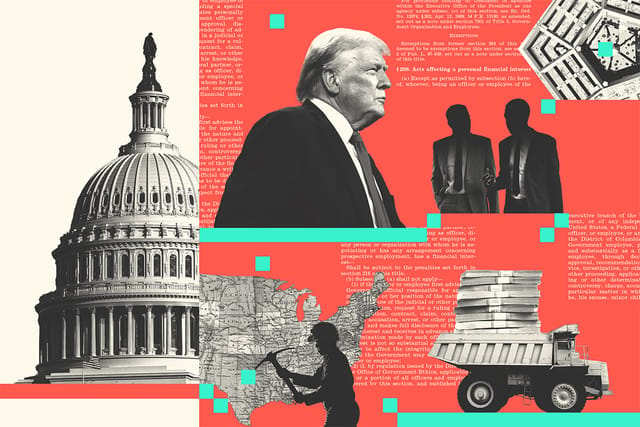
(Illustration: Luna Velez / POGO)
Testimony before:
House Committee on Natural Resources,
Subcommittee on Oversight and Investigations on "Unleashing America’s Mineral Potential: The Critical Mineral Commodity Supply Chain"
Good morning. Chairman Gosar, Ranking Member Huffman, Ranking Member Dexter, and members of the committee, thank you for inviting me today to testify.
My name is Faith Williams, and I’m the director of the Effective and Accountable Government Program at the Project On Government Oversight (POGO). POGO is a nonpartisan, independent watchdog that investigates, exposes, and champions reforms on systemic corruption, abuse of power, and waste.
As part of our longstanding work championing transparency and oversight, our organization has a history of engaging with the federal government on natural resources. For decades, POGO has investigated oversight into the oil, gas, and mining industries, exposing corruption and ethics violations that have cost U.S. taxpayers billions.1 Danielle Brian, our president and executive director, served as the civil society co-chair on the federal advisory committee tasked with implementing the Extractive Industries Transparency Initiative (EITI) in the United States.2
Critical minerals are vital to supply chains for electronics, semiconductors, batteries, and green technology. Securing the nation’s access to these commodities has been a priority for recent administrations of both political parties, and President Donald Trump has recently expanded the scope of the government’s involvement in this industry by investing federal funds directly into companies that mine critical minerals.3
Absent sufficient ethics, transparency, and oversight measures, however, POGO is concerned about the implications raised by this shift in strategy. We believe that additional guardrails must be implemented to ensure these equity stakes don’t raise costs to taxpayers, increase the likelihood of corruption, or harm competitive industry markets.
Financial Costs to Taxpayers
We should start by noting that, when it comes to critical minerals, taxpayers already get an unfair deal. Under the 1872 General Mining Law, taxpayers receive no royalties from the extraction of hardrock minerals on publicly owned lands, including the critical mineral mines we’re here to talk about today.4
In this administration’s zeal to invest in mining companies, the government has created the potential for even greater costs to taxpayers by failing to put the necessary transparency and oversight guardrails in place — or even, at times, by removing the guardrails that once did exist.
An executive order from March 2025, for example, largely shielded critical mineral deals from Congressional scrutiny.5 This barrier to oversight came alongside mass firings of civil servants across the government who might report or investigate waste, fraud, or abuse. Several agencies involved in deals to secure critical minerals — including the Departments of Defense, Commerce, and Energy, and the U.S. Export-Import Bank — have seen their inspectors general fired.6
In addition to reducing oversight, the March executive order also limited transparency. It ordered federal agencies, to the extent permitted by law, to rescind policies that required applicants for loans, grants, or equity investments to disclose information to agencies about the economic viability of their mines. Were the United States still involved in the Extractive Industries Transparency Initiative, there would be more transparency, but President Trump withdrew from the initiative during his first term, and the Biden administration did not rejoin.7
As the administration invests taxpayer dollars into critical minerals with less oversight and transparency than before, we’re seeing in real time the risks involved in dismantling these guardrails.
Take the government’s recent deal with Lithium Americas.8 When the Trump administration reevaluated a loan to the company this past fall, a top official in the Department of Energy’s Loan Programs Office raised concerns that the project could fail to attract customers.9 Now, American taxpayers own a stake in the company, and we lack transparency into the details of the agreement.
Deals like this naturally raise a number of questions: What measures are in place to prevent risky investments? Who monitors these investments? How will the government report on these equity stakes going forward? Are agencies even required to do so? What is the exit strategy, if any, for these deals? In the case of successful investments, how will taxpayers realize monetary gains? And how can we ensure these deals are fair and ethical?
Increased Likelihood of Corruption
Government investments necessarily create a myriad of ethics concerns, including questions of impartiality; the danger of government officials steering business to a company for their personal or private gain; potential disincentives to report fraud, waste, or abuse; and possible organizational conflicts of interests.10
We need strict rules about trades to ensure that no public or corporate officials are profiting from insider information. And the public needs transparency into the government’s decision-making process, so officials are free from even the appearance of corruption.
Recent investments show how the lack of ethics and transparency guardrails around the government purchasing stakes in mining companies increases opportunities for — and potential public perception of — corruption. One case from earlier this year provides a useful example.
In January, the Department of Commerce signed a letter of intent with USA Rare Earth that would give the government an 8% to 16% share in the company in return for up to $277 million in direct funding and $1.3 billion in loans.11 The deal required USA Rare Earth to secure private funding, and, as the company noted when it announced its deal with Commerce, it hired the financial services firm Cantor to lead fundraising.12
The problem is that the chairman and executive vice chairman of Cantor are the sons of Commerce Secretary Howard Lutnick. Before joining the administration, Secretary Lutnick himself was Cantor chairman and CEO, and when he resigned he transferred his stake in the company to his children. 13
It’s certainly possible that there is no conflict or corruption here. But the administration has not operated so transparently as to rule out a conflict, or at a minimum, the appearance of one. It has not made clear how companies were selected for investment, for example. It has not specified what — if any — procedures are in place to prevent conflicts of interest when agencies issue permits, set regulations, or make contracting or procurement decisions involving companies in which the government has equity.14
Potential Harms to Industry
Corruption, or the appearance thereof, is bad for business — it can limit investment, increase costs, and undermine public trust.
But the potential harms don’t end there: Absent clear transparency and ethics regulations, it would be easy for officials to provide sweetheart deals and a competitive advantage to companies in which the government has a stake. The government favoring a single company as a national producer in a specific sector runs the risk of stifling competition and innovation. Agencies like the Department of Defense could interfere in corporate decision making and free markets.15
And even for those companies chosen for investment, there are concerns. Alongside the lack of transparency, the legal justification for these deals is a gray area: CNBC has reported that an administration official said the stakes are voluntary agreements, which means no law needs to be invoked.16 A future administration, Congress, or a court could regulate, legislate, or rule in such a way as to change the legal premise for this or other deals.
We should recognize that these aren’t just hypothetical concerns. In July, for example, the Pentagon struck a 10-year deal with MP Materials to build out the domestic rare Earth magnet supply chain.17 The deal included a 15% stake in the company and an agreement that the Department of Defense would buy some of the company’s future output.
In their annual filing with the Securities and Exchange Commission last month, MP Materials summarized risks related to its deal with the Pentagon, which included that “There can be no assurances that the funding of and support for the transactions contemplated by the DoW Transaction Agreements will not be modified, challenged or impaired in the future,” and that “The DoW Transaction Agreements contain affirmative and negative covenants that may restrict our ability … to take actions management believes are important to our long-term strategy.”18
Conclusion
There are strong arguments for protecting the United States’ supply of critical minerals. But before the administration started buying up stakes in critical mineral mining companies with limited transparency, ethics guardrails, or oversight, it already had a multitude of tools to help secure these commodities via long-established and more transparent means, including the Defense Production Act and federal contracting procedures.
POGO supports adding additional transparency and accountability provisions to the Defense Production Act when it is next reauthorized. Beyond that, if the administration wants to be more bold or creative, it should formally request authority from Congress to do so.
In the meantime, we appreciate opportunities like this to raise our concerns about the heightened potential for corruption, harms to industry, and costs to taxpayers stemming from the government buying stakes in companies absent appropriate guardrails. We urge Congress to engage in robust oversight over these deals, and we are glad to work with any member of Congress on improving transparency and reducing potential waste, fraud, and abuse in this arena.