Strong Oversight and Commonsense Reforms to Improve Government Integrity
In our decades as a government watchdog, we’ve identified a number of commonsense steps Congress can take today to reduce waste and fraud.
(Illustration: Ren Velez / POGO)
Testimony before:
U.S. Senate Committee on Small Business and Entrepreneurship
"Running Government Like a Small Business: Cut Waste, Crush Fraud"
Chair Ernst, Ranking Member Markey, and Members of the Committee, thank you for the opportunity to testify today about waste and fraud in the federal government. I am Dylan Hedtler-Gaudette, acting vice president of policy and government affairs at the Project On Government Oversight (POGO). POGO is a nonpartisan, independent watchdog that investigates and exposes waste, corruption, abuse of power, and when the government fails to serve the public or silences those who report wrongdoing. We champion reforms to achieve a more effective, ethical, and accountable federal government that safeguards constitutional principles.
For more than 40 years, POGO has advocated for more effective, transparent, and accountable federal spending. We began as a primarily Department of Defense-focused watchdog but have since expanded our scope to encompass the entire federal government. Whether we have been exposing exorbitant expenditures at the Pentagon, price gouging by government contractors, or widespread problems in the context of emergency spending situations, we have long called for reforms and solutions to address waste and fraud.1
As a government watchdog organization, we know the value of rigorous oversight. This is why we have also been longtime champions and supporters of internal government watchdogs such as inspectors general (IGs) and entities like the Government Accountability Office (GAO).2 These watchdogs exist to root out waste, fraud, and abuse and to crack down on corruption through investigations, audits, and the issuance of recommendations. If we are to effectively address waste and fraud in the federal government, watchdogs and oversight practitioners like IGs and the GAO — and Congress itself — must be sufficiently resourced, adequately funded, consistently supported, and proactively insulated from undue political influence.
As such, it has been extremely disheartening to see the current administration systematically undermine and dismantle government oversight, from the opening days of its term through the present day. Unlawfully firing IGs, attacking the GAO, and appointing manifestly unqualified individuals to key oversight positions (just to name a few examples) are not the actions of an administration that takes oversight and accountability and the integrity of government seriously.3 In fact, they are the opposite. The recent public disregard for oversight from the executive branch only makes the role of congressional oversight more important. That’s why we at POGO are glad you’re holding this hearing today.
In addition to our broad focus on oversight and accountability, POGO has also worked toward promoting small business participation in the federal contracting ecosystem as a means toward spurring competition, bringing down costs to taxpayers, and breaking the corrosive stranglehold that a handful of large companies have on the federal contracting system.4
The Small Business Administration (SBA) stimulates the small business sector, supporting small business receipt of federal awards. For this, it should be applauded. But the SBA has also experienced its share of oversight lapses and instances of waste and fraud, including but not limited to problems during the COVID-19 pandemic relief era.5 Given the size and scope of the federal budget and the sheer quantity of discrete programs, projects, and activities that budget facilitates in a given fiscal year, federal agencies must always remain vigilant in overseeing and managing the activities within their purview, and Congress must routinely engage in rigorous oversight to ensure compliance and efficacy. The SBA is no different than any other agency in this regard.6
The title of this hearing centers the need to run the federal government like a small business, by cutting waste and stamping out fraud. Setting aside the question of whether government — which does not operate in the pursuit of profit or maximized shareholder returns — can or should be run like a business, the issue of how to address waste and fraud is an important one.
The GAO estimates that, according to fiscal data from 2018 to 2022, the government lost between $233 billion and $521 billion to fraud each year, and it calculates that $2.8 trillion in improper payments have been issued by the federal government since 2003.7
Waste is a more subjective category, but POGO has a long track record of documenting and exposing wasteful spending, such as the nearly $2 trillion (and counting) projected to be spent on the F-35 Joint Strike Fighter program, despite routine failures of basic performance assessments in operational testing environments.8 Another example of wasteful spending that POGO has highlighted is the increasing reliance on service contracts by the federal government, which data shows actually costs more than in-housing those activities.9 Anticipating another likely exercise in wasteful spending, we’re watching the recently commenced Golden Dome missile defense project, a prime candidate for increased scrutiny and oversight.10
Commonsense Reforms for Addressing Waste and Fraud
In our decades of serving as a government watchdog, we’ve identified several pragmatic, commonsense solutions to the twin diseases of waste and fraud that plague the federal government. I lay some of those reforms out below.
Preserve, strengthen, and insulate inspectors general.
As noted above, IGs play a critical role in promoting integrity in the federal government by investigating and exposing waste, fraud, abuse, and corruption. IGs should therefore be funded and resourced sufficiently so as to maximize their effectiveness. Congress should update the Inspector General Act of 1978 to further protect and insulate IGs from political meddling and interference so they can perform their vital duties without fear or favor, as we have previously recommended.11 Moreover, the Senate must take its advise and consent role more seriously when it comes to confirming IG nominees: No unqualified or politically compromised nominee should ever be confirmed.
Protect and strengthen the Government Accountability Office.
The GAO is an indispensable congressional resource when it comes to investigating and analyzing what the federal government is doing with public funds. To safeguard this crucial institution so it is able to do its job effectively, Congress should ensure that it has the necessary funding and resources, while also enacting reforms to further enhance the GAO’s capacity and efficacy. Specifically, Congress should pass the GAO reforms contained in the Congressional Power of the Purse Act.12 Relatedly, Congress should also reform the process for appointing the Comptroller General in such a way so as to prevent the president from undermining the GAO from within by appointing an unfit or otherwise adversarial individual who does not believe in the core mission of the GAO. In the substantive arena, Congress should more regularly act on GAO recommendations and reports, including those set forth in the annual report on duplicative programs.13
Reform existing systems and tools for tracking and analyzing federal funding.
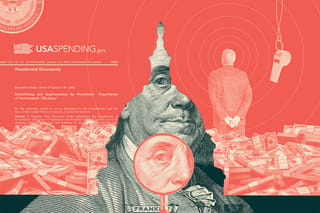
A key component of ensuring integrity and mitigating waste and fraud in federal spending is having strong and effective tools and mechanisms for monitoring dollars after they are spent. Currently, resources like USASpending.gov are too weak, and reporting requirements are either inadequate or ignored by agencies. There are numerous ways to improve how we track federal dollars and provide tools for spotting and heading off leakages in the spending chain, including shoring up subaward recipient reporting, requiring better and more consistent award descriptions and other information, and expanding the quality and types of data collected.14
Enact stronger ethics and conflict of interest rules to safeguard the federal contracting process.
One of the key drivers of government corruption, including waste and fraud, is a perversion of the federal contracting process through which contracts are awarded. Large, well-connected companies peddle influence and leverage connections to rig the system in their favor.15 Congress should enact strong conflict of interest rules to ensure that federal contracts are awarded through a rigorous and objective process of merit and in accordance with programmatic guidelines and public interest needs, not on the basis of cronyism and as a result of corporate capture. Included among these reforms should be stronger revolving door rules and more transparency in federal contractor lobbying and political activities.16
Waste, Fraud, and Where to Find It
To level-set today’s discussion, I want to begin by contextualizing the scale and scope of waste and fraud in small business programming context relative to other areas of the federal government. As I noted above, GAO’s estimates of waste and improper payments extend into hundreds of billions — even into trillions of dollars, when aggregated over time.
The Small Business Administration had a little more than $17 billion available to it in budgetary resources last fiscal year. This makes SBA one of the smaller agencies in the federal government. By way of contrast, the Department of Defense had more than $2 trillion in budgetary resources available to it last year, making it the largest discretionary budget in the entire federal portfolio.17
The Committee on Small Business and Entrepreneurship has a specific jurisdiction that includes oversight of SBA and not the Department of Defense, so it naturally tracks that this committee and this hearing will accordingly focus on issues related to its jurisdictional remit. However, we should all agree that, when deciding how to allocate finite oversight resources and bandwidth to address waste and fraud, our government should focus on the agencies that receive and spend the most money. Logically, we will find the most waste and fraud with the least effort if we focus on the biggest agencies and expenditures.
Unfortunately, when it comes to finding waste and fraud, this administration has appeared to focus its attention on agencies, programs, projects, and activities that fit into political and ideological categories with which it disagrees, rather than focusing on the most egregious instances of corruption.18
The SBA has been no exception. One program that has received attention recently is the 8(a) contracting program, designed to provide socially and economically disadvantaged small businesses resources and access to the federal contracting ecosystem.19 In June of this year, SBA Administrator Kelly Loeffler announced an audit of the program in response to what she called “rampant fraud.”20 While it is imperative to conduct robust oversight of all contracting programs, in fiscal year 2024, $41.8 billion was awarded through 8(a) contracts, representing just about 5.4%of the total $755 billion in federal contract awards.21
To add more detail and data to this picture, and to be more specific in naming examples that should have drawn far more attention and focus from those invested in addressing cozy dealings and ethics concerns, here are a few cases POGO has investigated in 2025 alone.
Last week, POGO and Mother Jones reported on a number of former clients of White House Border Czar Tom Homan that have recently won lucrative border and immigration-related contracts. Partly given Homan’s former consulting for these companies last year, ethics experts say there is at least an appearance of corruption.22
Earlier in November, we highlighted a disturbing pattern of contract awards at the Department of Homeland Security (DHS) through which the agency appears to be circumventing its own leadership’s oversight by issuing a series of contracts for $99,999, just below the $100,000 threshold at which the secretary has decided to weigh in with sign-off.23
In October, POGO co-published an investigation with Mother Jones detailing how a DHS contract worth almost a billion dollars was awarded to a firm with “no track record” as a federal contractor through a “rushed” process that involved a DHS official with ties to the firm’s founder.24
In September, POGO and Mother Jones co-published an investigation that showed how Trump-tied lobbying firm Ballard Partners helped a surveillance and biometric company called BI² land a no-bid ICE contract worth millions of dollars. Prior to hiring Ballard, BI² had for years struggled to break into federal contracting.25
In August, POGO released an investigation uncovering past financial and employment ties between senior Trump administration officials at the Office of Management and Budget (OMB) and the Pentagon with tech contractors vying for a piece of the administration’s “Golden Dome” project.26
In March, we published an investigation exposing the political ties of the ICE contractor CSI Aviation. The firm, whose owner hosted a Trump campaign rally in the fall of 2024, could make billions of dollars running deportation flights, despite its involvement in numerous high-profile controversies.27
In February and March, we published two investigations digging into the ongoing business and financial ties between Elon Musk, the owner of several companies with federal contracts, top political appointees at OPM, and staffers on the Department of Government Efficiency (DOGE) team at the Treasury Department who were granted access to highly sensitivedatabases.28
In January, we released a new investigation into the revolving door between private prison giant GEO Group and the Department of Homeland Security, revealing that ICE’s former top detention official, Daniel Bible, had recently accepted a job with one of the agency’s largestcontractors.29
What these examples showcase is the pervasiveness of cronyism and a potentially biased award process on display in less than one year under this administration. It is these kinds of malfeasance and misconduct in federal contracting and lobbying that should be the focus of congressional oversight and legislative reform efforts.
Conclusion: What Oversight Is — and What It Is Not
Oversight is essential to ensuring integrity and effectiveness in the federal government. Without robust and consistent oversight, the public cannot trust that resources, including hard-earned tax dollars, are being used appropriately and efficaciously. We cannot be sure that government officials are acting in good faith and in the public interest, in accordance with both the norms and rules of ethical conduct, without strong and persistent oversight of official conduct.
All of this said, not all oversight is created equal, and not all activity labeled oversight are appropriate or legitimate. Targeting perceived political enemies with spurious claims of misconduct or illegality, for example, is not oversight. Threatening to go after nonprofit groups and philanthropic foundations on the basis of ideological or political disagreements is not oversight.30 Indiscriminately firing large numbers of federal employees and unlawfully withholding duly enacted funding is not a legitimate exercise in oversight.31 Congress burying its head in the sand and allowing all of this is not oversight. True oversight is what IGs do every day, work that leads them to identify tens of billions of dollars in potential savings to taxpayers each year.32 Oversight is the auditing and investigating and myriad substantive recommendations made by the GAO every year.33 Oversight is the serious work done by congressional committees in holding hearings like this one, engaging in inquiry and fact-finding, and issuing investigative reports that form the evidentiary basis for future legislative reforms.
Common threads across the serious and legitimate kind of oversight conducted by numerous stakeholders, inside and outside of government, are things like objectivity, a focus on provable facts, a reliance on solid data, and the willingness to speak truth to power, regardless of who holds power or the political or ideological affiliation of those involved.
I will conclude here by urging this committee and Congress as an institution to focus on conducting real oversight and prioritizing the worst and most harmful occurrences of misconduct and malfeasance, not just the politically advantageous and convenient ones.
I urge the Senators on this committee to consider the specific and actionable reforms suggested above and to look into the instances of corruption we have highlighted this year. We stand ready, willing, and able to partner with you in these efforts.
Related Content