Congress Can Shield Whistleblowers from Schedule Policy/Career
Without an independent enforcement mechanism available to whistleblowers, Congress needs to empower them to fight retaliation in the courts.
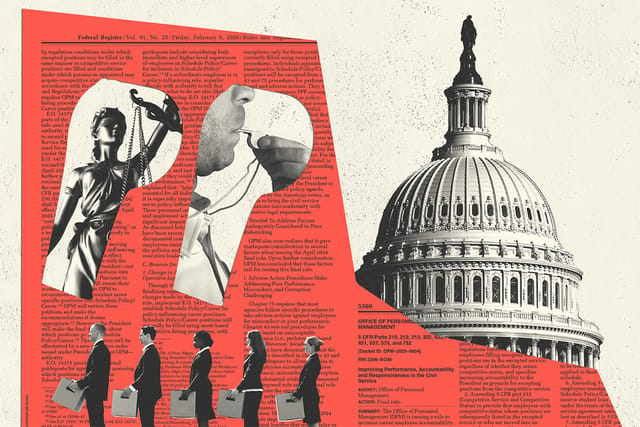
(Illustration: Luna Velez / POGO)
In February, the Office of Personnel Management (OPM) published its final rule formally establishing Schedule Policy/Career. Regardless of this move’s constitutionality, the administration will now reclassify what will likely be tens or even hundreds of thousands of federal employees to strip away their due process rights.
Federal employees who suddenly find themselves reclassified and involuntarily transferred into this new, expansive category of positions deemed to be “policy-influencing” will become at-will workers, lose critical job protections, and risk being fired by political appointees for any reason at all, including partisan or retaliatory purposes.
With this change, the administration is further empowering itself to dismantle the nonpartisan civil service and turn ordinary federal workers — those who help run the daily functions of government and deliver services to people across the country — into political pawns.
The administration admitted it issued this rule despite the overwhelming opposition (94%) expressed in approximately 40,500 public comments. This policy also runs counter to the opinions of the vast majority of the American public, who recognize the importance of a nonpartisan civil service.
Civil service protections don’t exist just to protect federal employees. They also help ensure the health, safety, and welfare of the public. The Project On Government Oversight (POGO) has reported, testified about, commented on, and analyzed the impact of this policy, the risks it poses to national security, and its threat to services and benefits for communities across the country.
Perhaps most critically, the protections targeted by Schedule Policy/Career empower people to blow the whistle on government corruption and abuse of power. POGO has long worked to strengthen protections for whistleblowers, and this final rule will render many of those protections effectively useless, causing a devastating impact.
A Chilling Effect on Whistleblowers
Employees reclassified under Schedule Policy/Career will lose major statutory due process protections against prohibited personnel practices, such as being retaliated against after blowing the whistle when the government violates the Constitution, breaks the law, or betrays the public’s trust.
The rule claims, “The vast majority of those appointed under Schedule Policy/Career will…retain protections against prohibited personnel practices including retaliation against whistleblowing.” However, its only method of ensuring as much is that the rule “requires agencies to establish internal policies protecting employees from prohibited personnel practices.”
It is not enough to trust agencies to police themselves. Without independent enforcement to ensure decisions are adjudicated fairly, the whistleblower protections retained by Schedule Policy/Career employees will be merely symbolic.
Currently, most executive branch whistleblowers who face retaliation can file claims with the Office of Special Counsel, which operates under a mission to safeguard the merit system, and appeal to the Merit Systems Protection Board for adjudication. This process itself can already be a timely and costly ordeal. (And more recently, the independence of both the Office of Special Counsel and the Merit Systems Protection Board has been compromised.)
Once employees are transferred into Schedule Policy/Career, they will lose even those basic protections from retaliation. Instead, they will be left to the mercy of their agencies, forced to seek protection from the same agencies they allege are retaliating against them, while many internal agency watchdogs have already been defanged.
As Schedule Policy/Career becomes implemented, more federal employees will lose these protections.
Schedule Policy/Career will deter whistleblowers from coming forward in the future, leaving lawmakers further unequipped to address wrongdoing.
OPM claims its “initial estimate of 50,000 positions was a reasonable approximation of potential conversions.” This seems like a dubious proposition considering the administration has already expanded criteria agencies should consider for reclassification, and the rule authorizes OPM’s director to petition the president to include anyone the director feels “appropriate” for reclassification under Schedule Policy/Career.
Stripping protections from civil servants — including those on the front lines in communities and those best positioned to root out corruption as it manifests — risks opening the floodgates to rampant retaliation against whistleblowers who alert the public to abuses of power the administration wishes to keep secret. In the current environment of loyalty tests, whistleblowers accused of being “frivolous”, “complainers, ideologues, and poor performers,” cabinet officials threatening to put civil servants “in trauma,” incapacitated independent agency watchdogs, and agencies restaffed with political loyalists — all amidst breakdowns in government services, growing corruption and abuse of power, and historic lows of trust in government — there is little doubt that many potential whistleblowers will hesitate to report wrongdoing for fear of retaliation.
Congress Can Shield Whistleblowers
Congress has the responsibility to protect the public from waste, fraud, abuse of power, and corruption. It relies on whistleblowers to conduct oversight and to legislate responsively. Schedule Policy/Career will deter whistleblowers from coming forward in the future, leaving lawmakers further unequipped to address wrongdoing. Congress should pass bipartisan legislation to negate the impact of Schedule Policy/Career and closely monitor agencies as the rule is implemented, especially scrutinizing how agencies intend to protect whistleblowers through internal processes alone.
Congress should also ensure whistleblowers have access to a credible, independent outlet to enforce their protections by providing them with direct access to federal courts, including entitlement to request a jury trial.
Whistleblowers who can still appeal to the Merit Systems Protection Board must first exhaust administrative remedies before filing in court, even if it means waiting years for a final decision from the board. Recent bipartisan legislation aimed to provide court access for whistleblowers who did not receive a timely final decision through the board, but it failed to pass in the Senate.
For employees reclassified under Schedule Policy/Career who blow the whistle, access to federal courts is the only truly independent mechanism remaining to defend themselves against retaliation. As Schedule Policy/Career is implemented, the stakes for whistleblowers — and the crucial disclosures they bring to light — will make this necessary reform all the more urgent.