Trump’s First Year of Attacks On Government: What Can Be Fixed
A year into the second Trump administration, POGO takes stock of its impacts to the federal workforce, service delivery, and public trust.
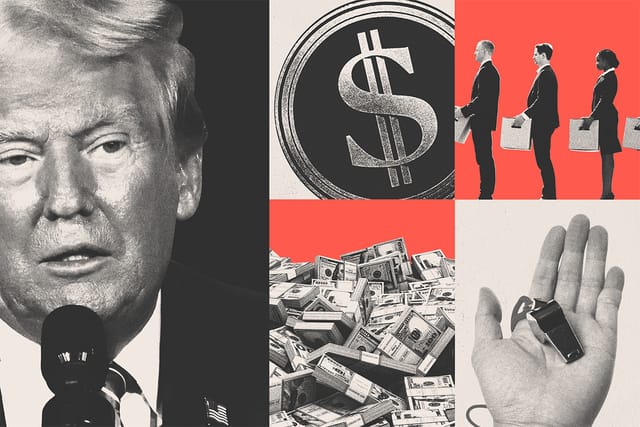
(Illustration: Ren Velez / POGO)
When President Donald Trump took office a little more than a year ago, he came in with sweeping promises to alter the landscape of government and an unusual body to help do it: the Department of Government Efficiency (DOGE). An entity that acted as an agency when it was handy to assume authority and acted as a White House office when it was handy to avoid accountability, this effort ― led by billionaire Elon Musk ― took a chainsaw to government. By disregarding norms, regulations, and laws, DOGE wreaked havoc while failing miserably in its stated aim to save two trillion dollars. In fact, federal spending rose in FY 2025.
In addition to establishing DOGE, Trump signed a flurry of executive orders targeting the federal workforce. The administration has also attacked or undermined oversight bodies, whistleblowers, and watchdogs, including but not limited to inspectors general (fired en masse last January), the Office of Special Counsel, the Merit Systems Protection Board, the Office of Government Ethics, internal Department of Homeland Security watchdogs, and the Government Accountability Office, making it more difficult to investigate the impacts of these changes, shield the employees who remain, and protect the public from abuses of power. The result is generational damage to our merit-based civil service, a failure of government services, a flourishing culture of corruption and abuse of power, and a people whose faith in their government is nearing all-time lows.
A Decimated Civil Service
In Trump’s first year in office, an estimated 317,000 federal employees have left or been forced out of government, a reduction the Cato Institute called the “largest peacetime workforce cut on record.” Workforce cuts were neither thoughtful nor precise; rather, they reflect the administration’s attacks on diversity, foreign aid, civil rights, consumer protection, and other programs, departments, agencies, and people deemed “woke.” They have impacted senior Black officials, and Black women, in particular.
Just last week, the administration released its final rule to reclassify a portion of career civil servants as at-will employees. POGO anticipates that stripping employment protections from federal employees will make it easier to fire tens of thousands of workers and replace them with partisan loyalists.
Breakdowns in Government Services
From last January to March, the wait time for a call back from Social Security peaked at an average of two and a half hours. In August, the inspector general at Veterans Affairs reported “severe occupational staffing shortages” at VA facilities, a 50% increase from the prior fiscal year. Staffing cuts at the IRS prompted two tax watchdogs to warn the agency may struggle to maintain service levels this tax season. Many stories of impact are anecdotal for now; it will take years for a full accounting of the effect of the past year’s cuts.
Growing Corruption and Abuse of Power
The administration’s blitz on oversight bodies and whistleblowers has been accompanied by a pattern of corruption. A DOGE staffer signed a secret agreement to share sensitive Social Security data with an unidentified political advocacy group. An official from the Executive Office of the President oversees ethics at the White House. The border czar was allegedly recorded accepting $50,000 from FBI agents posing as business executives seeking government contracts (which he denies), while the Department of Justice division devoted to combating public corruption has been gutted. Contracts are awarded to the president’s supporters, and the revolving door is spinning at full speed. The president and his family have grown immeasurably richer over the last year, announcing new business ventures around the world and jumping into the crypto market while the president is promoting its use and deregulation.
Failing Trust
According to the Pew Research Center, in December, just 17% of Americans said they trust the government to do what is right “just about always” or “most of the time,” one of the lowest levels in nearly 70 years.
Distrust is sadly not a new phenomenon, but this administration’s efforts to remodel the federal government have directly impacted people across the country and around the world. Immigrants, communities of color, women, LGBTQ people, and those relying on the social safety net have been especially harmed.
Solutions
Though there is an incredible amount of work to be done, much of this damage can be repaired. POGO has several solutions Congress can implement to restore the merit-based civil service, strengthen whistleblower protections, protect inspectors general and other watchdogs, combat corruption and abuse of power, and strengthen congressional oversight.
To shore up the merit-based civil service in the wake of Schedule Policy/Career, Congress should take the following steps:
- Closely monitor agencies as they implement the Schedule Policy/Career rule reclassifying federal employees as at-will.
- Pass the Saving the Civil Service Act (H.R. 492 / S. 134) or similar legislation that would limit the impact of the rule during the second Trump administration.
- Strengthen Hatch Act protections by passing the Ranking Member’s Hatch Act Enforcement Transparency and Accountability Act (H.R. 1688 / S. 806).
- Consider alternatives to the Merit Systems Protection Board to address its lack of independence.
- Engage the Government Accountability Office to study the long-term effects of shrinking the federal workforce, particularly as it relates to agencies carrying out their statutory mandates.
To strengthen whistleblower protections, Congress should take the following steps:
- Allow whistleblowers direct access to court and jury trials, a particularly urgent reform given Schedule Policy/Career.
- Overturn Navy v. Egan and treat security clearance suspensions, revocations, or denials in retaliation for disclosures as a prohibited personnel practice.
- Ban retaliatory investigations into whistleblowers.
- Allow intelligence community whistleblowers to legally disclose directly to congressional intelligence committees without first notifying their agency inspector general.
- Create an independent mechanism for national security and intelligence community whistleblowers to challenge retaliation.
- Strengthen confidentiality protections for whistleblowers by protecting identifying information in addition to their identities.
To protect inspectors general and other watchdogs, Congress should take the following steps:
- Consider new measures to ensure independence of agency and independent agency watchdogs, including inspectors general and the Office of Special Counsel.
- Confirm only inspectors general who are apolitical, experienced, ethical, and independent.
- Reassert the power of the purse to ensure the Council of the Inspectors General on Integrity and Efficiency (CIGIE) is both fully funded and apportioned.
- Protect the Government Accountability Office from partisan attacks and executive branch overreach.
To combat corruption and abuse of power, Congress should take the following steps:
- Fully embody its constitutional prerogatives, including its power of the purse, its duty to advise and consent to presidential nominees, and its exclusive power to declare war.
- Expand financial conflict of interest laws to include the president and vice president.
- Restore the independence of the Office of Government Ethics and expand the law to ensure it has clear, independent authority to investigate complaints and issue binding corrective and disciplinary actions.
- Increase transparency and accountability for special government employees.
- Strengthen ethics within the legislative branch, including by banning congressional stock trading.
- Establish ethical guidelines around cryptocurrency.
Finally, to strengthen its powers of oversight, Congress should take the following steps:
- Plan for routine oversight using an 80/20 rule-of-thumb approach, where 80% of work is pre-planned and 20% is available for emerging issues that warrant scrutiny.
- Keep the public informed, including by publishing hearing memos.
- Work across the aisle to plan and perform oversight, including by releasing a single report instead of separate majority and minority reports.
- Increase and improve each office’s work with whistleblowers.
- Craft strong oversight letters and minimize political theater at hearings by making them bipartisan and considering reforms to their format.
Conclusion
There is an arrogance and a brutality in this administration’s approach toward our government and the people it serves. And there is a certain sly grin and winking nod that seems to imply that while many are losing out, a select few are more powerful and profitable than ever. This harms all of us.
Meaningful change will require Congress to be a powerful, engaged, representative body committed to rigorous oversight and ethical governance and to building the government that we, the people, deserve.