Congress Must Protect Whistleblowers After a Year of Attacks
Whistleblower protections are being systematically dismantled, but it’s not too late for lawmakers to fight to reinforce them.
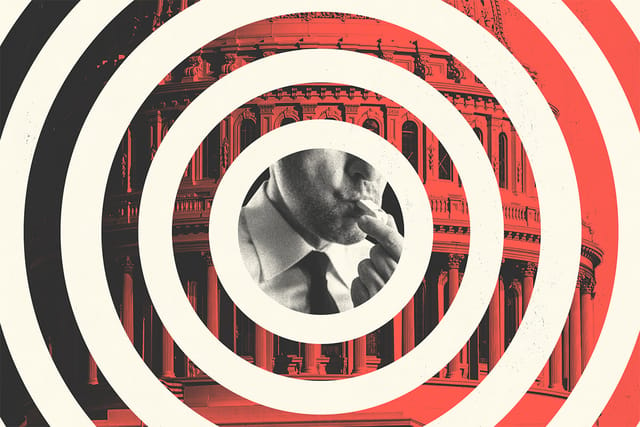
(Illustration: Luna Velez / POGO)
Whistleblowers have always been essential for holding power accountable and safeguarding the public’s trust. By revealing hidden truths about what’s happening in the federal government, whistleblowers strengthen institutions, protect communities from harm, and serve as a critical check on abuse of power. They have influenced policies, sparked reforms, and reminded us that our country’s strength lies in the courage of its people.
Because whistleblowers perform such a necessary public service, we have laws to protect them from being retaliated against for speaking out. Even with these legal protections, whistleblowers are too often suspended, investigated, demoted, or fired for exposing issues like threats to national security, environmental concerns, airline safety, civil rights and civil liberties, healthcare, social security, veterans’ care, and more.
Since January 2025, the Trump administration has dismantled systems that enable whistleblowers to report wrongdoing and eroded their legal protections. Despite whistleblowers remaining a crucial backstop against corruption and abuse of power, with bipartisan support in Congress, blowing the whistle has only become more fraught.
Independent watchdogs are being weakened and politicized. Entities accountable for serving whistleblowers have rolled back their commitments to the truth. Agencies seem to interfere with investigations and target dissenters en masse. Mass firings, job insecurity, and a widespread culture of fear have created a chilling effect across the government. The entire structure that makes whistleblowing possible is being weakened and is creeping toward collapse.
In an era of hyperpolarization, democratic backsliding, and widespread disinformation, we must reaffirm our commitment to protecting whistleblowers so they can keep coming forward to help protect communities across the country. After over a year of attacks on whistleblowers, Congress must legislate to reinstitute and strengthen whistleblower protections.
Firing Independent Watchdogs and Politicizing Oversight
Whistleblowers rely on an independent watchdog system of inspectors general, the Office of Special Counsel, and the Merit Systems Protection Board to serve as safe reporting channels, to investigate allegations impartially, and to enforce whistleblower protections fairly and effectively. Over the past year, the Trump administration has worked to systematically cull officials they deemed unfit for their political agenda and eroded the integrity of these oversight bodies.
Inspectors General
In January 2025, President Donald Trump fired at least 17 inspectors general (IGs) without justification. IGs are one of the main entities that investigate whistleblower complaints. They are entrusted by whistleblowers to investigate complaints and report their findings objectively, without political bias.
Trump’s firings of these IGs were later ruled to be unlawful, but were not reversed. He replaced some fired IGs with people who seem to be more partisan and politically aligned with the administration, including pledging “to support the initiatives” of the administration. IGs aren’t meant to be partisan lackeys for any particular administration or agenda, but to act independently for the sake of uncovering the truth.
Since the new IGs were appointed, there have been accusations of political interference, including agencies suppressing findings and reports disappearing. Particularly troubling are allegations of the Justice Department’s IG office refusing to investigate the alleged misconduct of a senior official, in an “apparent collapse” of internal oversight.
Office of Special Counsel
In early February 2025, Trump fired Special Counsel Hampton Dellinger without cause. Dellinger led the Office of Special Counsel (OSC), the primary entity that receives whistleblower disclosures and investigates whistleblower retaliation. Especially when whistleblowers distrust their agency’s inspector general, OSC has proved vital as an outside reporting channel that’s independent of whistleblowers’ employing agencies.
Trump first replaced Dellinger with Secretary of Veterans Affairs Doug Collins in an acting capacity — an inherent conflict of interest, especially because OSC receives more prohibited personnel practice complaints, including whistleblower retaliation, from VA employees than any other agency. Trump then replaced Collins with another member of his cabinet, Jamieson Greer, who is still serving in an acting capacity. Trump’s nominee to lead OSC this past summer, Paul Ingrassia, brought with him a sordid history of animosity toward civil servants (whose protections OSC is empowered to enforce). Ingrassia withdrew his nomination in the fall due to allegations of antisemitism and the resurgence of text messages in which he referred to himself as having “a Nazi streak.”
Over the past year, OSC itself has undercut its ability to execute core agency mandates. Despite its mission to protect federal employees, OSC reversed its own previous position, arguing that agencies can fire probationary employees “with very limited restrictions on the reasons for termination.” The agency has also reversed previous Hatch Act reforms, which had increased oversight for nonpartisan civil servants to do their jobs free from partisan influence.
An analysis of publicly available OSC data conducted by a federal employment law firm found a stunning decrease in oversight by the agency. Amidst a surge of whistleblower disclosures during fiscal year 2025, OSC referred for investigation only 27 out of 2,535 whistleblower disclosures — less than 1.1%. Simultaneously, it has cut its own referral targets, from 60 referrals in fiscal year 2024 to an anticipated 20 in fiscal year 2026.
Politicization of OSC creates fear that complaints will not be handled fairly and protections will go unenforced. And when OSC undermines its own commitment to serving whistleblowers and lives “in a coma,” it erodes the very trust and accountability it was created to uphold.
Merit Systems Protection Board
In February 2025, Trump fired Cathy Harris, the only Democrat serving on the Merit Systems Protection Board (MSPB), despite the fact that the board is meant to be bipartisan to ensure its independence. The MSPB is the fundamental enforcement mechanism for whistleblower protections. Whistleblowers can appeal retaliation claims to the MSPB to be heard by an administrative law judge, who serves as a neutral arbiter. Whistleblowers can then appeal to the full three-person panel of the board. Harris is currently appealing her dismissal to the Supreme Court.
The board itself recently relinquished its own jurisdiction to hear certain appeals of administrative judges, making it easier for agencies to discipline or fire those judges. This risks politicizing judges’ rulings, opening the door to attacks on the MSPB’s own administrative law judges and potentially jeopardizing the foundational structure of civil service protections. All this while the MSPB faces declining staff levels amidst a surge of whistleblower disclosures, retaliation, and prohibited personnel practices.
Office of Government Ethics and Council of the Inspectors General On Integrity and Efficiency
In February 2025, the administration fired the director of the Office of Government Ethics, which handles conflicts of interest and ethical violations sometimes linked to whistleblower complaints. For five months during 2025, Jamieson Greer also served as acting director at this office. During an April 2026 House Ways and Means Committee hearing, Greer stated in response to questioning that during his tenure, he seemingly provided little to no leadership toward ensuring members of the administration adhered to federal ethical standards.
The administration also temporarily and illegally defunded the Council of the Inspectors General On Integrity and Efficiency (CIGIE) in the fall of 2025. The council hosts multiple whistleblower hotlines, so for months whistleblowers were unable to access these hotlines and faced additional obstacles to reporting their complaints. The council’s funding was later temporarily restored only amid bipartisan pressure by Congress. POGO, alongside whistleblower advocacy organizations Public Employees for Environmental Responsibility and the Government Accountability Project are currently fighting in court to ensure that CIGIE receives all of its congressionally mandated funding.
Reducing Whistleblower Protections and Limiting Reporting Mechanisms
In February 2026, the administration finalized the Schedule Policy/Career rule that will fundamentally reshape the federal workforce, affecting the future of whistleblowing altogether. While this rule change is currently being litigated, agencies have begun reclassifying what will likely be tens to hundreds of thousands of federal employees into a widening category of so-called “policy-influencing” positions. Reclassification will strip them of whistleblower protections by cutting off pathways to OSC and the MSPB.
Many of these employees are well-positioned to witness and report wrongdoing, due to significant responsibilities in agency headquarters or providing direct services in communities across the country. Under Schedule Policy/Career, they won’t just be more vulnerable to retaliation. Enforcement of their whistleblower protections will be left to their agency’s discretion, forcing them to rely on protection from the same agencies they allege are retaliating against them.
Another pending regulatory change would allow agencies to extend “suitability and fitness” evaluations to employees — not just applicants — based on their on-the-job conduct. This opens another avenue to retaliate against whistleblowers by pretextually labeling them as poor performers unsuited for federal employment.
While Schedule Policy/Career requires agencies to establish standards to protect whistleblowers, agencies had already started undermining internal processes and protections prior to the new rule.
The Department of Defense issued new standards to penalize “frivolous” reporting of complaints, with the Defense Secretary smearing those utilizing inspector general processes as “complainers, ideologues, and poor performers.” These new standards also disallow anonymous complainants, which increases the personal risk for military whistleblowers. Stricter rules for complainants will likely result in fewer investigations. Mandated investigation deadlines may result in dismissing allegations due to time constraints. And requiring whistleblowers to meet higher evidentiary standards will likely discourage the reporting of legitimate concerns.
Director of National Intelligence Tulsi Gabbard is alleged to have politically interfered with an intelligence community whistleblower complaint intended for Congress (which Gabbard denies), blocking it internally for several months and exposing a fatal flaw in the Intelligence Community Whistleblower Protection Act.
Protections for government scientists were also reduced at the Environmental Protection Agency and National Oceanic and Atmospheric Administration. Both agencies rescinded updated scientific integrity policies that had strengthened scientists’ right to speak publicly, clarified processes for reporting political interference, and reinforced protections tied to whistleblowing and dissent. Weakening these safeguards further discourages reporting and oversight, which in turn increases risks to health and safety by obstructing weather warnings, minimizing environmental risks, and weakening disaster preparedness.
Loyalty Tests, Mass Retaliation, and a Chilling Effect
In addition to undermining legal protections for whistleblowers, the Trump administration has made it clear that hiring and firing decisions should be explicitly based on partisan loyalty. The administration has included loyalty questions in job applications, issued internal memos against hiring for diversity, equity, and inclusion (specifically seeking only those “dedicated to the furtherance of American ideals, values, and interests”), and directly asked job applicants how they will support the president’s policies. Schedule Policy/Career allows for easy removal of employees who do not personally align with the president’s policy agenda.
Whistleblowers are under a systemic assault, but the damage is not yet beyond repair.
The FBI has purged itself of agents, prosecutors, and employees for political reasons and perceived disloyalty. This mass retaliation includes those who assisted with investigations into suspected foreign interference in the 2016 election, 2020 election interference, and the January 6, 2021 insurrection. This includes a former acting director who refused to provide a list of everyone who participated in January 6-related cases, which would have been thousands of employees. Acting Attorney General Todd Blanche recently bragged that there “isn’t a single man or woman…in that organization that had anything to do with the prosecution of President Trump.”
The Department of Veterans Affairs has furthered a culture of “snitching” in an agency already plagued by a negative culture. The administration has encouraged employees to report their colleagues for any suspected activity related to diversity, equity, and inclusion at the Department of the Interior and the Environmental Protection Agency, and for so-called “anti-Christian bias” at the State Department.
Department of Homeland Security (DHS) leadership placed on administrative leave numerous Federal Emergency Management Agency employees in retaliation for raising concerns about agency leadership’s lack of qualifications, bureaucratic bottlenecks, and centralized control that undermined disaster response and recovery. Some who were later reinstated were then suspended again, although FEMA recently did bring back some of these whistleblowers. Retaliation concerns were escalated to Congress, especially since DHS confirms retaliation complaints even less frequently than other federal agencies, at a rate of just .35%.
Whistleblowers at the Department of Housing and Urban Development who reported evidence of fair housing and civil rights enforcement being weakened or ignored were fired or suspended shortly thereafter.
Scientists at the National Institutes of Health who filed whistleblower complaints were fired or placed on administrative leave for defending scientific research and public health decisions.
The Environmental Protection Agency fired or disciplined more than 150 employees after initially investigating and putting on administrative leave those who signed a dissent letter criticizing the administration for undermining the agency’s mission.
Additional Threats to Whistleblowers and Supporters
Further attacks on whistleblowers and their supporters have been reported in the past year.
The administration tried to revoke a prominent whistleblower attorney’s security clearance, jeopardizing his ability to represent clients and sending a message to others who might take on similar whistleblower cases.
The FBI raided a Washington Post reporter’s home in connection with an Espionage Act prosecution of a government source despite the reporter not being a target herself, making clear the personal risks for journalists working with insider sources.
Protecting whistleblowers requires more than symbolic commitment: It must be a legislative priority.
A National Labor Relations Board whistleblower received a threatening note on his door containing sensitive personal information and photos, apparently taken by a drone, of him walking his dog. This came after the whistleblower had raised concerns about the Department of Government Efficiency (DOGE) infiltrating government systems and stealing a large amount of personal information about American workers.
How Congress Can Protect Whistleblowers
Whistleblowers are under a systemic assault, but the damage is not yet beyond repair. Through reforms, lawmakers can help protect whistleblowers and ensure the truth is able to come to light.
Here are the ways Congress can restore protections now:
- Provide whistleblowers with direct access to federal court when they do not receive timely relief from retaliation, and claw back independent enforcement of protections under Schedule Policy/Career.
- Update protections and close enforceability loopholes for federal contractors. The bipartisan Expanding Whistleblower Protections for Contractors Act (S.874 / H.R.5578) has passed out of the Senate and passed unanimously out of committee in the House earlier this Congress.
- Reform the intelligence community whistleblower process. Ensure that disclosure channels are secure and effective, allow whistleblowers to make protected disclosures directly to congressional intelligence communities, and establish independent adjudication of retaliation against these whistleblowers.
- Strengthen the right of federal employees to petition or furnish information to Congress by providing a private cause of action if agencies stop or hinder a federal employee from providing information directly to Congress.
- Pass the Daniel Ellsberg Press Freedom and Whistleblower Protection Act to prevent the government from prosecuting members of the media or general public under the Espionage Act. This would also increase due process protections for whistleblowers charged with violating the Espionage Act.
- Close gaps in protections and enforcement for military whistleblowers. This should include aligning burdens of proof with civilian federal agencies and reinforcing bans on unlawful non-disclosure agreements and on restricting communications with Congress.
- Reverse the heightened burden of proof for “duty speech” whistleblowers, or whistleblowers who provide evidence of wrongdoing as part of their regular job responsibilities.
- Overturn Navy v. Egan and ensure judicial oversight of security clearance retaliation, especially when whistleblowers’ constitutional protections against discrimination based on race or national origin are alleged to have been violated.
Conclusion
Since the founding of this country, often in its most perilous moments, ordinary people have summoned the courage to speak truth to power. During times of war, scandal, injustice, and fear, people of conscience have helped change the course of history. If we want the truth to continue coming out, we must defend those who bring it to light.
Protecting whistleblowers requires more than symbolic commitment: It must be a legislative priority. Decades ago, Congress passed numerous bills that fundamentally shaped whistleblower disclosure channels, incentives, and protections. In 1986, Congress allowed whistleblowers to share financially in fraud recoveries, which was replicated by the IRS and SEC to entice more people to speak up about those cheating the federal government. In 1989, Congress explicitly banned retaliation against federal whistleblowers and strengthened appeal rights. But that was nearly 40 years ago, and we were still a long way from truly rewarding and celebrating whistleblowers. And while there has been incremental progress since, that progress is threatened and employees are increasingly at risk as the systems that enable whistleblowing in the first place are being undermined and dismantled. It’s time for Congress to recommit that whistleblowers — and the truth — are a foundation of our democracy and deserve full protections that benefit the government and the public.