Congress’s Insurrection Act Invocation To-Do List
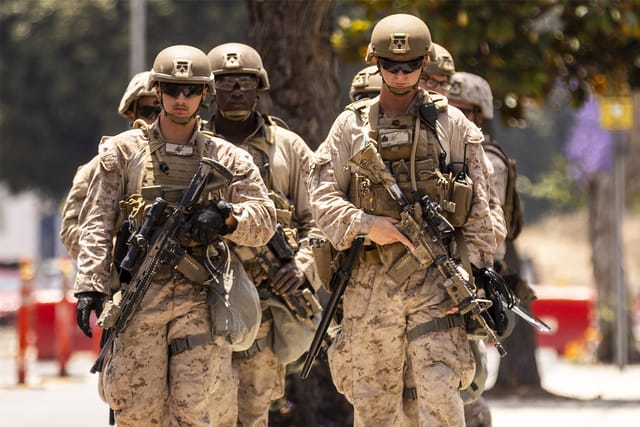
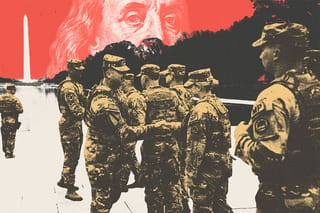
U.S. Marines walk to their assignment at the Wilshire Federal Building in Los Angeles, California, Friday, June 13, 2025. (Photo by Stephen Lam/San Francisco Chronicle via Getty Images)
Since January 2025, there have been multiple instances where the American people have held their breath wondering if the president would invoke the Insurrection Act. The president sent Marines and National Guard to Los Angeles last summer, and, most recently, had ICE and CBP engage in escalatory federal responses to civil action against ICE operations in Minneapolis, and has also publicly threatened to invoke the Insurrection Act on multiple occasions. While the administration’s increased use of force against the American people, whether through overreach by federal agencies or through domestic deployments of the military, is in its own right incredibly problematic and in need of intense legal and public scrutiny, the invocation of the Insurrection Act would give domestically deployed American service members the legal permission to engage in civil law enforcement.
While the invocation of the Insurrection Act is not inevitable, Congress still needs to prepare.
POGO has written extensively about the Insurrection Act and the concerns surrounding it. In short, the act grants presidents the power to use the military as domestic law enforcement in certain emergencies. Unfortunately, as it stands now, the verbiage of the act is vague, lacking clearly defined language, which leads to a confusing lack of legal clarity, making it easy to exploit by an overreaching executive.
Lawmakers have spoken in general, sweeping terms about their concerns with invoking the act, and about how wrong it would be for the president to take that step. What is often missing from their rhetoric, however, is any indication of the immediate actions they would take if the president did invoke the act. Today’s executive branch operates with such disregard for Congress’s role in governance that our elected representatives are often kept in the dark. Our legislators need to take steps to overcome this and cut through the screen of executive obfuscation.
In fact, Congress should look to the very people who would be called upon should the president invoke the Insurrection Act. When our troops train for the possibility of contact with an enemy force, they consider multiple scenarios for how their unit may be engaged. And to remain cohesive, organized, and focused on the mission, they review a selection of actions through rehearsals, often called immediate action drills. They run these drills repeatedly, so that when predicted contact is made, everyone involved knows exactly what to do with minimal direction or distraction. Given how frequently the president has come close to invoking the Insurrection Act in his first year back in office, members of Congress need to do more than just voice their concerns; they need to figure out their own immediate action drills and to start rehearsing.
While they can and should be doing all they can now to reform the Insurrection Act, they also need to be prepared to take immediate action upon its invocation. Congress may have just a few weeks — or even mere days — to act between when a president invokes the act and when troops arrive on the streets of U.S. towns or cities. If prepared, Congress can move quickly to discover key information about those deployments and to prepare for and potentially challenge them. Congress will be ready to protect constitutional rights and possibly even save lives.
Congress can and should act as a strong and effective check on presidential power.
POGO studied the July 2025 deployment of U.S. Marine forces to Los Angeles and has developed a kind of immediate action drill for Congress to protect the rights and safety of the American people should the president invoke the Insurrection Act. It took us six months to get materials from the Marines through the Freedom of Information Act (FOIA), but now that we know what documents exist and what they contain, we’ve created a list of things members of Congress can and should immediately demand if the executive branch deploys the military under the Insurrection Act. By doing so, members will be able to help prepare their constituents, and potentially to take legal action before troops arrive on local streets. This would be preferable to Congress relying on organizations, like POGO, to obtain these materials through the lengthy FOIA request process. If the president were to invoke the Insurrection Act, time would be at a premium for Congress to engage in necessary oversight before troops were deployed.
The materials we received included outlines of the standing rules for use of force that the Marines and National Guard members in Los Angeles were given as guidance about how and when they were to interact with Angelenos. These are roughly equivalent to a domestic version of the rules of engagement troops are normally provided in deployed, combat environments. Their purpose is “to educate active-duty service members on rules governing the use of force to Augment and support the protection of Federal functions and property [in the vicinity of] Los Angeles.” The standing rules specifically called out the Fourth Amendment and repeatedly emphasized de-escalation and limited use of physical force, in stark contrast to the actions on display in Minnesota by ICE officers. These materials helped shape our understanding of the instructions given to service members deployed domestically and helped shape our recommendations to Congress.
Additionally, materials we did not obtain, but that would have been useful in understanding the planning and considerations that went into the operations in Los Angeles, are operations orders. These are documents issued by higher headquarters to tell the units what the mission is and what the desired end state is. In most domestic scenarios, the higher headquarters will be U.S. Northern Command. The smaller units use that information to shape their operational planning. All components of a unit’s operation will be derived from these requirements.
POGO has previously advocated for Congress to enact legislation reforming the Insurrection Act, and we continue to advocate for those changes. However, considering the potential immediacy of invocation, Congress should be ready to execute the “immediate action drill” comprising the following steps:
- Demand to receive all materials on the standing rules for use of force for the troops deployed in support of the invocation.
- Demand an explicit outline of the jurisdictional guardrails between the deployed federal troops and local law enforcement.
- Demand to see the operations orders from the U. S. Northern Command or other appropriate higher headquarters that detail mission requirements and the desired end states for the deployed federal troops.
By requesting the standing rules for use of force, Congress could learn to what extent service members are being instructed to use force against civilians and could then demand immediate changes and reforms if needed, in conjunction with any legal action that state and local governments may take to limit the executive overreach through the courts.
In addition, requesting an outline of the jurisdictional guardrails placed on service members could help Congress learn exactly how troops are expected to interact with local law enforcement. For example, the standing rules for use of force materials from Los Angeles highlighted that service members may not provide direct support to law enforcement. It’s possible that, with the invocation of the Insurrection Act, that could change. By demanding to know the jurisdictional guardrails, Congress can understand to what extent the executive branch truly expects troops to engage in civil law enforcement and can conduct more direct oversight.
Finally, demanding to see the operations orders issued by the higher headquarters overseeing the troop deployments will give Congress a deeper understanding of the role the military units will be filling in any given operation. It will also help Congress shape possible responses and oversight actions.
While the content of standing rules for use of force briefs by no way exonerates or legitimizes the decision to domestically deploy troops, they do show the tension at play between the perceived intent of the executive branch and the reality faced by the forces ordered to act on that intent. Our service members are left balancing their obligation to follow orders with the oath they took to support and defend the Constitution, and the implicit extension of that oath to protect and defend the liberties of all American people. The political decisions of our leaders trickle down the chain of command, leaving small unit leaders in our military to grapple with the incredible burden of ensuring the people they command aren’t being put in a position where they may end up harming or being harmed by a civilian.
The invocation of the Insurrection Act would be yet another facet of the rampant executive overreach the current administration is engaged in. Congress, the supposedly co-equal branch of government, can and should act as a strong and effective check on presidential power. Members of Congress should be prepared to engage in strong, necessary oversight if the president takes the escalatory and politically motivated step to invoke the Insurrection Act.
For over forty years, POGO has provided Congress with advice and recommendations on how they can effectively engage in oversight of the executive branch. While we will continue to advocate for and prioritize legislative reform, we must also prepare our legislative representatives to respond quickly and effectively to protect their constituents’ rights and safety. Now, more than ever, they should consider the recommendations we provide here and look back on those recommendations we offered in the past so they can take preemptive, concerted action before the rights and civil liberties of the American people are further infringed upon.