Congress Must Act to Curtail Domestic Deployment
Deploying troops to American cities incurs steep costs.
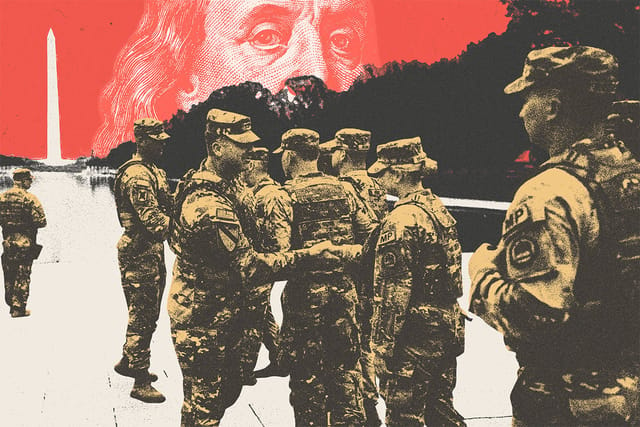
(Illustration: Ren Velez / POGO)
Testimony for:
House Committee On Oversight and Government Reform
"Oversight of the District of Columbia"
Chairman Comer, Ranking Member Garcia, and members of the committee, thank you for the opportunity to testify today on the militarization of law enforcement in the District of Columbia.
I am Virginia Burger, senior defense policy analyst with the Project On Government Oversight (POGO). POGO is a nonpartisan, independent watchdog organization that investigates and exposes waste, corruption, abuse of power, and when the government fails to serve the public or silences those who report wrongdoing. For over 40 years, we have championed reforms to achieve a more effective, ethical, and accountable federal government that safeguards our constitutional principles.
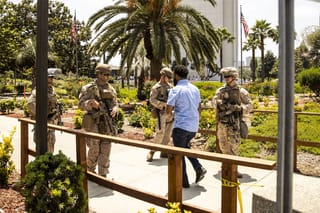
The executive branch’s actions over the last three months, deploying uniformed military personnel to American cities in support of poorly justified and ill-defined calls to combat crime and protect federal assets, sit in violation of those principles. When Americans walk through their cities to see armed service members standing on street corners, executing orders grounded in politicized rhetoric, trust in their military is degraded.1 The structural divisions between military operations and civil law enforcement — societal norms foundational to our democracy — are eroded, and the potential for violent conflict between Americans and their own military escalates.
Our apolitical military is a cornerstone of our democracy, and the domestic deployment of our troops raises concerns because it shatters that cornerstone. I’m here today to address these concerns.
The Cost of Domestic Deployments
I am not a lawyer, nor do I pretend to speak with authority on the specific legal issues surrounding the deployment of the National Guard to our nation’s capital and the potential expansion of federal troop deployments across the country. What I can do, however, is call this what it is: a dramatic overreach of executive power, one that normalizes the presence of uniformed, federal forces in our cities.
The executive branch justified these deployments by making statements referencing rampant crime in what they refer to as “Democrat cities,” with a senior administration official claiming residents are subject to a “constant bloodbath.”2 While no amount of local crime justifies the use of military intervention in lieu of local law enforcement, the reality — according to data released by the Justice Department — is that violent crime in Washington is at a 30-year low.3 In fact, rates fell in 2024 and, so far, also 2025.4
The activation of the D.C. National Guard further highlights a concerning legal loophole for the executive branch. The district is a singular case, given its minimal home-rule abilities and lack of statehood. It has a unique and often fraught relationship with our federal government. While its National Guard can and does operate in many ways identically to state National Guard units, instead of reporting to a governor, it reports to the president.5 As such, the executive branch retains the authority to mobilize the D.C. National Guard with impunity, avoiding formal federalization, which requires specific statutory authority from Congress.6
The Washington deployments follow the deployments of the National Guard and Marines to Los Angeles earlier this summer, which were under similarly inflammatory circumstances that remain legally dubious today.7 I wrote about the cost of the L.A. deployments in an analysis for POGO, titled “The Cost of Domestic Deployment.”8 In that piece, I outlined the deployment’s cost to democracy, the cost to public safety, and the cost to military readiness. While deployments in Washington and L.A. are not identical, the same costs exist in each, and the issues I raised regarding L.A. can be extrapolated to apply to the National Guard deployments that we are experiencing in Washington now, and that we may experience in more cities in the future.
The Cost to Democracy
The legalities of the Posse Comitatus Act have been the subject of increased discourse as the executive branch has continued to push the envelope regarding military support to law enforcement.9 While this brings into question the legal justification of any domestic deployment, the division of labor between civilian law enforcement and the military has both practical and philosophical benefits.
Troops train for war: They are equipped to face designated enemy combatants in declared conflict zones. Police train to police, and they are focused on community safety and adherence to civil norms and regulations. Keeping policing in the hands of local civilian, rather than military, authorities keeps law enforcement more accountable to the public. And while, across our country, local policing still requires support and reform, it is still more in line with our democratic values to rely on local law enforcement, who live in and remain accountable to their communities, to police our streets, not federal troops.
By activating National Guard units, the executive branch is driving an erosion of norms that allows them to push what the public will accept. Ultimately, it could lead to a circumvention of the laws designed to keep the military out of civilian affairs.
And, according to Joint Task Force – DC’s own public affairs office, this cost also damages Americans’ trust and confidence in the military.10 The Army’s own assessments show how the military, once one of the most trusted American institutions, is rapidly losing public support.
The Cost to Public Safety
Without diving into too much conjecture, it could be surmised that as the public loses trust in the military, the potential for violent clashes between Americans and uniformed service members rises. It can only stand to reason that any instances of service members exercising force against American citizens is a failure of our democratic norms and a dramatic issue of public safety.
In L.A., for example, numerous federal agencies, military units, and civil authorities were all performing overlapping duties, with unclear and limited explanations of how each entity was authorized to interact with the general public. U.S. Marines were on the ground in L.A. with the National Guard, Immigration and Customs Enforcement, Customs and Border Protection, the California Highway Patrol, the L.A. County Sheriff’s Department, and the Los Angeles Police Department (LAPD).11 With the influx of federal law enforcement agencies now operating in Washington in capacities wildly outside their previously understood missions, this same confusion continues today.12
The Marine units that deployed to L.A. — the 2nd Battalion 7th Marines and the 3rd Battalion 7th Marines — were both infantry units. Some of the National Guard members currently in the capital are also infantry personnel.13 As outlined in Marine Corps doctrine, the mission of an infantry battalion is to “defeat the enemy by fire, maneuver, and close combat.”14 While service members may be employed in this capacity across a broad spectrum of conflict, at its core, an infantry battalion is purpose-built and trained to execute operations as a combat force. No amount of rapid training on less-than-lethal crowd control can eliminate that innate mission or counter that deeply ingrained training.15
The Marines were previously deployed to L.A. in 1992, in response to riots following the acquittal of four police officers accused of beating Rodney King. The 1992 deployment has been used repeatedly as a case study on the issues and concerns surrounding federal military assistance to civil law enforcement. One often cited example highlights how local law enforcement gave the Marines an order to “cover” a building known to have civilians in it.16 For local law enforcement and the National Guard, that simply meant for armed individuals to point their weapons at the building and be prepared to shoot. For the Marines, based on their training and procedures, that meant opening fire at the building. Ultimately, no civilians were killed, but that was due more to luck and poor aim than anything else.
In June, as in 1992, Marines were rushed to an American city with little to no evidence of thorough, thoughtful prior coordination. Little information has been made public about the training the Marines received before deploying, though local news stations captured footage of the Marines conducting crowd control maneuvers in L.A., prior to being operationally deployed in the city.17
While we can hope that this rapid, less-than-lethal training established standards for protecting the public safety, there was still an innate risk. When met with a moment of stress and uncertainty, it’s not unreasonable to think service members in these situations will fall back on what they’ve been trained to do — defeat the enemy. And if that enemy is the American public as they exercise their First Amendment rights, the situation can quickly become difficult and unsafe for everyone involved. This same concern exists in Washington, as multiple agencies with overlapping, unclear jurisdictions try to fill the gaps within the poorly articulated and seemingly non-existent crisis they have been called in response to.18
The Cost to Military Readiness
Domestic deployment doesn’t just endanger our ideals and our people, it also endangers our nation as a whole. Every service member sent to an American city is a service member who’s not doing the job they enlisted to do — defend the United States against potential adversaries. The Marines’ presence in L.A. illustrates how domestic deployment impacts our nation’s ability to respond to potential global conflict.
In June, acting Department of Defense Comptroller Bryn MacDonnell estimated the cost for the deployment of Marines and National Guard to L.A. would be $134 million.19 She also said that the money would come out of the units’ operation and maintenance accounts. That means they likely had to redirect funds that were already committed for other priorities — equipment, training, maintenance, and other routine and necessary annual unit requirements.
Moreover, the Marines sent to L.A. all come from the 7th Marine Regiment based out of Twentynine Palms, California. This regiment is part of I Marine Expeditionary Force, or I MEF. I MEF deploys Marines across the Indo-Pacific region annually in a variety of capacities, from large scale exercises with partner forces ;to staging forces in anticipation of potential conflict.20 To deploy in these situations, units go through set training courses and preparation procedures months in advance.21 Pulling the Marines out of these operations to perform inappropriate law enforcement duties disrupts these processes and likely forces I MEF to realign complicated training schedules, matrices, and plans across the entirety of the West Coast Marine Corps. This puts the service branch purpose-built to act immediately in the face of global crises in a position where they may be unable to quickly respond to conflict in the Pacific.
The deployment of state National Guard units, like the deployment of Marines, degrades readiness for other missions. Several of the states that have sent troops to the District of Columbia — South Carolina, Louisiana, and Mississippi — regularly experience the impacts of hurricanes.22 National Guard units are often called up to respond to these disasters and support their communities.23 We currently sit in the middle of hurricane season: If South Carolina or Louisiana were hit with a devastating storm, would their National Guard be equipped to respond in a timely and appropriate manner?
The Cost to Government Efficiency
Our National Guard should not be mobilized to perform the duties of domestic, local, civilian law enforcement. The cost of deploying the National Guard to Washington sits around $1 million a day, with hundreds of thousands of dollars in contracts going to house, feed, and support guard members.24 As of today’s hearing, the National Guard has been in the capital for 38 days, totaling approximately $38 million dollars in taxpayer money spent.
These costs grow increasingly insulting when it’s revealed that the guard members who have been called away from their homes and families spend a significant amount of their time collecting garbage and finishing landscaping projects around the district.25 The time and money spent to have guard members mowing the grass on the National Mall — a task that would otherwise be completed by the now under-funded National Park Service — are wasteful expenditures.26
Recommendations
As the executive branch continues using federal troops for law enforcement in Washington and looks to expand to other cities, Congress can take necessary steps to curb this dangerous overreach. POGO recommends Congress take the following steps:
Establish clear controls to differentiate agency roles.
Every level of government law enforcement has a distinct and appropriate role to play. We recommend that you establish controls that ensure the already existing agencies each play their authorized and appropriate part. For example, local law enforcement is responsible for enforcing local laws; let local police do the policing, not federal troops. Local policing should be conducted by agencies that are familiar with and accountable to their communities.
Remove the president as commander of the District of Columbia National Guard.
Congress should ensure the district retains local control of their own departments and assets, including by amending D.C. Code 49-409 to remove the president as the commander of the D.C. National Guard.27 POGO has previously written about curtailing a president’s ability to abuse their power.28 Turning control of the D.C. National Guard over to city leaders would limit the potential for abuse from the executive branch.
Improve transparency around National Guard deployment.
Congress can and should establish statutes that require every National Guard unit domestically deployed to publicly release their concept of operations, risk assessment, and rules of engagement. This will ensure transparency and help Congress and the American people understand whether deployments are appropriate and in line with our nation’s values and requirements, or if they are an overreach and potentially an abuse of presidential power.
Place meaningful limits on the invocation of the Insurrection Act.
POGO has already offered recommendations for how Congress can reform the Insurrection Act so it allows a president to respond to a genuine crisis while also placing meaningful guardrails on a president’s ability to invoke the Act.29 These can also be applied to other legal authorities, such as 10 U.S.C. §12406. Necessary reforms include — but are not limited to — the following:
- removing antiquated terms from the law that create confusion regarding scope;
- clarifying conditions under which the Insurrection Act may be invoked;
- clarifying that the Insurrection Act does not permit the suspension of habeas corpus or the imposition of martial law;
- requiring the president to consult with Congress before invoking the Act;
- requiring the president to make specific findings on the need for invocation of the Act and report them to Congress no more than 24 hours after invocation;
- imposing clear time limits on domestic deployment of the military; and
- requiring judicial review of whether the criteria under the Act have been met.
Place meaningful limits on emergency powers.
Much of our current situation is predicated on the president’s ability to declare emergencies with little to no serious justification or transparency. POGO has previously advocated for reform regarding the presidential abuse of the National Emergencies Act.30 We recommend several reforms to the Act, including that Congress take the following steps:
- mandating that a presidentially declared national emergency automatically expires after 30 days unless Congress affirmatively votes to extend it;
- determining that a national emergency declared by the president and approved by Congress expires after one year;
- requiring with each proclamation that the president provide a report to Congress that includes a description of the circumstances necessitating the declaration, an estimated duration of the emergency, and a summary of actions the president intends to take;
- requiring the president to provide a report every six months on the status of the emergency and actions they have taken to address it; and
- subjecting current existing national emergencies to these reforms.
Conclusion
America is a nation built on norms and ideals. Since January, we have all watched as the executive branch continues to degrade and, at times, openly destroy the norms and ideals we as a nation depend on to maintain our more perfect union. The use of our uniformed service members to achieve a vision of a militarized America is something that should alarm everyone. Our military exists to defend our democracy. Our military members joined to support a cause greater and deeper than themselves as individuals, a cause founded on democratic principles.
Deploying service members to patrol the streets of our nation’s cities, wasting taxpayer dollars and eroding public trust, is a violation of those principles. We strongly urge Congress to exercise its role as an equal branch of government, reverse this executive overreach in Washington, and fulfill its oversight duties as the executive branch continues to call for deployments into other American cities.
Thank you again for the opportunity to provide this testimony. We at POGO appreciate you holding this hearing, and we are committed to working closely with all members of the committee to safeguard our nation’s constitutional principles.