Military Oaths and Unlawful Orders
A few important questions and answers from our senior defense policy analyst
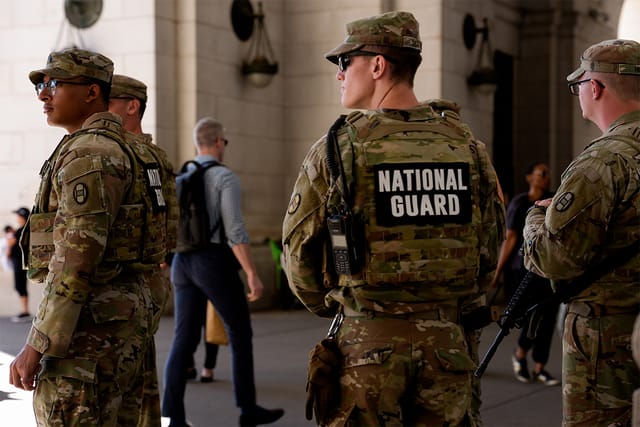
(Photo by Andrew Harnik / Getty Images)
Earlier this week, several veterans who are Democratic members of Congress released a video urging members of the military and intelligence community to uphold their oaths and refuse unlawful orders. Yesterday, President Donald Trump responded on Truth Social, suggesting in one post that the creation of the video was “SEDITIOUS BEHAVIOR AT THE HIGHEST LEVEL,” and in another saying it was “SEDITIOUS BEHAVIOR, punishable by DEATH!”
To better understand what exactly these legislators were asking service members to do, we turned to POGO’s Senior Defense Policy Analyst Virginia Burger, who served as an active-duty Marine officer for nine years. We asked her to share her personal knowledge of that role and the oath that defines it. Below are a few questions and answers to help us all understand what we can expect of our National Guard members, soldiers, sailors, airmen, Guardians, and Marines.
What is the oath service members swear?
There are two distinct oaths — enlisted personnel swear an oath of enlistment, while officers swear an oath of office. Members of the National Guard have an additional line in their oath that acknowledges the Constitution of their specific state, too.
In each oath, the service member swears that they will support and defend the Constitution. Enlisted service members also swear they “will obey the orders of the President of the United States and the orders of the officers appointed over me, according to regulations and the Uniform Code of Military Justice.”
When you took the oath, what did you understand it to mean?
Taking the oath is a solemn moment — the ceremony of and care given to the event highlights the gravity and significance of it. I initially swore an oath upon matriculating to the United States Naval Academy as a midshipman, and then again on the day I commissioned as a second lieutenant in the United States Marine Corps. I then reaffirmed my oath every time I was promoted, through the rank of captain. The oath has significant meaning for every service member, but as an officer it truly highlights the burden of leadership and the responsibility you hold to faithfully care for and lead the enlisted service members assigned to your charge.
By swearing an oath to the Constitution, we are recognizing that document as the ultimate arbiter of our actions, not a single person or leader, uniformed or civilian. Our oath is also coupled with the Uniform Code of Military Justice (UCMJ) — every service member is obligated to follow the laws and regulations outlined within it.
The UCMJ outlines every service member’s obligation to carry out lawful orders, and the manual for courts-martial further expands on the subject, with the point boiling down to the fact that every service member has an obligation to disobey unlawful ones. There is no nuance to it — if any service member receives an order that is unlawful, they must refuse to execute it. If not, they are just as complicit in the illegality of it as the person who ordered them to do it.
Every time I raised my right hand, I was reminding myself, regardless of how small or minimal I felt my individual contributions to the military may have been, that, ultimately, regardless of clime or place (as the Marines like to say), I was obligated to uphold the values and principles of our nation through my service to our country.
Is the obligation to disobey an unlawful order different for junior and senior members of the military? Do officers have a different responsibility than enlisted members?
It is inherent in every service member’s oath that they will, when presented with an unlawful order, disobey it. It is not just an assumption, but a requirement.
The most significant role, however, belongs to the leaders, whether they are commissioned, noncommissioned, or warrant officers. The officers appointed over our most junior enlisted service members have a duty to refuse unlawful orders not just for inarguable legal, ethical, and moral reasons, but also to ensure that the most junior service members they lead are not left to make that call.
An unlawful order that must be refused by the 18-year-old E1 or E2 is a failure of every leader in the chain of command, from the fire team leader all the way up to the four-star general serving as the combatant commander.
Is the obligation different depending on whether you are in the United States or abroad?
No — the obligation to refuse unlawful orders does not change depending on where you are. Whether you are operating domestically or abroad, the obligations and requirements of the oath and the UCMJ remain the same. Whether you are an active-duty Marine on a ship in the Caribbean or a National Guard member in Washington, D.C., it remains the same.
How have service members responded to unlawful orders in the past?
War is hell and people are flawed, so illegal orders and the tragedy that often follows them are, unfortunately, a part of our nation’s history. During my service, I had the distinct privilege of training newly commissioned Marine Corps officers at The Basic School, in Quantico, Virginia.
Part of their training includes continued discussions of the oath we all took, as well as burden of leadership. To do that, we would provide them with case studies of incidents where officers failed to uphold their oath and facilitated the execution of unlawful orders and actions. The two used at The Basic School are the 2005 Haditha Massacre in Iraq, and the 1968 My Lai Massacre in Vietnam.
In both situations, an officer failed to recognize their obligation to either refuse an unlawful order or recognize and stop someone below them from issuing one. Today, both of these moments are used to educate newly commissioned leaders to prevent atrocities like these from happening again.
Do you know how service members are responding to these discussions about unlawful orders today?
While I am no longer on active duty, I have many friends and loved ones who still are. While I do not speak for them, I can say that many are currently serving with heavy reservations of what may be asked of them.
I know an infantry company commander whose Marines asked him what he would do if he was ordered to have the company fire on protestors. His answer was that he would vehemently refuse, and he would never make his Marines be the ones who had to disobey an order. However, he told them he would have to place the company between the protestors and those who would open fire.
That is the oath our service members take, the promise they make when they swear to support and defend the Constitution of the United States.