Prediction Markets Open the Door for Corruption and Conflicts
Congress must act to prevent government officials from profiting off of prediction markets.
(Illustration: Luna Velez / POGO)
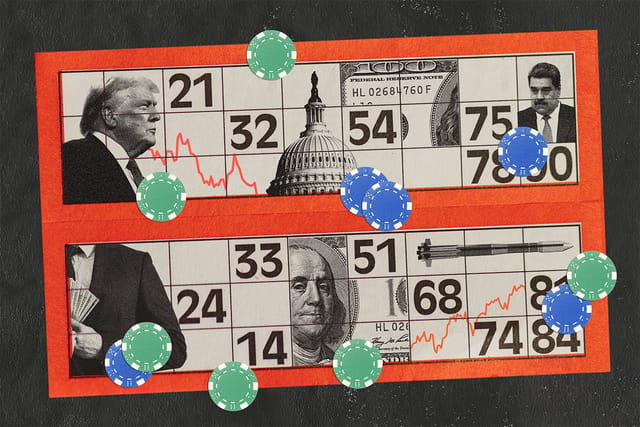
Recently, traders on Polymarket, a prediction market platform, drew the attention of Congress and the media after making significant profits betting on political events. In January 2026, an anonymous trader made a profit of over $436,000 after bidding on whether Venezuela’s president, Nicolás Maduro, would be out of power by the end of January. Not long after, at least six accounts earned about $1 million from correctly betting that the United States would attack Iran by the end of February. One account made $553,000 betting on the death of Iran’s Supreme Leader, Ayatollah Ali Khamenei.
Prediction markets are online platforms where participants buy and sell contracts based on the outcome of future events. On platforms such as Polymarket and Kalshi, users buy or sell “event contracts” that typically have binary outcomes, meaning participants take positions on whether an event will occur (“yes”) or not (“no”). These contracts are usually priced between one cent and one dollar, with the price reflecting the probability of the event occurring, paying out if the predicted outcome occurs. Unlike sports betting, which is regulated at the state level, prediction markets are regulated at the federal level by the Commodity Futures Trading Commission (CFTC).
Traders of the two political event contracts mentioned above raised suspicions of potential insider trading from Congress, the media, and the public. Most of the anonymous trader’s bids concerning Maduro’s capture were placed just hours before President Donald Trump announced the raid in Venezuela and captured Maduro and his wife. Similarly, the six accounts that earned about $1 million from the military strikes against Iran were created shortly before the attacks occurred, and some of the bets were placed mere hours before the strikes began.
A Legal Gray Area with Real Consequences
The U.S. has existing laws and rules, such as statutes 18 U.S.C §§203-209, that prohibit government officers and employees from participating in any government matter in which they have a personal direct or indirect financial interest. However, these statutes exclude the president and vice president of the United States, which creates a different standard of ethical obligations for the two highest-ranking officers in the executive branch than that for other federal employees. The president and vice president often rely on self-commitment and ever-changing accountability mechanisms. Additionally, ethical standards and actions required by the law do not uniformly apply across all three branches of government. Some statutes apply broadly to executive branch officers and employees, with certain provisions extended to certain employees of the legislative and judicial branches. Similarly, each branch of government has its own ethical codes of conduct.
While the 18 U.S.C statutes cover a swath of ethical misconduct, including compensation from private sources and conflicts of interest, neither the statutes nor existing regulatory guidance addresses the difficulty in limiting conflicts of interest in prediction markets. In addition, the authorizing statute that designates the CFTC as regulators of these markets, the Commodity Exchange Act, does not articulate rules about public officials engaging in prediction market trading.
As the legal and regulatory landscape currently stands, prediction markets create a serious risk of corruption, conflicts of interest, and regulatory arbitrage.
In fact, despite prediction markets operating under the CFTC, it is the market platforms themselves that are tasked with monitoring and enforcing regulatory oversight, essentially having the ability to self-certify and police whether the contracts they approve for trading comply with existing regulations. Oftentimes, after undergoing the platform’s certification process, controversial contracts go live on the platform before the CFTC can meaningfully review them. This lack of preventative intervention leaves the application of existing laws and rules largely in the hands of prediction markets, with major loopholes.
Prediction markets currently operate in a legal gray area, as at least eight states are in litigation with prediction market platforms. There are critical legal questions that have yet to be answered. Namely, does trading through these prediction markets constitute as gambling? And does the CFTC have broad jurisdiction over contracts that potentially interfere with state laws?
As the legal and regulatory landscape currently stands, prediction markets create a serious risk of corruption, conflicts of interest, and regulatory arbitrage. For example, Donald Trump Jr. serves on Polymarket’s advisory board and has been named a strategic advisor to Kalshi, two major prediction market platforms currently in litigation. As the son of President Trump, Trump Jr.’s proximity to nonpublic information and government decisions risks the appearance of and potential for insider trading and personal financial gain.
Existing statutes, the Commodity Exchange Act, and CFTC regulations do not clearly restrict or prohibit this kind of arrangement for any government officer or employee currently, though the CFTC announced it is seeking public comment on event contracts ahead of issuing regulations.
Congress Can Prevent Corruption with These Solutions
Fortunately, Congress can act now to address these risks by passing meaningful legislation to protect the public from corruption in prediction markets and ensure that our government preserves independent policymaking, free from financial conflicts of interest. There are a number of options Congress can consider.
Ban the president, vice president, members of Congress, appointed government officials, judicial officers and employees, and senior executive branch officials (i.e., covered individuals) from trading event contracts. Government officials and staff privy to nonpublic information should not be able to legally engage in prediction markets. They have a structural advantage that creates an uneven playing field and clear opportunities for self-dealing that distort public opinion and can corrupt the integrity of government policymaking.
Prohibit dependents and spouses of covered individuals from engaging in any financial transaction through prediction markets for the duration covered individuals are employed within the government. This would serve as a comprehensive safeguard to avoid the appearance of impropriety and potential self-enrichment. Without this safeguard, officials could effectively transfer their informational advantage and the profit opportunities it creates to family members, rendering any direct prohibition trivially easy to circumvent.
Expand the Commodity Exchange Act’s public interest standard through legislation or rulemaking. The Commodity Exchange Act currently authorizes the CFTC to determine whether an event contract is “contrary to the public interest” and prohibit any activity regarding such contract. The act should be amended or the CFTC should define what “contrary to the public interest” entails. This can include specific contracts that incentivize trading on nonpublic information, such as those tied to legislative and judicial outcomes or executive agency rulings.
Narrow the scope of the ban: Prohibit covered individuals, their spouses, and dependents from trading event contracts related to policy, political events, and death. Banning event contract trades related to policy and political events establishes a boundary that helps prevent prediction markets from becoming primary drivers of the law and policymaking process. The government should consider how the appearance of impropriety affects the public trust in government and the integrity of decisions made by government officials. Politicians and lawmakers should not be incentivized to vote a certain way or shape political events for the purpose of betting on and potentially profiting from it.
Additionally, traders using prediction market platforms have bet on the death of political leaders and have reportedly threatened a journalist, asking them to change their reporting in order to place bets or luring them to collude for a shared profit. Federal oversight must prevent this from becoming prevalent. Public safety is essential to preserving the integrity of public opinion and free speech. To ensure individuals can engage freely in public discourse and that prediction markets operate as intended, safety must remain a priority. There should be an outright prohibition on trading any event contracts related to the death of a political figure or any human being, as it raises serious public safety concerns. Not only that, but it is also a perverse tool that dehumanizes life. Human lives should not be wagered for any potential economic rewards.
Amend the STOCK Act to explicitly include event contracts. The CFTC has taken the position that event contracts fall under the Commodity Exchange Act’s broad definition of “swap.” While the STOCK Act covers swaps, consistent application to event contracts remains uncertain. When the STOCK Act was drafted in 2012, prediction markets were neither as prevalent nor as politically relevant as they are today. The law’s commodity and swap provisions were also never explicitly applied to event contracts. This amendment would make clear that event contracts fall under the same insider trading prohibitions across all three branches of government.
Require financial disclosure reports to document event contract transactions for covered individuals, their spouses, and dependents. These financial disclosure reports would document any event contract transactions, including the date, nature of the transaction (purchase, sale, exchange), and profit realized, if any.
While current law requires annual financial disclosures and periodic transaction reports from government officials detailing their personal financial interests as well as those of their spouses and dependent children, it does not explicitly cover event contracts. Congress should amend existing legislation or enact new legislation to address this directly. Additionally, unlike the STOCK Act, no minimal threshold should apply. Any transaction made on prediction markets should require disclosure.
Designate the Office of Government Ethics or another agency to develop specific guidance governing the participation of government officials and other covered individuals in prediction markets. Existing conflict of interest rules were developed with traditional financial assets and securities, such as stocks and bonds, in mind. The Office of Government Ethics or another designated agency should issue specific guidance that clearly outlines whether trading contracts through prediction markets constitutes a conflict of interest.
Related Content
New Spineless Stock Trading Ban Could Tank Bipartisan and Genuine Reform in Congress
Congress must prioritize real reform to regain the public’s trust
Congress Must Urgently Pass the Bipartisan Restore Trust in Congress Act
The people deserve a Congress that serves the public, not their stock portfolios.