Why a Trillion-Dollar Defense Budget Won’t Buy Victory in Iran
Sending ground troops to Iran raises new risks and emphasizes the need to return to rational defense budgets that better serve our foreign policy.
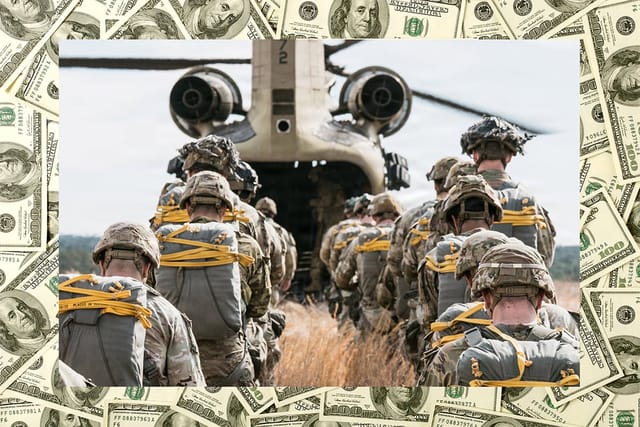
(Illustration: Luna Velez / POGO)
Reports have recently described several different U.S. military ground forces as heading toward Iran. Until now, the U.S. has not had any “boots on the ground” and has relied on aircraft and missiles to conduct its military operations against Iran. The movement of ground forces toward Iran raises questions as to what further operational goals would necessitate forces beyond what is already in theater, how the use of ground units might allow for different results, and what additional risks may be involved in deploying them.
The United States currently spends close to $1 trillion annually on the military — more than what’s spent by the next nine countries combined (per the most recent available data). It is important for taxpayers to understand what these expenditures get us, what they don’t, and how budgetary shortcuts and gimmicks cost the public more money without getting much in return.
To help break down the concerns surrounding U.S. ground troops in Iran, Project On Government Oversight’s (POGO) Director of the Center for Defense Information, Greg Williams, posed some questions to Senior Defense Policy Analyst Virginia Burger.
Tell us about your military background and how it informs your defense expertise.
I served as an officer in the U.S. Marine Corps for nine years, during which time I spent 10 months in specialized training focused on the operational planning for Marine Expeditionary Units (MEUs). Throughout my career, I was also part of various operational planning teams charged with engaging in military planning for units all the way up to the three-star command level.
Now I’m the senior defense policy analyst at POGO, where I spend a significant amount of my time reviewing past and current defense policy. While a lot of my focus is on the defense budget and the policies surrounding it, I still spend a considerable amount of time analyzing military strategy, since these decisions are all interconnected.
What types of operations has the U.S. engaged in so far in this conflict with Iran?
Up to this point, the war with Iran has been an air campaign. This means the U.S.’s operations have consisted of missiles and bombs dropped from aircraft or shot from surface ships, submarines, or, in some limited cases, artillery barrages from High Mobility Artillery Rocket Systems (HIMARS). However, as Senator Chris Murphy (D-CT) said at the outset of this conflict, “There is no experience [in history] that shows an air campaign alone will result in positive regime change.”
While the purpose or desired end state for this conflict seems to vary wildly depending on who you ask, all the options that have been publicly discussed require some amount of ground forces to be achieved. Whether the goal is regime change or the seizure of nuclear materials, from my understanding, both require people on the ground, in Iran, to be successful.
And now, a month into this war, some key stakeholders have suggested the focus should just be on reopening the Strait of Hormuz. That too would require ground forces to hold key terrain to establish necessary safety corridors through the territory. Based on my understanding, from a purely strategic perspective, whatever the end state is, it requires the use of ground troops.
What ground campaigns could be on the horizon?
Thus far, two MEUs have been sent to the Middle East, along with roughly 2,000 paratroopers of the 82nd Airborne Division’s Immediate Response Force. MEUs are units of approximately 2,200 Marines, often increased with operational augments, embarked on three amphibious ships, with amphibious assault vehicles, light infantry forces, assault aircraft, and strike aircraft. Fundamentally, their purpose is to conduct amphibious assault.
Both MEUs tasked were already deployed in the Pacific. The first, the 31st MEU, was due to arrive in theater on March 27. The second, the 11th MEU, is just a few weeks from arriving in the Middle East. And when we say “arrive” in the Middle East, we mean that the ships arrive within the area of operations designated as U.S. Central Command. For ships coming from the Pacific, that means all of their personnel and cargo have floated into the Arabian Sea and are awaiting further tasking and orders.
The third unit that has been tasked is the 82nd Airborne, which is considered the Army’s rapid deployment force. One of their standing missions is to keep an Immediate Response Force (IRF) of up to 3,000 light infantry soldiers constantly on standby, able to deploy anywhere in the world within 18 hours. Light infantry means they do not bring along heavier military assets like tanks, armored vehicles, or self-propelled artillery. Some reporting on the 82nd has said they will stage at U.S. bases in Kuwait.
Regardless of the purpose and capabilities of these units, it’s worth noting that anything they could accomplish in support of gaining control of the Strait would still be limited.
All these units — both MEUs and the 82nd Airborne — are purpose-built to engage in rapid ground operations. The Marines can conduct amphibious assaults in and around the Strait, while the 82nd is well-positioned to backfill those Marines or seize and hold terrain slightly farther inland, like airfields. While the United States has maintained extensive naval and air assets in the region since the start of Operation Epic Fury, none of those pre-positioned units could seize physical terrain.
These newly arrived amphibious and light infantry forces are purpose-built to engage in fast, initial seizure of terrain. In the case of MEUs, that looks like putting light infantry forces on either amphibious assault vehicles or assault aircraft and pushing to designated objectives. For the 82nd, it’s the same, but likely exclusively via aircraft. Notably, though, neither the MEUs nor the 82nd are meant to sustain heavy combat. In theory more than practice, these units should be backfilled eventually by heavier-equipped forces. However, history has shown us that is not always the case.
Regardless of the purpose and capabilities of these units, it’s worth noting that anything they could accomplish in support of gaining control of the Strait would still be limited. The difficult terrain, the extensive network of Iranian mines, and the breadth of Iranian capabilities and forces from small boats to self-destructing aerial drones means that even if U.S. ground forces seize necessary terrain in and around the Strait, safe passage for commercial shipping will hardly be assured. The cost of even limited control will be American lives.
Iran’s ability to threaten shipping in some capacity is unlikely to ever be fully eliminated. Commercial traffic would still likely require naval escort to provide sufficient cover against remaining Iranian threats. The number of vessels required to do this in any meaningful capacity rapidly extends beyond the U.S.’s ability, given maintenance cycles and our limited number of available ships, compounded by the cancellation of the last three major shipbuilding programs — Constellation, Zumwalt, and the Littoral Combat Ship.
Have the U.S.’s defense expenditures helped increase the chances of safety and success for these operations, or not?
Though we’ve reached an unprecedented level of defense spending, our spending has squandered resources on weapons that don’t work while leaving a number of concerning vulnerabilities.
First, I'm concerned about the years of deferred shipbuilding and maintenance that have left the Navy unable to properly support MEU deployment cycles. We’ve already seen the USS Gerald R. Ford leave the fight due to maintenance problems, and we could have similar problems with amphibious ships, leaving Marines ashore without the support they need. We are rapidly overextending an already limited amphibious fleet, which, from my position as a defense analyst, will have significant long-term consequences for military readiness.
Second, we are burning through munitions faster than they can be replaced. The doctrinal strategy of U.S. ground forces typically relies on continuous bombardment from airstrikes as part of “combined arms” planning. Unfortunately, the complexity of modern munitions has led to our buying only limited stocks, which are rapidly running out. The rate at which this war has already burned through these limited stockpiles during the ongoing air campaign remains unsustainable when considered outside the vacuum of just Operation Epic Fury, especially if burn rates must increase in support of ground operations.
Third, our defensive missiles are also expensive, in limited supply, and are running out. At the same time, the radars needed to coordinate these defensive missiles have been shown to be vulnerable and targetable by Iranian self-destructing drones, with multiple already being rendered combat ineffective to the point where the U.S. is reportedly replacing these expensive systems with ones that would otherwise be in the Pacific, pre-positioned against potential adversaries like North Korea or China. If we run out of missiles or radars, American forces — ground or otherwise — will be immensely vulnerable to Iranian strikes.
Finally, despite decades of U.S. intelligence indicating Iran’s plans to use mines in the Strait of Hormuz, American minesweeping capabilities have been vastly reduced since past conflicts. After dismantling the Navy’s Mine Warfare Command in 2006, minesweeping capabilities have dwindled with the decommissioning of the Navy’s purpose-built minesweeper ships. The Littoral Combat Ships (LCS) that came online over a decade ago to fulfill this and other roles remain plagued with poor performance and budget overruns, and their mine countermeasures mission package remains untested. On top of these issues, two of the three LCSs that were tasked to provide minesweeping capabilities in the Middle East are currently in the Pacific.
What would it take for warships and oil tankers to be able to safely transit the Strait of Hormuz?
From a military perspective, protecting commercial traffic in the Strait of Hormuz presents problems both in terms of the number of different threats and the overall scale. Even if U.S. ground forces seize requisite key terrain in and around the Strait, the array of Iranian threats is so significant that, without some level of cooperation from the Iranian government, true safe passage will never be guaranteed.
Per my analysis, to achieve a truly open Strait, the U.S. would have to expand and extend the scope of the war so significantly to a level that would cost uncountable American and Iranian lives at a scale not known by current generations, with no guarantee that the time, money, and lives spent would ultimately lead to a positive outcome for anyone involved.
As Congress considers validating this war through dedicated, supplemental defense spending legislation with a $200 billion price tag, it needs to consider that our spending should be guided by thoughtful strategy and supported by the kind of national commitment and deliberation that comes from the regular hearings and legislative processes. Hasty, vague supplemental spending only validates the minimal, poorly executed strategic efforts of this administration.
Related Content

Adding Hundreds of Billions to Pentagon Budget Wastes Taxpayer Dollars Without Making Us Safer
Congress cannot approve a reckless budget increase without a sound defense strategy and exit plan to the illegal war in Iran.


As the Administration Launches Strikes Against Iran, Congress Must Reclaim Its Constitutional War Powers
Only Congress can declare war — Trump’s military actions in Iran are illegal