DOGE Owes Us an Explanation
Transparency and oversight are key to reducing government waste. Sunsetting without issuing a final report shows DOGE never really cared about either.
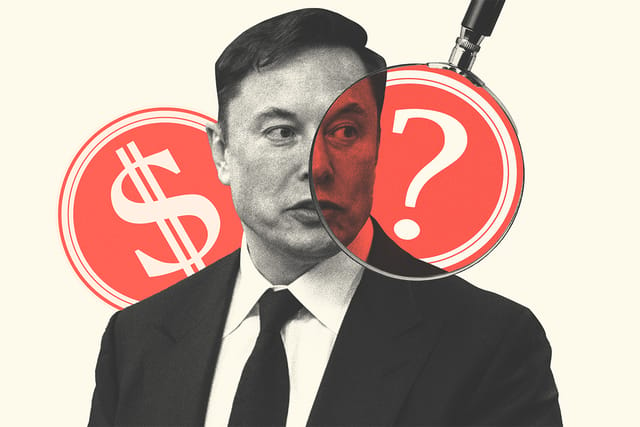
(Illustration: Luna Velez / POGO)
The recent public reporting around the quiet demise of the Department of Government Efficiency (DOGE) got me reminiscing about DOGE’s inception, and my own relationship, and POGO’s relationship, to that undertaking.
The sunsetting of DOGE on July 4 of this year (as prescribed by the original executive order establishing it) comes as no surprise, but what is shocking — or at least what should be — is the administration’s admission that it’s not going to provide Congress or the public at large with a final tally of DOGE’s impact.
Avoiding accountability to Congress and transparency to the American people is a slap in the face. But it’s nothing new: DOGE has been operating this way all along, and the slaps have been frequent. This long-standing opacity and lack of oversight is exactly why we deserve a final accounting of its work, its supposed savings, and its harms.
When I say that POGO has been involved with DOGE from the beginning, I mean that literally. I actually had the privilege of testifying before the very first hearing held by the House of Representatives’ DOGE subcommittee, held less than a month after President Donald Trump’s inauguration. I was invited to testify because POGO takes a backseat to nobody when it comes to arguing in favor of more effectiveness, accountability, and integrity in the operation of the federal government. For the entirety of our 45 years, we have fought to make the government work better, act more ethically and responsibly, and do a better job of stewarding precious taxpayer dollars and overall public resources. In short, we are deeply committed to rooting out waste, fraud, and abuse — a framing and phrasing DOGE used to describe its own work.
But while we had some early hope that DOGE might have been able to do some good, it quickly became clear that the project was not making a serious effort to improve efficiency, but instead was using that messaging to execute a political and ideological agenda. In my testimony at that first hearing, I outlined several steps government officials could take if they were sincere in their desire to address waste, fraud, and abuse. At their core, these recommendations build on a simple, causal argument: More oversight and more transparency produces more accountability.
In closing down without issuing a final report, DOGE is undermining this virtuous sequence. But as I noted, this is nothing new. From the beginning, POGO has called out DOGE’s secrecy and unaccountability. We raised alarms about how a lack of clarity around the structure of the department — or was it an agency? or an office? — served to shield it from oversight and transparency rules, undercutting trust in the operations of the entity itself and reducing its potential effectiveness. We surfaced concerns about how a lack of transparency allows for conflicts of interest, which can serve as the catalysts of corruption and wasteful spending. We even sued DOGE so the public could more easily access records to which it has a rightful claim.
I also had the opportunity to weigh in a few more times with additional hearing testimonies for the House and Senate at which I pointed out the various ways DOGE was falling short and how the government could truly address and resolve issues like waste, fraud, abuse, and corruption in federal spending and operations. The logistics might be complex, but the answers remain common sense.
DOGE understood this too: Just as it adopted the language of waste, fraud, and abuse, it also made gestures toward transparency. One example is its “Wall of Receipts.” On its site, DOGE posted a running list of cuts to government spending. Elon Musk famously claimed that he would find $2 trillion in waste, fraud, and abuse. DOGE has ceased operation in the last week or so and it claims to have saved taxpayers $215 billion. The numbers behind this claim are there for all to see, but they show the futility of transparency without oversight: Throughout DOGE’s life cycle, reporting has highlighted repeated instances of miscalculations, errors, and inaccuracies in its disclosure of those savings.
A complete encapsulation of DOGE’s impact, of course, would also take into account the potential costs and harms of the office. Such an accounting would certainly need to come from an independent third party with no vested interest in ballooning or exaggerating the end results. But it’s still necessary.
While there’s still much we don’t know here, we do know that government programs have been weakened and those who the programs are intended to support or help have been hurt. Federal workers have either been fired or pressured to leave, further gutting federal government capacity and effectiveness, not to mention causing harm to those workers and their families. Last though certainly not least is recent reporting on the how DOGE-led cuts and the eventual disbandment of USAID could have compounded the impact of the Ebola outbreak currently underway in certain African regions, a possible global public health crisis that already carries devastating human impacts that could end up landing on U.S. shores at some point.
A true accounting of DOGE’s impact is no less than what we deserve.
Reporting also shows there may have been less tangible costs, as well as costs that haven’t yet come due. Earlier this year, reports surfaced that DOGE personnel may have been misusing sensitive Social Security Administration data on the American people for political purposes. Former DOGE staff also admitted in court proceedings to using very basic AI chatbot prompts to lazily identify federal grant programs for cancellation, identifying grants based only on key ideological trigger words, not on comprehensive or rigorous assessments of the programs and their efficacy. And we still don’t know the extent of what DOGE got up to in the last year and a half or so, since the Trump administration is still resisting efforts to access key DOGE-related documents and the necessary “receipts.”
While there is no reason to believe that this administration would provide it, a true accounting of DOGE’s impact is no less than what we deserve. And a final report from DOGE itself is the first step. Even if it focused only on financial savings, a final report to Congress and the American people that puts on record the administration’s claims about the impact of DOGE would provide a starting point for a more complete accounting.
For an endeavor whose mission was supposedly to simply crunch the numbers and make evidence-based decisions around the effectiveness and efficiency of federal programs, you would think DOGE would be eager to provide such a concluding report. I suppose that, in the case of DOGE, it’s efficiency and effectiveness for thee and not for me.
Finally, when it comes to actually addressing waste, fraud, and abuse, we’ll say it again: The list of real reforms and solutions is long, but it comes down to transparency and oversight. Empowering watchdogs and improving the infrastructure we use to monitor and assess federal government programs and operations are key first steps.
The most critical change, however, is that Congress must commit to taking more seriously its own responsibility to keep close tabs on the trillions of dollars it appropriates and sends to federal agencies every year, including any executive branch intervention into those funds. Demanding that DOGE provide a public accounting of its impact won’t undo the harms of the last two years, but it will create a foundation we can build on for the future.