Congress Can Prevent DHS Abuses
Congress has an opportunity to rein in abuses by immigration enforcement agents. Here’s what lawmakers should change to have the most impact.
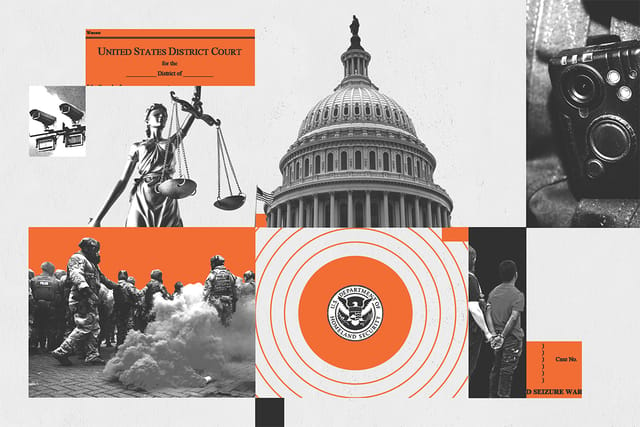
(Illustration: Ren Velez / POGO)
The Problem
For years, the Project On Government Oversight (POGO) has called for reforms to address the long history of abuses and lack of accountability within the Department of Homeland Security (DHS).1 In the wake of widespread brutality by immigration agents in Minneapolis, Chicago, and across the country, it has become searingly clear that immediate change is necessary.2
The Solution
The House and Senate minority leaders have proposed a framework for reducing abuses by immigration enforcement agents.3 Proposals include ending “indiscriminate arrests”; expanding when agents need a warrant signed by a judge rather than a DHS employee; prohibiting profiling based on race, ethnicity, accent, language spoken, or job; strengthening use-of-force policies and increasing accountability for legal or policy violations by agents; requiring body-worn cameras; and making agents readily identifiable. POGO supports all of these approaches.
To ensure these proposals result in meaningful change, they should include the following provisions:
- Create a right to sue federal law enforcement officers. Without real consequences that can be imposed by entities outside of DHS, stricter standards for agents will only exist on paper. Federal law currently allows lawsuits against state officials who violate constitutional rights, but not federal officials.4 Congress must close this loophole.5
- Prohibit racial profiling. Customs and Border Protection (CBP) in particular has long engaged in racial profiling.6 With the courts facilitating this dangerous and unconstitutional practice, it is up to Congress to make sure immigration agents cannot detain people based on their race or ethnicity.
- Fund oversight offices in DHS. Congress should provide increased, dedicated funding for DHS’s Office for Civil Rights and Civil Liberties and its Office of the Immigration Detention Ombudsman, and it should prevent those funds from being reallocated.7
- Set standards for body-worn cameras. Beyond dedicating more funding to equip DHS agents with cameras, Congress should require certain standards, including prohibiting agents from reviewing footage before giving their initial account of an incident; setting clear standards to facilitate the release of footage under the Freedom of Information Act; and preventing the use of surveillance technology like face recognition on footage.8
- Limit the use of face recognition. There have been widespread reports of immigration enforcement agents using face recognition to identify and intimidate lawful protesters.9 In addition to barring face recognition in connection with body-worn cameras, Congress should restrict DHS’s ability to purchase and use face recognition apps and technology like Mobile Fortify and prohibit the use of the technology to target protesters.
- Restrict DHS purchase of personal information. DHS regularly circumvents the Fourth Amendment’s warrant requirement by purchasing highly sensitive personal information on citizens and immigrants alike from corporate data brokers.10 Congress should bar DHS from buying data it would need a warrant to collect on its own.11
- Tighten rules regarding judicial warrants. Recent reporting shows ICE has given itself permission to ignore decades of settled law and permit agents to enter homes without judicial warrants.12 This policy is abhorrent to the Fourth Amendment, and it should be prohibited in a statute that would also require judicial warrants for arrests. Congress should also restrict agents’ power to interrogate individuals they believe to be immigrants, at minimum by bringing those standards up to par with restrictions on what other law enforcement officers can do without a warrant.13
Contact
David Janovsky, Acting Director, The Constitution Project at the Project On Government Oversight (POGO), [email protected]
Don Bell, Policy Counsel, The Constitution Project at POGO, [email protected]