Weekly Spotlight: The war on unidentified vessels
One year since the Trump administration’s first missile strikes on boats in the Caribbean Sea and Eastern Pacific Ocean. Plus, a public reckoning on surveillance, preserving obscured records, and a thank you to our donors.

Editor's Note: Thank you to all of our supporters who are fueling this work. A special shout out to those of you who helped us reach our fundraising goals these past two months. Everything we do here at POGO — including this newsletter — is only possible because of the trust and generosity of our donors.
A disquieting anniversary

(Illustration: Luna Velez / POGO)
This past Wednesday marked one year since the Trump administration’s first missile strike on a small boat in the Caribbean Sea that killed 11 people. The administration has alleged, without remotely substantial proof, that the dozens of boats it has struck in the past year were all carrying ‘narcoterrorists.’ Smuggling drugs is not an act of war; it is a crime that must be treated with the due process of a court filing and a trial. Even if smuggling was somehow an act of war, the strikes happened without congressional authorization, making them unconstitutional. At the same time, administration officials have admitted that they do not know the identities of all the people killed in these strikes, and have made no effort to publicly name the victims. As POGO's David Janovsky wrote, “It is hard to imagine a more fundamental abuse of power than killing people without process, in active violation of the law, without even knowing who they are.”
- To date, the administration has conducted 68 strikes and killed 227 civilians.
- Accountability doesn’t just mean getting these illegal strikes to stop. It means forcing government leaders to answer for the innocent lives they may have taken.
- Read More: The Boat Strikes Aren’t Part of a War. They’re Murder. (Lawfare)
- ANALYSIS Guilt by Association: Trump’s Illegal Boat Strikes: The U.S. government claims they're targeting cartel members. But as POGO's David Janovsky wrote in an analysis last year, the administration is justifying boat strikes targeting people three degrees removed from cartel activity: as in, they know someone who knows someone who knows a cartel member.
Suing for the truth
As you may already know if you read our email on Wednesday, POGO Investigates is suing for the release of footage of the September 2, 2025, boat strike that allegedly shows the U.S. military killing shipwrecked survivors with a second missile. Such an action is a war crime. First, the Pentagon refused to comply with our request to release the footage of the second strike. Now, the administration is fighting to prevent the video from even being viewed by a judge, who could decide if it must be publicly released. You deserve to see what the government is doing in your name and draw your own conclusions. One year later, we’re still committed to getting this footage released, no matter what it takes.
POGO Requests Investigation of DHS Subpoenas on Journalists, Nonprofits
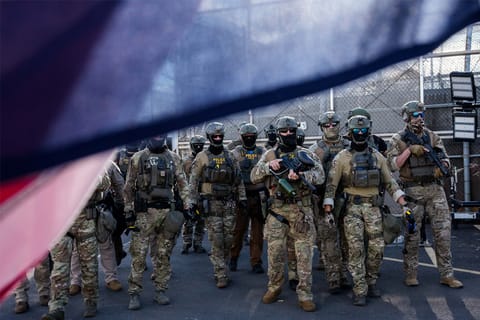
Immigration and Customs Enforcement (ICE) agents face off with protesters during a shift change outside of Delaney Hall Immigration Detention Center on June 7, 2026 in Newark, New Jersey. (Photo by Adam Gray/Getty Images)
We’re demanding an investigation into shocking reports that DHS is exploiting subpoena power to secretly obtain the private communication and financial records of journalists, nonprofits, and labor unions. If true, this is a massive abuse of power. Read more.
The public reckoning is here. Finally.

(Illustration: Ren Velez / POGO; Photos: Getty Images)
A mass surveillance infrastructure has been growing and embedding itself in our lives for decades now. Rather, public officials and corporations have colluded to ensure it. Flock Safety is just one vulture in the kettle of private companies that've taken it upon themselves to build spyware, sell the technology, and sell access to the data that tech collects to governments and law enforcement. What they’re doing is unconstitutional. Flock is the breaking point for the public because it shows just how in your face surveillance is. It’s about time. The surveillance reckoning we desperately need is finally here. A seeming majority of people across the political spectrum hate Flock and automated license plate readers. This sort of sweeping, bipartisan momentum can be a catalyst for the change we've long been pushing for.
- We’re already seeing states and local municipalities working to block Flock. Congress has the power to go a step further by not just reining in surveillance companies, but also by closing the loopholes in privacy law that let the government violate constitutional rights without consequence.
- Concerns about AI-powered surveillance were a key factor in members of Congress on both sides of the aisle stopping a blank check for surveillance, and POGO will continue to be a leader in that fight for as long as it takes.
- A coalition in the House introduced a bill to end federal funding for automated license plate readers.
- In the news: POGO was cited in an Arizona resident’s op-ed arguing why the state should end warrantless surveillance.
Putting censored reports back online
(Illustration: Luna Velez / POGO)
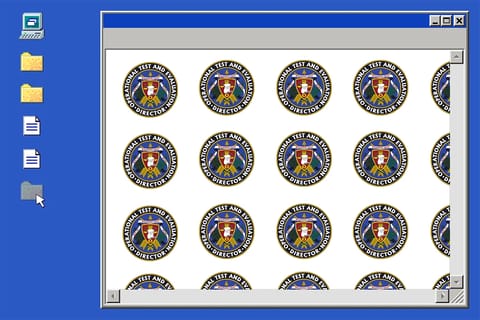
A few weeks ago, the Pentagon obscured 25 years of reports on the website of the Office of the Director, Operational Test and Evaluation (DOT&E). POGO just put those reports back online in an archive accessible through our website. The DOT&E is a crucial watchdog office within the Pentagon, responsible for testing the combat-readiness and safety of weapons before they head into mass production. It makes sure weapons work when our service members most need them to — life-saving work. For reasons truly unfathomable, the Pentagon has been undercutting the DOT&E since last year. Our country is actively at war with Iran. The Pentagon is asking for tens of billions in additional funding to wage that war. Especially at a time like this, we need to be sure that tax dollars aren’t hastily wasted on weapons that could fail our troops in combat. The public, journalists, and stakeholders on the Hill deserve ready access to these reports to understand where money is being spent and to determine if service members are being kept safe. We're glad we were able to preserve them.
- ANALYSIS Pentagon Cuts to DOT&E Could Endanger Troops: POGO’s Greg Williams explains how DOT&E reports work and why they matter. (As seen in The Military Times this week.)
Greg Bovino’s Border Patrol Agents Use Disproportionate Force, Data Shows
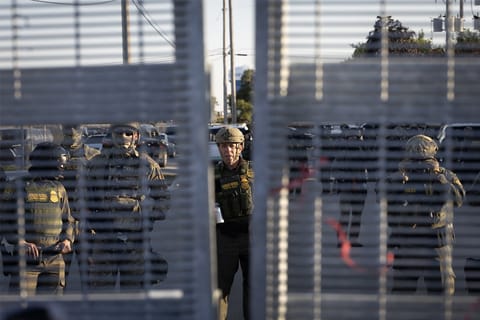
U.S. Border Patrol Commander Gregory Bovino, center, pictured with border patrol agents at an immigrant processing center in Broadview, Illinois, September 27, 2025. (Photo by Scott Olson/Getty Images)
Border Patrol agents in the El Centro Sector have reported using force on civilians more than three times as often as they have faced assaults — a ratio higher than anywhere else in the agency, write Will Sytsma and POGO Investigates’ Nick Schwellenbach.
- New federal records show that Bovino was under investigation by the Department of Homeland Security when he retired in March.