POGO Opposes Increasing Government-Wide Secrecy
The administration’s proposed nondisclosure agreement is overboard, unnecessary, and a threat to federal whistleblowing, oversight, and transparency.

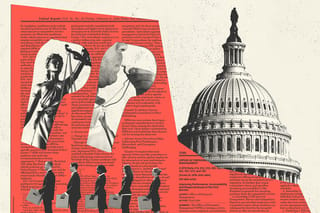
(Illustration: Luna Velez / POGO)
To:
- Scott Kupor
Director
U.S. Office of Personnel Management
1900 E Street, N.W.
Washington, DC 20415 - Re: “Confidential Government Information Nondisclosure Agreement,” Proposed Rule, 91 Fed. Reg. 31478, Docket ID: OPM-2026-0100
Dear Director Kupor:
The Project On Government Oversight (POGO) submits this comment to oppose the Office of Personnel Management’s (OPM) proposed rule, “Confidential Government Information Nondisclosure Agreement.”1 POGO is a nonpartisan, independent watchdog that investigates, exposes, and champions reforms on systemic corruption, abuse of power, and waste. Since POGO’s founding nearly five decades ago, we have worked directly with federal whistleblowers to expose government corruption and abuse of power, and have advocated before the executive branch and Congress to strengthen protections against retaliation.
We oppose this proposed rule because it will weaken protections and deter lawful whistleblowing — one of the federal government’s most important safeguards against waste, fraud, abuse of power, and other misconduct. We urge OPM to withdraw this proposed rule in its entirety.
OPM’s Definition of “Confidential Government Information” Is Overly Broad and Unclear
OPM has proposed a new government-wide nondisclosure agreement (NDA) that federal agencies could compel current employees and new hires to sign as a condition of employment. OPM claims that this proposal only seeks to ensure compliance with “current legal obligations,” and “does not create new substantive restrictions on employee speech or disclosure rights.”2 However, it creates a new restriction against disclosing an expansive and vague category of “confidential government information,” including pre-decisional or deliberative information, without authorization. This restriction would extend far beyond classified or controlled unclassified information. OPM defines confidential government information as “all non-public, confidential, or proprietary information, to include, but not be limited to, information relating to internal agency operations, personnel matters, procurement processes, or any sensitive, pre-decisional or deliberative material that is not currently publicly available and should not be disclosed under applicable law.”3
There are already laws governing information that we agree must remain confidential except when released with proper authorization and through lawful channels — classified information, Privacy Act information, sensitive information regarding government procurement or law enforcement operations, and numerous other categories of genuinely sensitive material.4 OPM’s proposed NDA restrictions would apply to a much wider range of ordinary government information, documents, and communications — not because they are sensitive, but simply because they are non-public — which may predictably include evidence of illegal activity, abuse of power, or other wrongdoing. A government-wide NDA increases conflict between this agency-imposed secrecy and employees’ statutory duty to disclose waste, fraud, abuse, and corruption, and creates ambiguity about how employees can still utilize lawful channels to report misconduct.
“Pre-decisional” or “deliberative” material is not inherently classified, sensitive, or protected from disclosure. Treating these categories as presumptively secret and subject to NDA restrictions turns routine policy development and ordinary governance into confidential activity. Moreover, OPM does not adequately explain why existing statutory frameworks are insufficient, nor does it justify why a new, blanket NDA is necessary.
Congress Designed Federal Whistleblower Laws to Encourage Early Warnings
Congress has enacted a comprehensive statutory framework governing federal whistleblowing, deciding what categories of information whistleblowers can disclose and providing specific protections to make those disclosures. This framework
- affirmatively protects disclosures of violations of law, rule, and regulation; gross mismanagement; gross waste of funds; abuse of authority; and substantial and specific dangers to public health or safety;5
- protects disclosures made before harm occurs, including pending misconduct;6
- forbids agency nondisclosure policies that prohibit or restrict lawful whistleblowing communications to Congress, inspectors general, and the Office of Special Counsel;7 and
- authorizes the Merit Systems Protection Board (MSPB) to hear appeals from employees who experience whistleblower retaliation or other prohibited personnel practices.8
The proposed NDA undermines the very rights and obligations that Congress has legislated. Federal employees are stewards of public trust and mandated to report corruption to proper authorities.9 A policy that discourages employees from reporting violations undermines the objectives Congress has sought to achieve. OPM should not force employees to choose between complying with a government-imposed confidentiality agreement and fulfilling their ethical duty to protect the public.
And each time Congress legislates to update whistleblower laws, it underscores that the primary purpose of whistleblower protections is to expose misconduct and to prevent harm before it occurs, not merely to report it after.10 Whistleblowers are the first and most effective line of defense, because misconduct is often discovered first by the employees closest to the facts. The public is best served when employees speak up before preventable harm occurs. Given that, whistleblowers frequently act before misconduct occurs.
There is no requirement for any law to already have been violated, a final decision to already have been made, or wrongdoing to already have occurred before a whistleblower can report wrongdoing. Employees need not wait until the contemplated action is implemented or until actual harm occurs to be protected.
Courts and the MSPB anticipate disclosures of threats of pending harm that haven’t yet occurred. To determine protected status, they assess factors including the likelihood that harm will result, when the alleged harm may occur, and the potential consequences of the harm.11 For instance, the Merit Systems Protection Board has determined that the Whistleblower Protection Act (WPA) protects disclosure of potential violations that are “real and immediate.”12 A disclosure is protected if a reasonable person could conclude that the information evidences an impending violation of law or a substantial and specific danger to public health or safety. Requiring misconduct to occur before a whistleblower could make a protected disclosure would force employees into the untenable position of either disclosing pending violations without protection or risking being complicit in the misconduct by waiting until after the fact. Courts have underscored that blowing the whistle on pending wrongdoing may be protected, stating that “A reasonable belief that a violation of law, rule, or regulation is imminent is thus sufficient to confer jurisdiction on the Board under the WPA.”13
Other provisions of the WPA, including a provision in 5 U.S.C. § 2302(b)(8)(A)(ii) protecting whistleblowers for refusing to obey illegal orders and in 5 U.S.C. § 2302(b)(9)(D) protecting whistleblowers for disclosing dangers to public health or safety, are similarly forward-looking.14
As such, whistleblower disclosures can and often do stem from pre-decisional and deliberative information. Protected disclosures may include pre-decisional information showing, for example, that agencies are considering or planning conduct that would result in violations of the law, gross waste, abuse of authority, censorship of scientific research, manipulation of intelligence analysis, or other threats that may arise during the deliberative process. Disclosures of these types of materials and communications may be protected when made through authorized channels.
OPM’s proposal, as drafted, would force employees to wait for violations to occur before disclosing evidence of wrongdoing, defeating the preventive purpose of whistleblower protections. Yet, as the U.S. Court of Appeals for the Federal Circuit notes, “The government is far better served by having the opportunity to prevent illegal, wasteful, and abusive conduct than by notice that it may only act to reduce the adverse consequences from such conduct that has already occurred.”15
OPM’s proposed NDA would suppress disclosures at the moment they are most valuable.
The Rule Will Predictably Chill Protected Whistleblowing
We acknowledge OPM’s claim that the proposal “expressly preserv[es] rights to make disclosures authorized by law, including protected whistleblower disclosures.”16 Yet, while OPM asserts that whistleblower protections remain intact, it fails to account for the foreseeable chilling effect on lawful disclosures of government misconduct. It relies on generalized assurances that statutory rights remain intact, without addressing whether those rights, in practice, could realistically be exercised. Even if the NDA does not explicitly prohibit whistleblowing, it operates by indirect constraint. The practical effect is to deter disclosures that Congress has explicitly protected.
NDAs can suppress lawful disclosures, even when they technically retain whistleblower rights, because employees often remain silent when faced with broad secrecy requirements.
Under OPM’s proposal, federal employees will not know what they can and cannot lawfully disclose, because this NDA would create confusion regarding the relationship between agency-imposed confidentiality and the rights guaranteed by Congress. Employees confronted with a broad confidentiality agreement will likely fear retaliation, discipline, termination, or personal legal liability if they lawfully disclose information. Fear and uncertainty are often as effective at silencing whistleblowers as explicit prohibitions.
Conversely, Executive Order 13556 on controlled unclassified information (CUI) incorporated language for which POGO advocated, making explicit, “The mere fact that information is designated as CUI shall not have a bearing on determinations pursuant to any law requiring the disclosure of information or permitting disclosure as a matter of discretion, including disclosures to the legislative or judicial branches.”17
The question about OPM’s proposed NDA is not whether whistleblower protections will technically survive on paper, but rather whether a reasonable federal employee would feel free to exercise those rights in practice. OPM does not meaningfully engage with legislative history or explain why a government-wide NDA would not cause the same chilling effect Congress seeks to prevent.
The Rule Conflicts with Congressional Anti-Gag Policies and Oversight Interests
Since the 1980s, almost every annual appropriations act has included an anti-gag rider that prohibits agencies from using appropriated funds to implement or enforce nondisclosure policies or agreements, unless they contain explicit language stating the NDA does not conflict with or supersede whistleblower protections.18 Congress also codified a near-identical restriction as a prohibited personnel practice in the Whistleblower Protection Enhancement Act.19
Congress’s continued inclusion of these anti-gag provisions reflects a legislative judgment that confidentiality agreements can deter protected disclosures, even when they are legally unenforceable against whistleblowers, and that employees would refrain from making disclosures even if those disclosures were still technically lawful.20
OPM seemingly attempts to adhere to the anti-gag rider language but errs by omitting language that specifies protections for disclosures to the Office of Special Counsel.21 Still, even if OPM changes the language to completely mirror that required language, this NDA would conflict with Congress’s intent, and it could amount to a prohibited personnel practice if it is implemented and enforced in a way that chills employee speech to the extent that it restricts them from making protected disclosures.22
The Rule May Be Arbitrary and Capricious
The proposed NDA covering “pre-decisional” and “deliberative” information restricts categories for which protected disclosures often arise, burdening the exercise of a statutory right.23 OPM fails to explain why existing legal frameworks — classification law, Freedom of Information Act exemptions, Privacy Act protections, procurement rules, and law enforcement restrictions — are insufficient, or why a government-wide NDA is necessary and narrowly tailored to an identified harm. The proposed rule ignores whistleblower laws’ preventive structure, and fails to deal with the conflict that would arise from restricting the disclosure of “pre-decisional” and “deliberative” information that Congress has statutorily authorized may be disclosed. As such, this rule is potentially arbitrary and capricious.24
The Rule Cannot Be Evaluated in Isolation from OPM’s Suitability and Fitness Proposals
Finally, as this proposed rule explicitly ties to suitability and fitness determinations, it must be evaluated in context with OPM’s separate proposals on those processes. Under those proposals, OPM would apply suitability determinations not just to applicants but to current employees based on their on-the-job conduct; would make it explicit that noncompliance with nondisclosure policies would be treated as a suitability issue; and would move suitability action appeals from the MSPB to OPM.25 These proposals would allow an administration to retaliate against a lawful whistleblower by alleging that the whistleblower violated NDA obligations. The employing agency could then bypass civil service protections to terminate the whistleblower more easily, because of a narrower internal appeal process without independent due process. OPM’s proposals would create a system that chills lawful whistleblowing and threatens whistleblowers with severe employment consequences for attempting to exercise their legal rights.
Conclusion
The fundamental flaw in OPM’s proposed NDA rule is that it treats whistleblower disclosures, rather than corruption and abuse of power, as the problem. Congress enacted federal whistleblower protections because agencies cannot be trusted to police themselves in secret. When OPM attempts to argue that it is whistleblowers who are lessening trust in government rather than the government misconduct that whistleblowers are revealing, it turns fundamental principles of good governance upside down.
This proposed NDA seems primarily focused on preventing politically inconvenient information from being disclosed and on shielding the administration from transparency, congressional oversight, accountability, and the public’s right to know.
OPM should instead work to better protect whistleblowers, who risk their careers to ensure our government — across Democratic and Republican administrations — better serves the interests of the people.
For the preceding reasons, POGO opposes this proposed rule and urges its withdrawal. Thank you for your consideration of this comment. If you have any questions, please contact Joe Spielberger at [email protected].
Signed by:
- Joe Spielberger
Senior Policy Counsel