The Cost of Domestic Deployment
Marines Deployed to Los Angeles Provide a Case Study
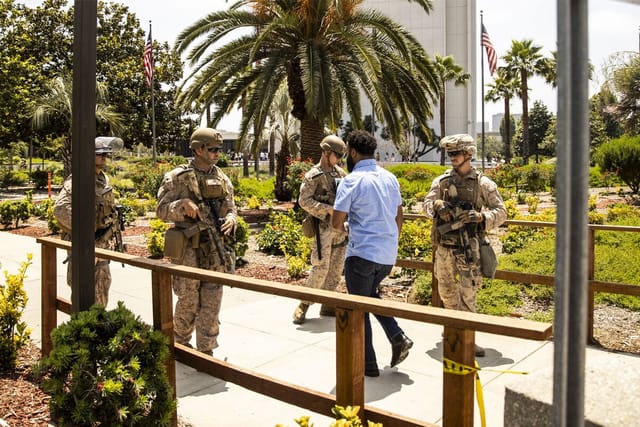
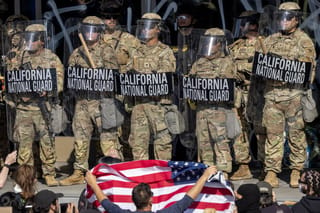
(Photo by Stephen Lam/San Francisco Chronicle via Getty Images)
When the Trump administration announced on June 9 that it would be sending 700 Marines to Los Angeles, the news became the subject of widespread legal analysis and punditry, and multiple congressional hearings. With the deployment of the Marines to L.A. coming to an end, it’s worth looking back on its impact. The possibility that a similar situation could arise in other cities remains, with the chance for further domestic deployment ever-looming.
It is worthwhile, then, to assess the cost of these deployments on American ground. There is the financial cost to the American taxpayer, of course, but more important is the impact domestic deployment has and could continue to have on American society — the cost to democracy, the cost to public safety, and the cost to military readiness. For this, the deployment of Marines to L.A. provides a useful case study.
The Cost to Our Democracy
The Marines are federal forces whose authority is established by Title 10 of the U.S. Code, with limited allowances for domestic deployment. With extremely rare exceptions, Title 10 forces cannot serve in a domestic law enforcement capacity, as it would be a violation of the Posse Comitatus Act. Enacted in 1878, the Posse Comitatus Act prohibits the use of federal troops as a domestic police force, the intent being that the federal military should not be used to intervene in the affairs of civilian government.
This division of labor between civilian law enforcement and the military has both practical and philosophical benefits. Troops train for war: They are equipped to face designated enemy combatants in declared conflict zones. Police train to police, and they are focused on community safety and adherence to civil norms and regulation. Keeping policing in the hands of civilian, rather than military, authorities keeps law enforcement more accountable to the public (although in practice, not nearly accountable enough).
As POGO outlined earlier this year, one major exception to Posse Comitatus is the Insurrection Act, which grants the president the power to use the military as domestic law enforcement in certain emergencies. Because the Insurrection Act does not clearly define when it may be invoked, it creates a legal gray area that can be exploited by an overreaching executive. In L.A., however, President Donald Trump did not invoke the Insurrection Act to justify deploying the military, instead sending Marines to federal buildings with the justification that presidents have an inherent authority to use the military within the United States to protect federal assets.
This comes at an unquestionable cost to American democracy. This erosion of norms allows the administration to push what the public will accept and to circumvent the laws designed to keep the military out of civilian affairs.
The Cost to Public Safety
In addition to undermining the norms that support American democracy, the deployment of troops in a domestic law enforcement capacity also comes at a cost to public safety. Since the president directed the deployment of federal forces to L.A., for example, numerous federal agencies, military units, and civil authorities were all performing overlapping duties there, with unclear and limited explanations of how each entity is authorized to interact with the general public. U.S. Marines were on the ground in L.A. with the National Guard, Immigration and Customs Enforcement, Customs and Border Protection, the California Highway Patrol, the L.A. County Sheriff’s Department, and the Los Angeles Police Department (LAPD).
The Marine units deployed — the 2nd Battalion 7th Marines and the 3rd Battalion 7th Marines — are both infantry units. As outlined in Marine Corps doctrine, the mission of a Marine infantry battalion is to “defeat the enemy by fire, maneuver, and close combat.” While service members may be employed in this capacity across a broad spectrum of conflict, at its core, an infantry battalion is purpose-built and trained to execute operations as a combat force. No amount of rapid training on less-than-lethal crowd control can eliminate that innate mission or counter that deeply ingrained training.
The Marines were previously deployed to L.A. in 1992, in response to riots following the acquittal of four police officers accused of beating Rodney King. The 1992 deployment has been used repeatedly as a case study on the issues and concerns surrounding federal military assistance to civil law enforcement. One often cited example highlights how local law enforcement gave the Marines an order to “cover” a building known to have civilians in it. For local law enforcement and the National Guard, that simply meant for armed individuals to point their weapon at the building and be prepared to shoot. For the Marines, based on their training and procedures, that meant opening fire at the building. Ultimately, no civilians were killed, but that was due more to luck and poor aim than anything else.
As the Marines and National Guard leave L.A., Congress needs to conduct hearings and investigations to uncover the actual costs of this operation.
In June, as in 1992, Marines were rushed to an American city with little to no evidence of thorough, thoughtful prior coordination. Little information has been made public about the training the Marines received before deploying, though local news stations captured footage of the Marines conducting crowd control maneuvers in L.A., prior to being operationally deployed in the city.
While we can hope that this rapid, less-than-lethal training established standards for protecting the public safety to which Marine leaders are adhering, there is still an innate risk. When met with a moment of stress and uncertainty, it’s not unreasonable to think Marines in these situations will fall back on what they’ve been trained to do — defeat the enemy. And if that enemy is the American public as they exercise their First Amendment rights, the situation can quickly become difficult and unsafe for everyone involved.
The Cost to Military Readiness
Domestic deployment doesn’t just endanger our ideals and our people, it also endangers our nation as a whole. Every service member sent to an American city is a service member who’s not doing the job they enlisted to do — defend the United States. The Marines’ presence in L.A. illustrates how domestic deployment impacts our nation’s ability to respond to potential global conflict.
In June, acting DOD Comptroller Bryn MacDonnell estimated the cost for the deployment of Marines and National Guard to L.A. would be $134 million. She also said that the money would come out of the units’ operation and maintenance accounts. That means they likely had to redirect funds that were already committed for other priorities — equipment, training, maintenance, and other routine and necessary annual unit requirements.
Moreover, the Marines sent to L.A. all come from 7th Marine Regiment based out of Twentynine Palms, California. This regiment is part of I Marine Expeditionary Force, or I MEF. I MEF deploys Marines across the Indo-Pacific region annually in a variety of capacities, from large scale exercises with partner forces to staging forces in anticipation of potential conflict. To deploy in these situations, units go through set training courses and preparation procedures months in advance. Pulling the Marines out of these operations to perform inappropriate law enforcement duties disrupts these processes and likely forces I MEF to realign complicated training schedules, matrices, and plans across the entirety of the West Coast Marine Corps. This puts the service branch purpose-built to act immediately in the face of global crises in a position where they may be unable to quickly respond to conflict in the Pacific.
Moving Forward
The ongoing situation in L.A. continues to be concerning on many levels — between the ICE raids, the legal concerns surrounding police misconduct against protestors, and the legally gray deployments of both the Marines and National Guard, it is all overwhelming and can be difficult to parse through and understand. As the Marines and National Guard leave L.A., Congress needs to conduct hearings and investigations to uncover the actual costs of this operation. That way, if and when this administration, or a future one, deploys American service members into another city, there is clear and understandable data regarding the impacts to our democracy, our safety, and our national security. The complexity may be intentional — the next city that sees U.S. troops deployed to its streets may not make as many headlines as the norms continue to erode and we become complacent. But while the cities may change, the costs and risks of domestic deployment will not.