Airstrikes, Maduro, and the U.S. Constitution
A Q&A with the Director of The Constitution Project at POGO
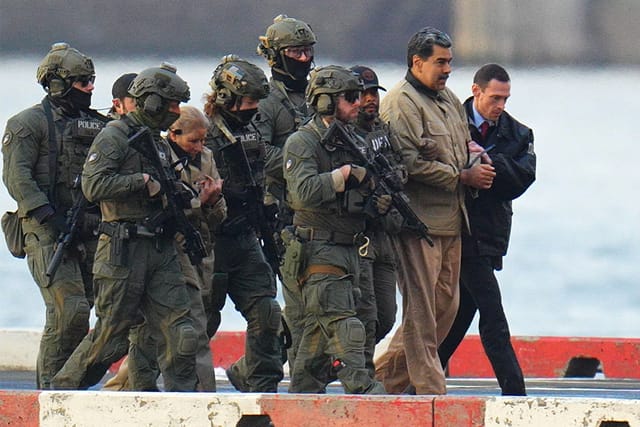
Nicolas Maduro and his wife, Cilia Flores, are seen in handcuffs after landing at a Manhattan helipad, escorted by heavily armed Federal agents as they make their way into an armored car en route to a Federal courthouse in Manhattan on January 5, 2026 in New York City. (Photo by XNY/Star Max/GC Images)
On January 3, 2026, the United States launched strikes against Venezuela and seized Venezuelan President Nicolás Maduro and his wife. The administration has offered shifting rationales for why it took this brazen action, or what exactly the United States will do next. But despite that lack of clarity, the legal analysis is clear: The airstrikes within Venezuela and capture of its president were illegal and a stunning example of presidential overreach. Congress must step in.
In the Q&A below, David Janovsky, acting director of The Constitution Project at POGO, offers some perspective on what happened — and what comes next.
First things first: Was what happened unconstitutional?
Simply put, declaring war is Congress’s job — not the president’s.
It is hard to imagine a more clear-cut act of war than launching airstrikes in a foreign country and spiriting away a head of state in the middle of the night. And that’s before factoring in President Donald Trump’s Saturday statement that the United States will “run” Venezuela, seize its oil, and launch a second attack if the country does not acquiesce.
The Constitution was written to prevent precisely what we just witnessed: an act of war instigated at the direction of one person alone. This isn’t just a bureaucratic formality, and the president’s unilateral action here wasn’t just “cutting through red tape.” It’s one of the most important checks in our system of checks and balances. Members of Congress are the ones directly elected by the people with the most to lose should the United States enter into a war. Forcing them to go on record in support of or against risking the safety of American troops and making them explain the reasons for their decisions to the people who vote them into office is a crucial accountability mechanism.
The Constitution does give presidents, as commanders in chief, some limited authority to use the military to repel sudden threats. But there is no plausible argument that this was the case here. Reporting has shown this attack — instigated by the U.S.— had been in planning for months.
Moreover, after the strikes we learned that the president didn’t just go around Congress — he didn’t even tell them what was happening. This is also illegal. The War Powers Resolution requires the president “in every possible instance” to notify Congress of plans to introduce the military into hostilities. While the fact of the military action itself is by far the bigger problem, the lack of notification further underscores the illegality of the operation — and the circumvention of checks and balances by the president.
But isn’t the administration saying the strike was a law enforcement operation? In that case, Congress wouldn’t need to grant approval, right?
One early skeptic of the strike, Senator Mike Lee (R-UT), was mollified by Secretary of State Marco Rubio’s assertion that the strikes were really a law enforcement operation to arrest Maduro, with the military merely protecting federal agents. It’s true that Maduro is now in civilian custody and facing federal criminal charges in New York City. But there are serious legal — and logical — problems with the administration’s argument.
On the logical side, we can just look at what actually happened last weekend. The claim that executing airstrikes which reportedly involved more than 150 American aircraft and killed 80 people is simply a law enforcement action is ridiculous on its face. Plus, as legal scholars have observed, use of force in law enforcement operations is only legal in response to an immediate threat, when no lesser force would suffice. Eliminating a country’s air defenses in advance of an assault does not count.
Over the last year, we’ve seen that the administration has been quite eager to rely on the notion of a “protective power” that allows the president to use the military to protect federal property and personnel. It’s been most notable when the administration used this power to justify deploying the military into U.S. cities. It now appears that the White House views the protective power as a pass not only to militarize cities, but also to launch major airstrikes in a foreign country.
Arresting a foreign head of state in their own country, with an accompanying military operation, isn’t legal. The administration may claim that the 1990 arrest of Panamanian dictator Manuel Noriega is a precedent that proves its capture of Maduro is legal. But the United Nations Charter — a treaty signed by the U.S.— prohibits uses of force that violate nations’ sovereignty. The United States long held that this applies to arrests in foreign countries without those countries’ consent.
That position changed in 1989, thanks to the Department of Justice’s infamous Office of Legal Counsel (OLC) — executive branch lawyers with a penchant for blessing presidential actions, no matter how egregious. Back in 1989, OLC stated that presidents could ignore the UN Charter and conduct arrests in foreign countries. While the legal machinations used to justify the argument are beyond the scope here, the fact is that the OLC essentially overwrote the Supremacy Clause of the Constitution, which states that treaties are among the legal authorities that make up the “supreme law of the land.” That opinion led to the arrest of Noriega, but it was wrong then and is wrong now.
What comes next? What can be done now?
This is where Congress has to step in. There is bipartisan legislation pending in the Senate that would direct the administration to remove troops from hostilities in Venezuela. That bill could see a vote as early as this week. Ideally, similar legislation will be introduced in the House soon as well.
Fighting to claw back war powers is a very obvious step that all members of Congress should want to take. In the days since the Venezuela raid, Trump has threatened military action against other countries around the world. For those opposed to such actions, reestablishing Congress’s power is a no-brainer. Even those who support further escalation also have a reason to defend congressional war powers: They should want to preserve Congress’s primacy in making such a consequential decision.
As we frequently point out, Congress has other tools available as well. It could restrict the use of funds for military operations in Venezuela. It absolutely should conduct rigorous oversight. (Bipartisan outrage by the Senate Judiciary Committee’s leaders at being excluded from classified briefings on Monday is a glimmer of hope that there is some appetite for oversight.) Should Congress decide it is warranted, it also has the power of impeachment.
In the longer term, this episode once again makes clear that it’s necessary to rebuild legal checks around the executive branch, and especially to rein in OLC.
The administration’s actions in Venezuela are shocking in their illegality, and the danger has not passed. It is essential for policymakers and the public to make it clear that this is unacceptable.
Related Content
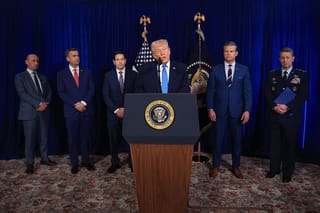
Capture of Venezuelan President Raises Urgent Constitutional Questions
POGO warns that the capture of Venezuelan President Nicolás Maduro without congressional approval violates constitutional war powers.