POGO’s Recommendations for the 2026 NDAA
The good, the bad, and the ugly in the fiscal year 2026 National Defense Authorization Act.
(Illustration: Ren Velez / POGO)
The Center for Defense Information and the Project On Government Oversight (POGO) have been working to promote a strong and efficient U.S. defense establishment for nearly half a century.
Through this year’s National Defense Authorization Act (NDAA), Congress has several opportunities to improve military readiness, reduce wasteful spending, and provide safer environments for our service members and the public they protect.
As the Senate and House begin the process of creating a single NDAA for fiscal year 2026 via conference, there are specific sections of the House and Senate versions of the bill that we believe, based on our long experience, are worthy of Congress members’ support or opposition (detailed in the categories below).
POGO’s Recommendations
Ensure Lawful Use of the Military
As important as it is to have effective and efficient armed forces, it is crucial that Congress play its constitutional role of deciding how and when those forces are used. With that in mind, POGO supports House Section 1733F, which repeals the obsolete authorizations for the use of military force (AUMFs) that sanctioned the use of force against Iraq in 1991 and 2002. We have long supported the repeal of these ongoing AUMFs, which have been used by multiple administrations to justify strikes well outside the bounds of their original intentions, and we support this preemptive repeal to ensure they are not used to erroneously justify future conflicts.
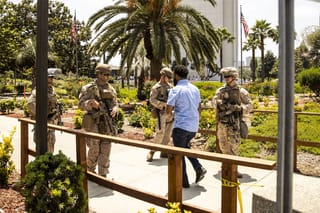
We also oppose House Section 1031 and House Section 1043, both of which would expand the use of the military to assist law enforcement at or near the border.
Ensure Best Pricing and Competition
The government should be aggressive in obtaining the best prices possible from defense contractors. There is much debate about how best to achieve this goal, but a lot can be learned from Congress’s own watchdog — the Government Accountability Office (GAO). As of October 1, the GAO had more than 750 outstanding recommendations for the Defense Department on its website. None of them suggest a widespread repeal of statutes governing defense spending, so we categorically oppose Senate Section 868, which repeals 86 separate statutes.
Additionally, we oppose House Section 1824, which seeks to replace Cost Accounting Standards (CAS) with Generally Accepted Accounting Principles (GAAP). We’ve written before about the problems with such a change, and we believe this reflects a fundamental misunderstanding about the differences between these frameworks. GAAP standards are designed to provide consistent information to investors in private corporations, whereas CAS are designed to protect the government from being overcharged by a private company.
Other sections we believe make it harder for the government to get the best prices include Senate Section 839 and Section 867, as well as House Section 811 and Section 1019.
Sections we believe make it easier for the government to get the best prices include Senate Section 835, Section 838, and Section 876, and House Section 802 and Section 803.
Limit the Use of Other Transaction Authorities (OTAs) Until We Know They Work
While Other Transaction Authorities (OTAs) are attractive as a means of sidestepping key acquisition laws and regulations, the jury is still out on whether they actually produce better outcomes. The GAO generally recommends further study of OTAs before broader adoption. Therefore, POGO supports NDAA sections that limit OTAs and gather data, such as House Section 813, Section 819, Section 820, and Section 1831, and Senate Section 875. We oppose those that broaden their application, including Senate Section 827 and House Section 3126.
Stop Wasting Money on Weapons that Don’t Work
A high price tag on weapons does not signify a worthy investment in our nation’s defense if those weapons don’t work. For example, multiple studies have shown the F-35 fighter continues to fail to meet basic performance requirements. We support House Section 152, which requires continued annual GAO reviews of the F-35 program.
Support Weapons That Do Work
Expensive and troublesome new weapons shouldn’t be acquired at the expense of effective weapons systems such as the A-10 close air support aircraft. We support House Section 143 and Senate Section 137, which protect the A-10 from retirement.
Ensure We Know What Works by Protecting the DOT&E
It’s hard to know whether new weapons actually work without a testing office free of influence from individual armed services and defense contractors. Since before its creation, POGO has advocated for a strong Office of the Director, Operational Test & Evaluation (DOT&E). This independence has been threatened by a recent Pentagon directive. House Section 903 and Senate Section 225 and Section 1620A help restore and protect this independence. Senate Section 805 undermines it.
Require the Pentagon to Pass an Audit
The Pentagon notoriously struggles to perform, let alone pass, regular audits. This makes it increasingly difficult for Congress to hold the department accountable. As such, we support House Section 1006, which imposes penalties for failed audits.
Ensure the Military Can Repair its Own Equipment
POGO has repeatedly advocated for service members to have the permissions, ability, and information they need to repair their own equipment, especially in combat zones. House Section 863 and Senate Section 836 provide exactly that.
We oppose House Section 1832 because it requires that critical repair data be acquired through data-as-a-service arrangements that may make data unavailable in combat, in remote locations, or if equipment manufacturers go out of business. Service members in combat should not have to rely on questionable network connectivity to be able to service their equipment and weapons.
Limit Conflicts of Interest
Government officials making purchasing decisions shouldn’t have their decisions clouded by the possibility of personal gain. We believe House Section 218 and Section 1063 strengthen protections against such conflicts of interest.
Strengthen Cost Controls Provided by the Nunn-McCurdy Act
One of the most useful laws for controlling costs in Pentagon spending is the Nunn-McCurdy Act, which requires the Pentagon to notify Congress when major defense programs suffer large cost overruns, and to consider cancelling them. We support House Section 806, which speeds up that reporting, includes operational costs in addition to acquisition costs, and makes it harder for the Pentagon to avoid cancelling problematic programs.
Apply State and Local Housing Laws to Privatized Military Housing
POGO has produced extensive investigative work on military housing that has received media attention and notice across the political spectrum due to the thorough and concerning reports. Military families can be denied the same environmental, housing, and personal injury protections that most Americans enjoy. This disparity exists because of the “federal enclave doctrine,” which essentially limits state and local laws on military bases (including tenant protection laws) to those that were in place the year the Pentagon acquired the land on which the base is built. That is why we support Senate Amendment 3544, which would limit the application of the federal enclave doctrine and provide important protections for military families.
We hope the NDAA process can produce a bipartisan path forward. Our recommendations are based on decades of dedicated work focused on creating an efficient and appropriately funded Department of Defense — a goal that is not only popular across the political spectrum, but is also, through bipartisan reform, possible.