Prediction Markets Are a National Security Risk
Profit motives created by prediction markets incentivize trading on military information for personal gain, potentially compromising national security.

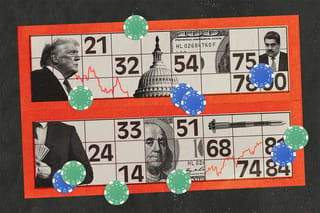
(Illustration: Luna Velez / POGO)
Congress and the Commodity Futures Trading Commission (CFTC) are working to establish a regulatory framework for prediction markets, but as this effort moves forward, insider trading within the government begs the question of whether military-related event contracts put troops in harm’s way and influence military action, thereby risking national security. Prediction markets allow traders to buy or sell event contracts covering a broad range of topics, but what has been eye-catching to both the government and the public are event contracts related to war and military matters. The Project On Government Oversight (POGO) has publicly supported a broad ban on event contracts related to any and all military matters.
According to a report by the Anti-Corruption Data Collective, markets shaped by groups and institutions pose a high risk of insider trading. Military-related event contracts fall under this category, and they create a financial incentive for military personnel, contractors, officials, or any individual with material nonpublic information to trade on these markets in hopes of a high payout. Worse, those individuals could also unknowingly — or intentionally — compromise military operations or other national security actions, or shape their own decisions regarding the operations or actions in a way to guarantee a payout.
Prediction markets present traders a binary option, typically in the form of “yes” or “no,” when buying an event contract. Each option is priced between $0.01 and $0.99. The value reflects the aggregated probability that the event will occur. For example, in December 2025, Kalshi hosted two markets that asked, “Will members of Congress be banned from trading stocks?” One of the markets provided a “Before 2027” option for traders to bet yes or no on whether members of Congress will be banned before 2027. The projected market probability is, at time of writing, approximately a 10% chance of “yes” and 90% chance of “no.” If a trader bets “yes” and buys 100 contracts, the trader will put down $10 and receive a net profit of $90 if the outcome is “yes.” If it’s “no,” they lose their bet. Unlike stock markets, which operate on a continuous daily open-close cycle, event contracts have a fixed expiration date tied to the event’s conclusion, after which traders may no longer place bets.
War- and military-related event contracts have increasingly been in the spotlight and scrutinized. For example, in April 2026, Polymarket, one of the largest crypto-backed prediction markets, hosted a market letting traders bet on whether a missing American pilot, whose plane had been shot down over Iran, would be found by a specific date. Polymarket later removed the market after sharp public criticism from Representative Seth Moulton (D-MA), and acknowledged that it shouldn’t have posted the market as it didn’t meet the platform’s integrity standards. Moulton also called for Polymarket to take down the other 219 war-related bets on the platform at the time.
Further, the Anti-Corruption Data Collective also found that contracts related to the military and defense were an outlier, having a disproportionately high rate of success in long-shot bets. Bets are considered long shots when a high volume of traders turn a profit after betting $2,500 or more on contracts with a projected chance of winning at less than 35%. Whether or not this is an indicator of something deeper like insider trading, Congress and the CFTC must not allow war and military actions to become commodified.
There is evidence that at least some military event contracts are in fact being traded by those with insider knowledge of — and the potential to influence the outcome of — military actions.
Considering the findings so far, it is clear that military-related event contracts can generate meaningful profit for successful traders. In March 2026, for instance, NPR reported that a Polymarket trader under the username “Magamyman” raked in more than $553,000 from a bet on when Iran’s then-Supreme Leader Ayatollah Ali Khamenei would be out of power, shortly before a United States and Israeli strike killed Khamenei. In May 2026, CBS News reported that nine connected accounts on Polymarket had a 98% win rate on bets they placed on contracts related to military actions, receiving more than $2.4 million in profits.
With that much money at stake, there could be a perverse incentive to profit off of insider knowledge. And there is evidence that at least some military event contracts are in fact being traded by those with insider knowledge of — and the potential to influence the outcome of — military actions. In April 2026, a U.S. Army special forces soldier was charged with using confidential government information to trade on Polymarket. Gannon Ken Van Dyke allegedly bet on an operation he helped plan — the ousting of then-Venezuela President Nicolás Maduro. This case is considered the first known example of U.S. authorities charging someone with insider trading on prediction markets. It is also the first enforcement case to test how laws regulating trading on material nonpublic information apply to prediction markets.
While prediction markets suddenly surged in popularity and appear to be novel, these markets have existed for a long time and, at times, faced similar scrutiny. In 2001, for instance, the Defense Advanced Research Projects Agency (DARPA), a research arm of the Department of Defense, funded a program that explored the accuracy and inner workings of prediction markets. This research was part of a project known as “FutureMAP,” and it tested whether prediction markets could be a reliable forecasting tool for political instability and terrorism in several Middle Eastern countries. Futures contracts involved predicting military activities and attacks, political instability, economic growth, U.S. casualties, and more.
However, this came under scrutiny from Congress and some Pentagon leaders. The Washington Post reported that, during a July 2003 Senate hearing, there were several remarks indicating concern about the FutureMAP program: A number of senators voiced criticism of such a project. Senator John W. Warner (R-VA), then-chair of the Senate Armed Services Committee, considered the program short-sighted and personally pressed DARPA to kill it; Thomas A. Daschle (D-SD) pointed out that this kind of prediction market is a “plan to trade in death”; Ron Wyden (D-OR) and Byron Dorgan (D-ND) also denounced the platform as something that would allow individuals to trade on political instability and terrorism in several Middle Eastern countries, with Wyden calling it “ridiculous and grotesque.” The Senate shut the project down, criticizing it as wasteful spending of taxpayer dollars and “the biggest spying and surveillance overreach.” From the other side of the room, two Pentagon leaders acknowledged the concerns as well. Then-Deputy Secretary of Defense Paul D. Wolfowitz expressed his shock when he learned about this kind of program en route to the Senate hearing and said that DARPA “got too imaginative,” and then-DARPA Director Tony Tether stated “it simply did not make sense to continue” the program amid the ethical and national security concerns and criticisms.
The criticisms expressed back then are similar to those being expressed today about these prediction markets. And it begs the question: If smaller military-related markets were under heavy scrutiny then, how do we justify allowing a much larger platform to trade on military actions?
Given the overall surge in popularity of today’s prediction markets and the national security concerns highlighted by reported cases of potential insider trading, it’s important to scrutinize the existing prediction market structure and determine how best to mitigate any possibility that national security could be compromised through it.
The popularity and high volume of trades on these military-related markets demands careful oversight from all bureaucratic levels.
In 2000, Congress passed a law called the Commodity Futures Modernization Act that significantly changed the structure of derivatives markets (which covers prediction markets). Prior to passage of the act, the CFTC was required to review event contracts before they could be traded; after passage, the agency was no longer required to review every contract prior to its being traded. Now, platforms can self-certify their contracts rather than submitting new products to the CFTC for review and approval. So, while the agency holds “exclusive jurisdiction” to oversee these market platforms, the checks and balances and the surveillance — a mix of automated monitoring and human review to detect suspicious trading activity, perform sanctions screening, and flag high-risk accounts and activity — are first performed by the platform itself.
The oversight structure between the platforms and the CFTC is continuous and complex. The agency retains the discretion to intervene and enforce standard compliance. In some cases, they can do an automatic review; in others, platforms would flag certain contracts for the CFTC, and the agency would have to decide whether they want to begin a review or not. Further, as with other derivative contract markets registered in the U.S., prediction markets must comply with Know Your Customer policies, requiring users to verify their identity with a government-issued ID and, in some cases, a Social Security number. So when suspicious activity is flagged, there is at least a legal identity attached to the account for further action. However, this only reliably holds for U.S.-registered prediction markets.
Some companies, such as Polymarket and Limitless, operate their main platform offshore on a wallet-based, permissionless model, and do not require identity verification. This raises significant concerns because with anonymity comes the very real possibility that an individual with military intel could bet on contracts for events they could influence the outcome of — potentially leading to catastrophic results — with impunity. Polymarket now has a U.S.-regulated arm called Polymarket US as a result of acquiring QCX, LLC and QC Clearing, two licensed derivatives entities, yet that doesn’t fully address the lack of transparency issue and being unable to hold traders accountable. While Polymarket US is subject to regulations and Know Your Customer policies, the main Polymarket platform is not. By using a virtual private network (VPN) and crypto-wallet to access the offshore platform, individuals could circumvent restrictions Polymarket agreed to under a 2022 CFTC settlement, in which the company paid a $1.4 million penalty and agreed to “cease offering access to trading in markets displayed on Polymarket.com, unless such offering” complies with U.S. laws and regulations. Regulators found the company had been operating an unregistered event contract market.
In addition to our concern regarding military-related event contracts, POGO also argues that certain event contracts that are being held on prediction market platforms violate current CFTC Rule 40.11, which authorizes the agency to review and prohibit event contracts related to or involving terrorism, assassination, war, gaming, and unlawful activity.
Considering the loose regulatory framework that prediction market platforms benefit from, it is better to be safe than to invite any chance that those with insider knowledge or influence (such as military personnel, contractors, or officials) would bet on military actions through these markets. The popularity and high volume of trades on these military-related markets demands careful oversight from all bureaucratic levels.
Legislative Solutions
The mere existence of military-related event contracts creates an incentive for any individual with military intel to bet on contracts, and they could be further incentivized to influence the outcome of military operations and compromise national security. Congress should pass legislation that prohibits prediction market platforms trading in the U.S. from approving event contracts related to all military matters.
Fortunately, there is wide bipartisan acknowledgment in Congress that prediction markets should not be allowed to host war- or military-related event contracts, as the risks outweigh the benefits. The Senate is even working on legislation that aims to address insider trading within the Department of Defense and on event contracts related to military actions.
As Congress moves forward with legislative efforts, POGO maintains that they should seek a categorical ban that clearly prohibits registered entities from listing contracts and swaps related to those under Rule 40.11, and should expand the prohibited list to include electoral outcomes, government and military actions, and death. Doing so would address ongoing suspicious trades that are a cause for concern. We have dived deeper in our public comment to the CFTC, explaining why certain contracts should be prohibited for trade.
POGO also urges Congress to pass legislation that would officially ban officials and employees across all three branches from engaging in prediction markets. Along with this ban, Congress should implement meaningful penalties when government officials and employees have been found to have engaged in insider trading. This prohibition aims to disrupt the incentives for individuals who have access to material nonpublic information, and to create a mechanism to hold the government publicly accountable for enforcing the ban.
Congress should also pass legislation that strengthens enforcement mechanisms and insider trading laws governing prediction markets, and should develop a clearer framework for the CFTC to regulate.
Considering the evidence of active insider trading, and allegations that it has happened with military personnel, it is crucial that Congress address the ongoing risk for abuse and misuse of military-related information in prediction markets. Military activities should not be commodified, as it has the potential to create perverse incentives for individuals with material nonpublic information to trade on prediction markets for personal profit at the expense of national security and the public’s interest.